Developing an effective marketing strategy is crucial for private schools to attract and retain students in an increasingly competitive environment. But where do you start?
This post will discuss the five most important marketing goals private schools should focus on, along with examples and tips to make your strategy successful.

Written By: Chad J. Treadway | November 22, 2023
Chad is a Partner and our Chief Smarketing Officer. He will help you survey your small business needs, educating you on your options before suggesting any solution. Chad is passionate about rural marketing in the United States and North Carolina. He also has several certifications through HubSpot to better assist you with your internet and inbound marketing.
As a k-12 private school principal or administrator, you may think that your school has been doing all the right things.
Truth be told, you may be. However, we all know that the seven most dangerous words in the English language are “we have always done it that way.”
On the other hand, you may sometimes feel like your message isn’t reaching the right people. You want local families to know just how amazing your school community is! The good news is that using inbound marketing and other smart tactics can get your school on prospective parents’ and students’ radars.
In this post, we’ll explore easy, proven ways to make sure you’re connecting with the families who’d appreciate everything your private school has to offer. Let’s get started!

Written By: Adam Bennett | November 22, 2023
Adam is the president and founder of Cube Creative Design and specializes in private school marketing. Since starting the business in 2005, he has created individual relationships with clients in Western North Carolina and across the United States. He places great value on the needs, expectations, and goals of the client.
Private schools are fighting hard to set themselves apart, and the fight keeps getting tougher. Parents have more options than they can sort through, and they're choosier than ever about which school a child ends up in. New schools keep opening, public schools keep improving, and education budgets keep tightening, so the threat is real. Enrollment numbers get picked apart, reputations get questioned, and the future of a school hangs in the balance.
There's a way out. A careful SWOT (Strengths, Weaknesses, Opportunities, and Threats) analysis gives your school the insight it needs for strategic planning. Once you understand your real strengths, you can play to them. Once you identify your weaknesses, you have something to improve. Opportunities you act on open new doors, and threats you handle early protect your school's future.
In a crowded market, SWOT analysis is your flashlight in the fog. It shows a clear path forward. It gives you the self-awareness and direction you need to sharpen an admissions process in a school market that never stops shifting. Schools that take a thoughtful SWOT analysis seriously are set up to raise enrollment and hold their ground for generations to come. The time for self-reflection is now. Read on, and you'll see how SWOT can be your school's quiet advantage for lasting success.
Understanding SWOT Analysis for Private Schools
SWOT analysis is a strategic planning tool that private schools like yours use to name your Strengths, Weaknesses, Opportunities, and Threats. The framework gives you one place to look at your school's internal and external environment. From there you can build strategies that play to strengths, mitigate weaknesses, capitalize on opportunities, and blunt threats.
The 4 Components of a SWOT Analysis
Strengths: These are the internal factors that give a school an edge over others. At your private school, strengths could be an experienced teaching staff, modern facilities, or a strong curriculum.
Weaknesses: These are the internal factors that hold a school back. At your private school, weaknesses might be higher tuition, a short list of extracurricular options, or a student body that lacks diversity.
Opportunities: These are external factors a school can turn to its own favor. Your school might find opportunities in shifting demographics, government funding rules for schools, or rising interest in a field of study.
Threats: These are external factors that can cause a school trouble. Threats to your school might be new competitors, changes in education regulations, or a shift in how the public feels about private school education.
The Importance of SWOT for Private Schools
Schools keep changing, and private schools keep working to stand out and win parents over. Parent attitudes shift, competition climbs, and differentiation matters more than it used to. That mix is why SWOT analysis has become a tool that schools like yours can't do without. Here are the reasons it matters so much for a private school trying to reach modern parents.
How Education Is Changing
Schools have changed a great deal over the years. Online learning took off, whole-child development moved to the front, and personalized teaching is now a top concern. Those few trends shape the market your school sells into today. A SWOT analysis lets a private school like yours see these shifts and judge how well you can adapt to them. Once you identify your strengths and weaknesses against each trend, you can make informed decisions and plan your strategies well.
Aligning With Modern Parents' Preferences
Today's parents want things their own parents never asked a school about. They still want a good education, but they also look for schools that build creativity, independent thinking, and the whole person. They want to be told the truth, and they want to hear from you often. A SWOT analysis lets your private school step back and gauge how well your offerings line up with what today's parents want. You can identify where you excel (strengths), where you fall short (weaknesses), the openings to serve parents better (opportunities), and what stands in your way (threats).
Staying Ahead of Competition
The private school sector is crowded. New schools keep emerging, each with its own curriculum, teaching methods, and facilities. To stay ahead, you need to know your school's competitive position. That's the job a SWOT analysis does for you. It helps a school like yours identify the strengths that set you apart, the weaknesses competitors might exploit, the openings that would give you a competitive edge, and the threats those competitors pose.
Differentiating Themselves
With so many options on the table, private schools have to differentiate themselves. A SWOT analysis helps you identify what makes yours unique. Is it an innovative curriculum, a veteran faculty, or first-rate facilities? Know your strengths, use them, and you can tell parents in plain terms why your school is the right pick. Own your weaknesses at the same time, and you can improve them, which sets you apart even further.
Formulating Effective Strategies
The whole point of a SWOT analysis is better planning. Once you know your internal strengths and weaknesses, plus the external opportunities and threats, you and your private school can build effective strategies. You can draw up steps to promote your strengths, address your weaknesses, capitalize on opportunities, and mitigate threats. Plan that way and your school reads as the smarter choice to modern parents.
Conducting a SWOT Analysis for Your Admissions Program
Knowing where your admissions program stands today, and where it could go, matters a great deal in a crowded education market. A SWOT analysis will help you plan. It also turns up useful insight that can shape your whole admissions strategy.
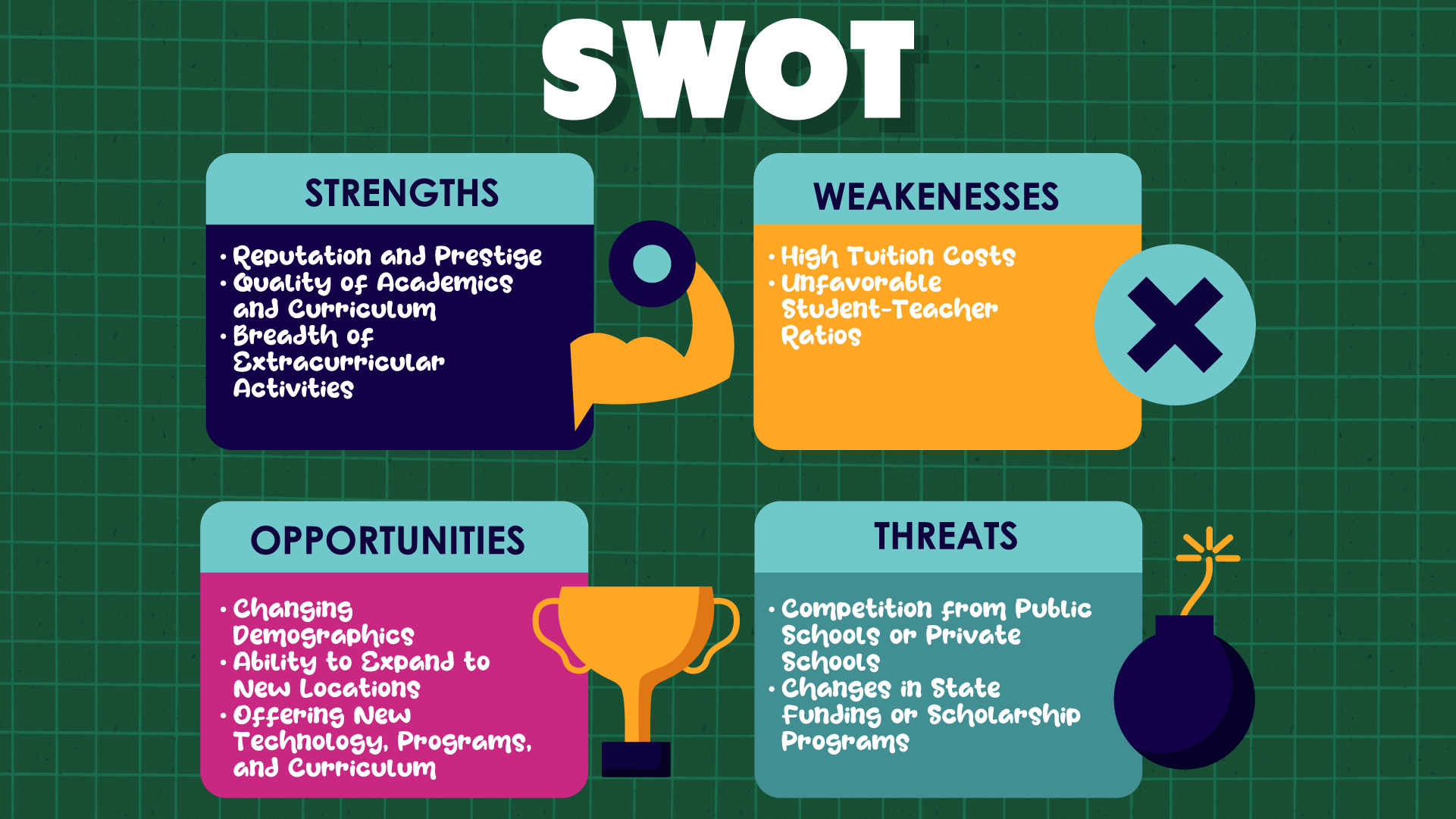
Here's an example of a SWOT analysis for Greenfield Academy, our fictional private school.
Strengths
Reputation and Prestige: The reputation of Greenfield Academy is one of its biggest strengths when it comes to drawing students and parents. A name with that kind of weight tends to signal a long record of academic excellence, alumni who did well, and a first-rate education.
Quality of Academics and Curriculum: An advanced, deep curriculum paired with high academic standards is a real strength for Greenfield Academy. Parents want schools with a strong learning environment, one that gets a child ready for college and for life. Greenfield excels here, so its admissions strategy should say so out loud.
Breadth of Extracurricular Activities: Beyond academics, modern parents care about the whole child. Greenfield offers a wide range of extracurricular options, from sports and arts to clubs and community service. That breadth is a real strength, and it adds value to the whole school experience Greenfield offers.
Weaknesses
High Tuition Costs: Greenfield Academy gives students a fine education, and it charges high tuition fees to do it. That's a real weakness, because it may deter many families who can't afford the cost. Greenfield needs to own that and look at ways to fix it, whether that means scholarships or flexible payment plans.
Unfavorable Student-Teacher Ratios: Greenfield runs larger class sizes, which leaves it with unfavorable student-teacher ratios, and parents can read that as a weakness. Parents often want smaller class sizes, where a child gets more individual attention and personalized instruction.
Opportunities
Changing Demographics in Surrounding Areas: Demographic shifts in the area around Greenfield Academy can hand its admissions program new opportunities. More young families are moving into the area, and that group is a rising share of the market for private education. It opens the door to higher enrollment for Greenfield.
Ability to Expand to New Locations: If there's demand for a good education in other locations, Greenfield could consider expanding. A new branch across town would draw more students and widen its reach.
Offering New Technology, Programs, and Curriculum: Schools never stop changing. A school like Greenfield Academy that adapts, by adding new technology, starting fresh programs, or updating its curriculum to match current demand, can seize real opportunities.
Threats
Competition from Public Schools or Private Schools: Public schools and other private schools keep getting better, and that can pose a threat to Greenfield Academy. Many of them offer free or low-cost education, which appeals to plenty of parents. Greenfield has to stay informed about what those competitors offer and how it compares.
Changes in State Funding or Scholarship Programs: A change in government policy on education funding or scholarship programs is a threat too. Cuts in funding, or new scholarship eligibility rules, could hit Greenfield Academy's enrollment and its finances.
Strategies to Improve Your Admissions Program
A SWOT analysis is a strategic planning tool that turns up real insight for sharpening your school's admissions program. Here are strategies to improve weaker areas, promote your strengths, capitalize on opportunities to expand your reach, and blunt the risks that come from threats and other outside forces.
Improving Weaker Areas
Once a SWOT analysis identifies the weaknesses in your admissions program, the next step is to plan a fix for each one. If high tuition costs are a barrier for many families, consider scholarships or flexible payment plans. If class sizes run large, find ways to cut the student-teacher ratio, whether that means hiring more teachers or rebuilding how classes are set up. Remember that fixing these weaknesses does more than improve your admissions program. It makes the whole school better.
Promoting Strengths
Your strengths are what set you apart from other schools. Once a SWOT analysis identifies them, put them to work drawing new students. Highlight them in your marketing materials, on your tours, and in meetings with prospective families. If your school is known for an advanced STEM program, that belongs front and center in your marketing. Promote your strengths well and you'll lift your school's appeal and raise enrollment.
Taking Advantage of Opportunities
Opportunities are external factors that could help your admissions program. Stay alert to them and be ready to seize them. If interest in arts education is on the rise in your town, consider expanding your arts program. If the demographics near you shift toward private education, adjust your marketing plans to reach those new students. Act on these opportunities and you'll expand your reach and lift your admissions.
Mitigating Risks From Threats
Threats are external factors that could hurt your admissions program. You've got to watch them and plan how to mitigate each one. If public schools in your area keep getting better, make sure your school still delivers value that justifies the cost of tuition. If a change in government funding looms, consider new funding sources or stepping up your fundraising. Address these threats early and you protect your school's future.
A SWOT Analysis Is the First Step to Enrollment Success
These are uncertain times, and few things matter more than a thoughtful, strategic approach to securing your school's future. Use the framework of a SWOT analysis and you gain the insight to sharpen your private school's admissions process, raise enrollment, and differentiate your school.
Start by identifying your distinctive strengths, then promote them hard. Recognize the areas that need improvement, and put creative solutions in place. Seize emerging opportunities so you can expand your reach. And keep a close watch on external threats.
Armed with the clarity a SWOT analysis gives you, you'll be ready to build data-driven strategies that lift your school further. The time for self-reflection is now. Don't leave your school's future to chance. Reach out today to talk about how I can give your admissions process the competitive edge it needs. With SWOT and me as your guide, healthy enrollment and long-term success can be yours.
Written By: Chad J. Treadway | November 20, 2023
Chad is a Partner and our Chief Smarketing Officer. He will help you survey your small business needs, educating you on your options before suggesting any solution. Chad is passionate about rural marketing in the United States and North Carolina. He also has several certifications through HubSpot to better assist you with your internet and inbound marketing.
If you're a private school administrator, principal, or board member looking for ways to reach modern parents, you've come to the right place. Think of it as cracking a complex code. One that unlocks the secrets to reaching them and driving your private school enrollment growth. This blog provides the cipher - an approach to creating targeted campaigns that engage elusive but essential audiences: parent personas.
Defining Parent Personas
Every parent is unique, and they all have different beliefs, values, and goals when it comes to raising their children. To capture these differences, private school admissions coordinators and administrators need to develop the concept of parent personas.
A persona is a semi-fictional representation of a key target audience segment grounded in actual data and insights.
A parent persona specifically is a fictional representation of a particular parent archetype. It helps private school administrators understand key parent demographics, psychographics, and archetypes that make up their target families and students. By defining these parent personas, you can tailor your messages and offerings to appeal to specific groups of parents and increase your chances of success. Without them, your marketing plans could miss the mark and fail to resonate with your intended audience. Defining parent personas is key to gaining deeper insight into your target market and connecting more effectively.
Factors to Consider When Identifying Your Target Parent Personas
Identifying your target parent personas is crucial to the success of your marketing strategy. Parent persona research is essential in understanding your audience and their needs, wants, and behaviors. Conducting parent surveys and interviews helps gather valuable data that can inform your marketing decisions.
Factors to consider when identifying your target parent personas include:
- Demographics
- Socioeconomic status
- Family Values
- Parenting Styles
- Religious Affiliations (if applicable)
- Communication Preferences
Developing Detailed Profiles: Crafting Personas Based on Your Research
Moving past flat descriptions to well-rounded narratives brings your personas to life. In today's rapidly evolving world, your school needs to cater to the specific needs and preferences of your families. Creating detailed profiles can help you understand the preferences and behaviors of parents, enabling you to craft products and services that resonate with them. Compile information about their age, gender, income, education, and other relevant aspects to create an accurate persona. Understanding your audience's desires enables you to craft targeted strategies that cater to their needs, thereby boosting your school's success.
Questions to Ask:
- What is the age range of the parents you're targeting?
- Where do these families live?
- What is their average household income?
- How many children do they have?
- What are the age ranges of their children?
- Are there specific cultural or religious affiliations?
- What do they value most in a school (academic rigor, arts programs, sports, etc.)?
- What are their expectations from a private school education?
- Are they looking for a specific curriculum or teaching method?
- Who decides where to send their children to school?
- What factors influence their decision-making process?
- How do they research potential schools (online, word-of-mouth, school visits, etc.)?
- How do they prefer receiving school information (email, social media, print)?
- What type of content do they find most valuable (student achievements, school updates, educational tips)?
- How frequently would they like to hear from you?
- What challenges do they face when choosing a school?
- What concerns do they have about private school education?
- What obstacles could prevent them from enrolling their children in your school?
Appealing to Personas Through Content
Leveraging the right content format, topics, tone, and channels for each persona is key to crafting campaigns that hit the mark. However, in order to appeal to your target parental personas effectively, you must first understand their unique wants and needs. By tailoring your content format, themes, tone, and messaging to each persona, you can speak directly to their specific pain points and aspirations.
Examples
Let's explore how a hypothetical school, "Greenfield Academy," crafted a marketing plan with a distinct persona for the different archetypes:
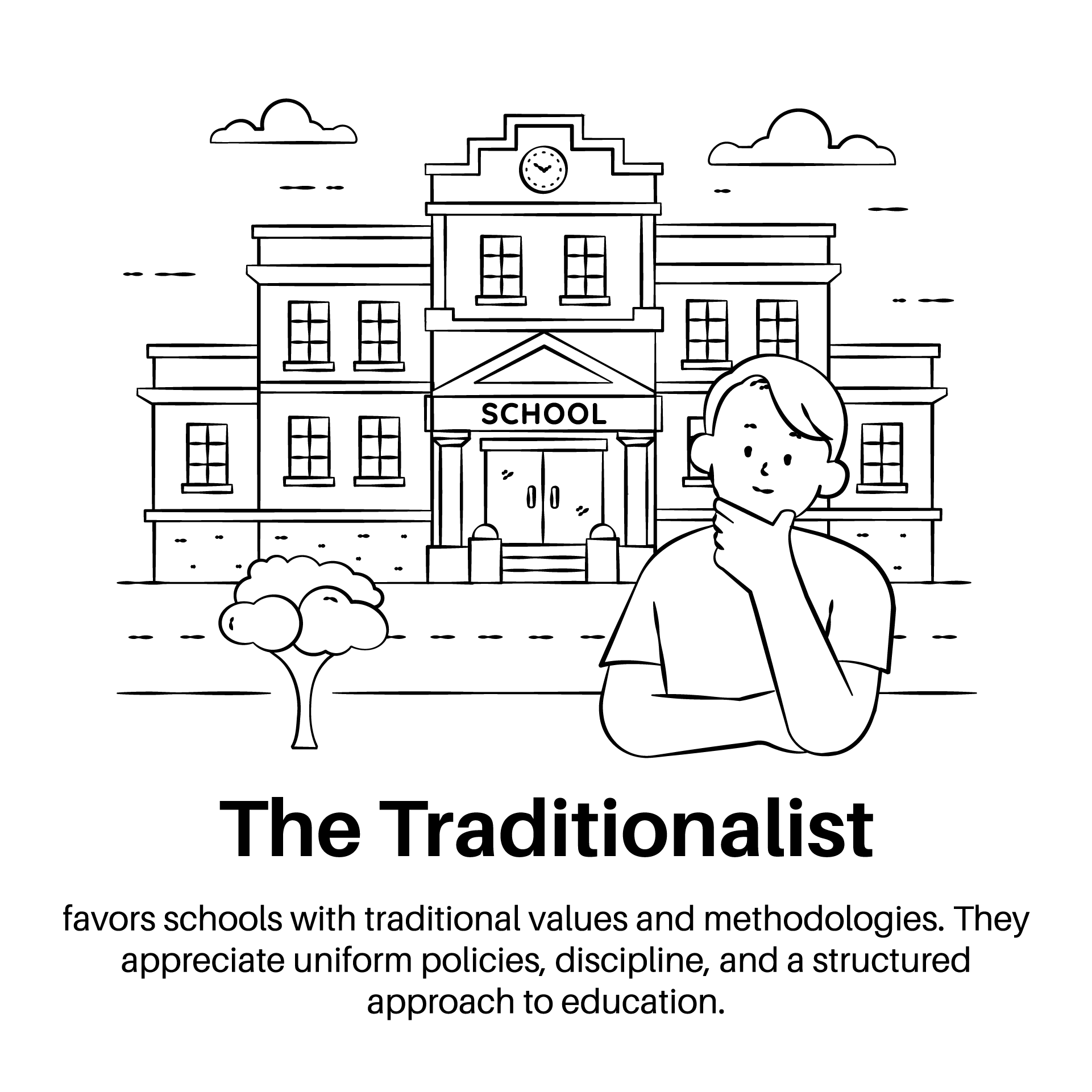
The Traditionalist
The Smith Family favors schools with traditional values and methodologies. They appreciate uniform policies, discipline, and a structured approach to education.
- John and Lisa Smith, both in their mid-40s
- Their children, Emma (11) and Daniel (14)
- Values structure, discipline, and a strong moral and religious foundation in education
- Enjoys the idea of school uniforms and traditional teaching methods

The Tech-Savvy Parents
The Johnson Family are always on the go and appreciate the integration of technology in education. They value online portals for grades, assignments, and communication.
- David and Sarah Johnson, a tech-savvy couple in their early 30s
- Their child, Ethan (9)
- Prefer schools with integrated technology for communication, assignments, and progress tracking
- Often on the go and appreciate digital tools for involvement
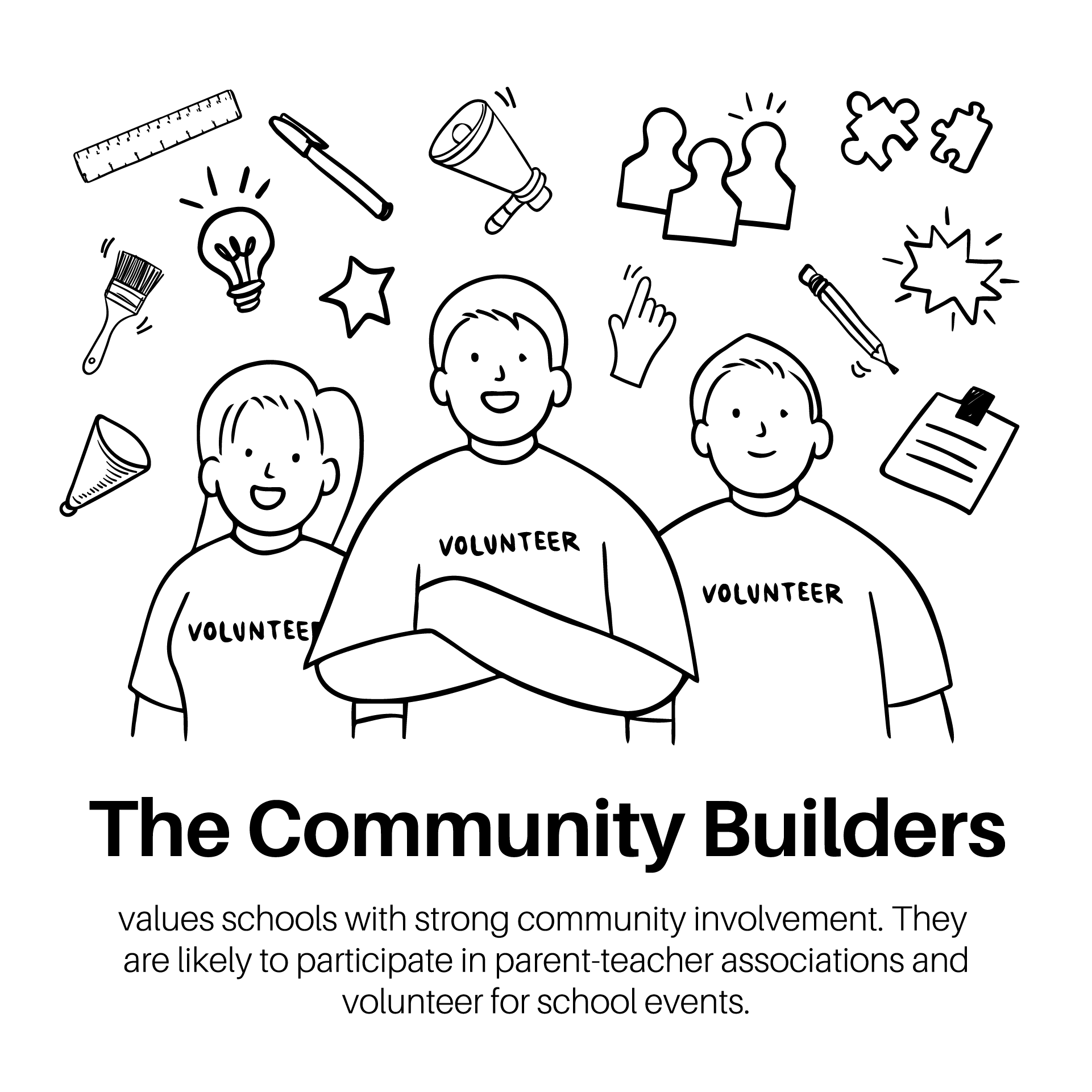
The Community Builders
The Garcia Family values schools with strong community involvement. They are likely to participate in parent-teacher associations and volunteer for school events.
- Carlos and Maria Garcia, a vibrant couple in their late 30s
- Their child, Sofia (8)
- Actively involved in the Parent-Teacher Association (PTA) and volunteer for school events
- Value strong community ties and school involvement

The High Achiever
The Anderson Family wants their children to excel academically. They value rigorous curriculums and opportunities for advanced learning.
- Michael and Emily Anderson, both in their early 40s
- Their children, Olivia (12) and Benjamin (16)
- Seek schools with rigorous academic programs and opportunities for advanced learning
- Encourage their children to excel academically

The Nurturer
The Wilson Family values a supportive and nurturing environment over a strictly academic focus. They appreciate schools that emphasize personal growth and character development.
- Robert and Susan Wilson, a caring couple in their early 40s
- Their child, Lily (10)
- Value a supportive and nurturing environment that emphasizes character development
- Emphasize personal growth and well-being over strict academics
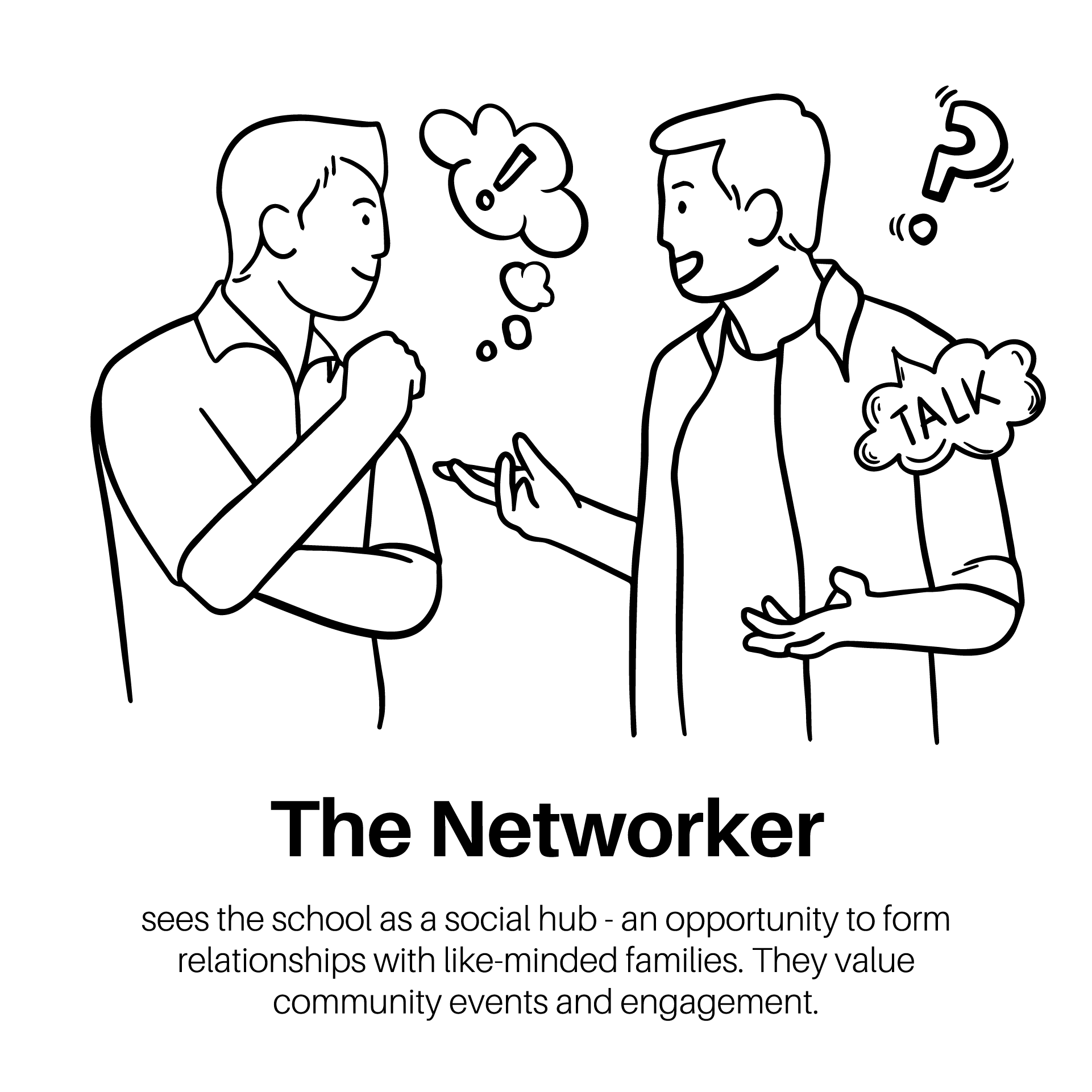
The Networker
The Davis Family sees the school as a social hub - an opportunity to form relationships with like-minded families. They value community events and engagement.
- James and Laura Davis, social and outgoing parents in their late 30s
- Their child, Ava (13)
- See school as a social hub and enjoy community events and engagement
- Value relationships with like-minded families

The Innovator
The Patel Family is drawn to schools that offer innovative teaching methods, technology integration, and forward-thinking philosophies.
- Raj and Priya Patel, innovative-minded parents in their late 30s
- Their child, Aiden (11)
- Attracted to schools with forward-thinking teaching methods and technological integration
- Appreciate schools with progressive educational philosophies
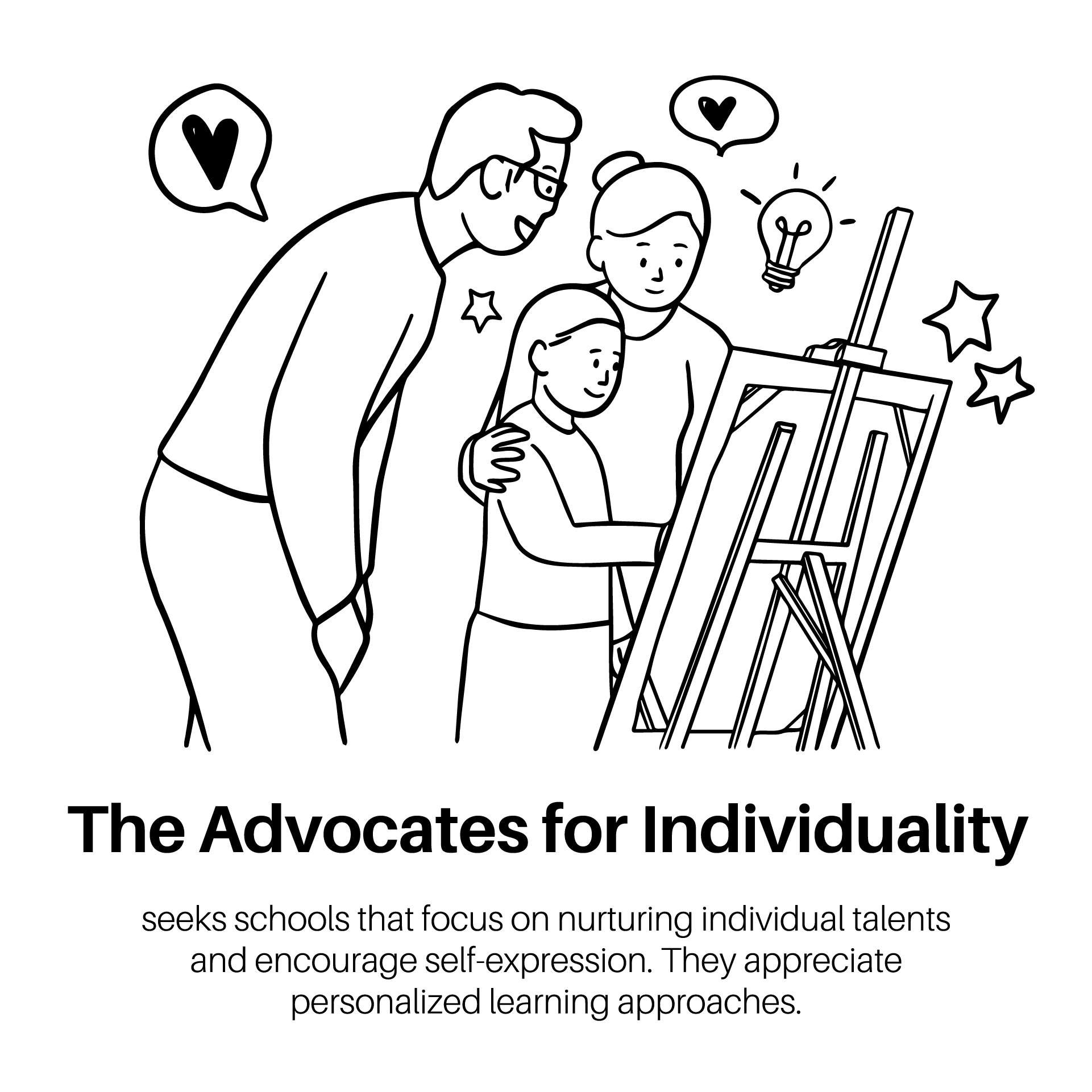
The Advocates for Individuality
The Carter Family seeks schools that focus on nurturing individual talents and encourage self-expression. They appreciate personalized learning approaches.
- Mark and Jessica Carter, a creative couple in their early 40s
- Their child, Mia (15)
- Seek schools that nurture individual talents and encourage self-expression
- Value personalized learning and creative development

The Sustainability Champions
The Miller Family values environmental education and practices in schools. They are drawn to schools with green initiatives and outdoor learning opportunities.
- Adam and Rebecca Miller, environmentally conscious parents in their early 40s
- Their child, Noah (12)
- Value schools with green initiatives, environmental education, and outdoor learning
- Actively promote sustainable practices at home and school

The Global Citizens
The Kim Family values diversity, inclusivity, and global awareness in education. They appreciate a school curriculum that includes subjects like world cultures, languages, and global issues.
- Young and diverse parents, Minho and Mei Kim, in their late 20s
- Their child, Kai (9)
- Value diversity, inclusivity, and global awareness in education
- Appreciate a curriculum that includes world cultures, languages, and global issues
Leveraging Communication Channels
Effective communication is pivotal for any organization to grow and succeed. However, simply blasting out the same message across all platforms is not enough. It is essential to know the preferences of your target audience and communicate with them in a way that they can relate to and value. This is where the concept of leveraging communication channels comes into play. By adapting your outreach and platforms to suit the preferences of different personas, you can effectively convey your message and establish a strong relationship with your audience. Taking the time to understand which platforms your audience prefers and how they engage can mean the difference between success and failure. So, take the time to understand your audience's preferences and adapt your communication strategies accordingly for maximum impact.
Metrics and KPIs to Track
Metrics and KPIs are crucial in tracking progress and identifying areas for improvement. When determining which metrics to track, it's important to consider your school's goals and objectives. For example, if you are looking to increase website traffic, you may want to track metrics such as page views, unique visitors, and bounce rate. Similarly, if you are focused on improving parent and student satisfaction, metrics such as Net Promoter Scores and student retention rates can provide valuable insights. When setting goals for these metrics and KPIs, it's important to establish benchmarks based on your industry standards, historical data, and competitor performance. By regularly tracking and analyzing these metrics, you can make data-driven decisions and take meaningful actions to improve your school's performance.
Adjusting Your Strategy: How to Pivot Your Approach Based on Data and Insights
Creating an effective marketing strategy involves creating a plan that works for your target audience. This means being able to segment your audience into specific groups so that you can more easily tailor your messaging and automate your marketing workflows. Using personas allows you to create more personalized messaging and content that speaks directly to parent's needs and preferences. By segmenting your audience in this way, you can ensure that your marketing efforts are focused on delivering the right message to the right people at the right time. So if you're looking to improve your marketing ROI, consider using personas as part of your segmentation and automation strategy.
Adjusting Parent personas is significant to the success of a school's marketing and communication strategies and can be used to create tailored content that resonates with each individual parent. Once you have identified your target personas, leveraging the right platforms and outreach channels is critical for reaching those audiences in order to measure your efforts and see the highest ROI. From there, you can focus on targeting segmented personas with personalized messaging through automated marketing or advertising campaigns. All of these areas are important for developing an effective strategy that will help meet your goals within budget.
Optimizing Personas
As you gather new data and insights, periodically review and update your persona profiles to keep them current. Set reminders to revisit personas every six months. Monitor parent feedback channels to identify any emerging trends or changes in needs. Stay on top of market research to realign personas if necessary. Validating them annually through surveys or interviews is also recommended. Keep personas dynamic and reflective of your real parent segments.
Conclusion
As mentioned throughout this blog post, creating parent personas isn’t easy, but it can drastically draw out a clear audience profile and effective communication plan down the line. If you need any guidance on mapping out parent personas or tailoring content, don't hesitate to book a free 30-minute consultation with me to kickstart the process for your private school's digital marketing strategy.
Written By: Adam Bennett | November 20, 2023
Adam is the president and founder of Cube Creative Design and specializes in private school marketing. Since starting the business in 2005, he has created individual relationships with clients in Western North Carolina and across the United States. He places great value on the needs, expectations, and goals of the client.