Private schools are fighting hard to set themselves apart, and the fight keeps getting tougher. Parents have more options than they can sort through, and they're choosier than ever about which school a child ends up in. New schools keep opening, public schools keep improving, and education budgets keep tightening, so the threat is real. Enrollment numbers get picked apart, reputations get questioned, and the future of a school hangs in the balance.
There's a way out. A careful SWOT (Strengths, Weaknesses, Opportunities, and Threats) analysis gives your school the insight it needs for strategic planning. Once you understand your real strengths, you can play to them. Once you identify your weaknesses, you have something to improve. Opportunities you act on open new doors, and threats you handle early protect your school's future.
In a crowded market, SWOT analysis is your flashlight in the fog. It shows a clear path forward. It gives you the self-awareness and direction you need to sharpen an admissions process in a school market that never stops shifting. Schools that take a thoughtful SWOT analysis seriously are set up to raise enrollment and hold their ground for generations to come. The time for self-reflection is now. Read on, and you'll see how SWOT can be your school's quiet advantage for lasting success.
Understanding SWOT Analysis for Private Schools
SWOT analysis is a strategic planning tool that private schools like yours use to name your Strengths, Weaknesses, Opportunities, and Threats. The framework gives you one place to look at your school's internal and external environment. From there you can build strategies that play to strengths, mitigate weaknesses, capitalize on opportunities, and blunt threats.
The 4 Components of a SWOT Analysis
Strengths: These are the internal factors that give a school an edge over others. At your private school, strengths could be an experienced teaching staff, modern facilities, or a strong curriculum.
Weaknesses: These are the internal factors that hold a school back. At your private school, weaknesses might be higher tuition, a short list of extracurricular options, or a student body that lacks diversity.
Opportunities: These are external factors a school can turn to its own favor. Your school might find opportunities in shifting demographics, government funding rules for schools, or rising interest in a field of study.
Threats: These are external factors that can cause a school trouble. Threats to your school might be new competitors, changes in education regulations, or a shift in how the public feels about private school education.
The Importance of SWOT for Private Schools
Schools keep changing, and private schools keep working to stand out and win parents over. Parent attitudes shift, competition climbs, and differentiation matters more than it used to. That mix is why SWOT analysis has become a tool that schools like yours can't do without. Here are the reasons it matters so much for a private school trying to reach modern parents.
How Education Is Changing
Schools have changed a great deal over the years. Online learning took off, whole-child development moved to the front, and personalized teaching is now a top concern. Those few trends shape the market your school sells into today. A SWOT analysis lets a private school like yours see these shifts and judge how well you can adapt to them. Once you identify your strengths and weaknesses against each trend, you can make informed decisions and plan your strategies well.
Aligning With Modern Parents' Preferences
Today's parents want things their own parents never asked a school about. They still want a good education, but they also look for schools that build creativity, independent thinking, and the whole person. They want to be told the truth, and they want to hear from you often. A SWOT analysis lets your private school step back and gauge how well your offerings line up with what today's parents want. You can identify where you excel (strengths), where you fall short (weaknesses), the openings to serve parents better (opportunities), and what stands in your way (threats).
Staying Ahead of Competition
The private school sector is crowded. New schools keep emerging, each with its own curriculum, teaching methods, and facilities. To stay ahead, you need to know your school's competitive position. That's the job a SWOT analysis does for you. It helps a school like yours identify the strengths that set you apart, the weaknesses competitors might exploit, the openings that would give you a competitive edge, and the threats those competitors pose.
Differentiating Themselves
With so many options on the table, private schools have to differentiate themselves. A SWOT analysis helps you identify what makes yours unique. Is it an innovative curriculum, a veteran faculty, or first-rate facilities? Know your strengths, use them, and you can tell parents in plain terms why your school is the right pick. Own your weaknesses at the same time, and you can improve them, which sets you apart even further.
Formulating Effective Strategies
The whole point of a SWOT analysis is better planning. Once you know your internal strengths and weaknesses, plus the external opportunities and threats, you and your private school can build effective strategies. You can draw up steps to promote your strengths, address your weaknesses, capitalize on opportunities, and mitigate threats. Plan that way and your school reads as the smarter choice to modern parents.
Conducting a SWOT Analysis for Your Admissions Program
Knowing where your admissions program stands today, and where it could go, matters a great deal in a crowded education market. A SWOT analysis will help you plan. It also turns up useful insight that can shape your whole admissions strategy.
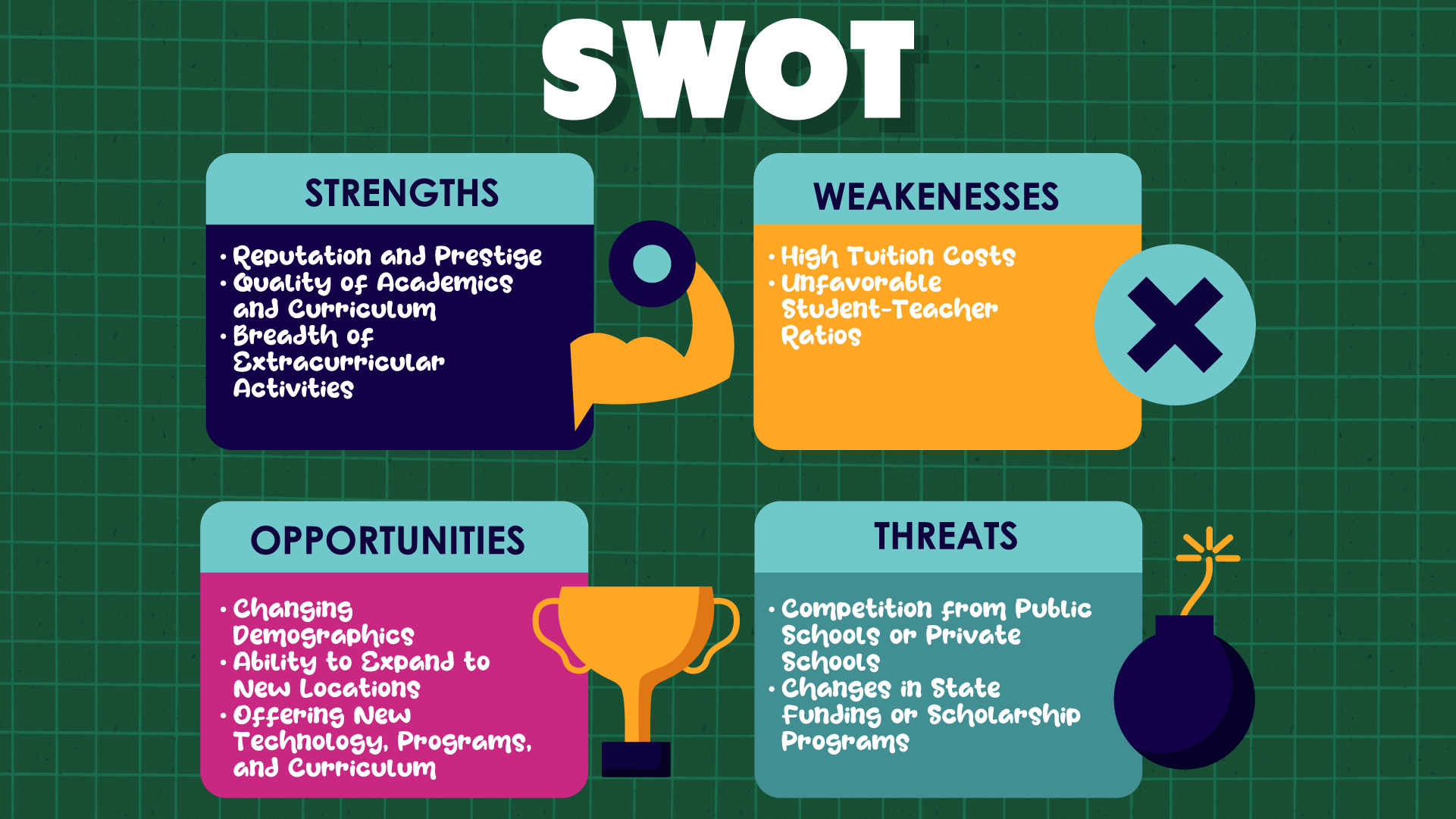
Here's an example of a SWOT analysis for Greenfield Academy, our fictional private school.
Strengths
Reputation and Prestige: The reputation of Greenfield Academy is one of its biggest strengths when it comes to drawing students and parents. A name with that kind of weight tends to signal a long record of academic excellence, alumni who did well, and a first-rate education.
Quality of Academics and Curriculum: An advanced, deep curriculum paired with high academic standards is a real strength for Greenfield Academy. Parents want schools with a strong learning environment, one that gets a child ready for college and for life. Greenfield excels here, so its admissions strategy should say so out loud.
Breadth of Extracurricular Activities: Beyond academics, modern parents care about the whole child. Greenfield offers a wide range of extracurricular options, from sports and arts to clubs and community service. That breadth is a real strength, and it adds value to the whole school experience Greenfield offers.
Weaknesses
High Tuition Costs: Greenfield Academy gives students a fine education, and it charges high tuition fees to do it. That's a real weakness, because it may deter many families who can't afford the cost. Greenfield needs to own that and look at ways to fix it, whether that means scholarships or flexible payment plans.
Unfavorable Student-Teacher Ratios: Greenfield runs larger class sizes, which leaves it with unfavorable student-teacher ratios, and parents can read that as a weakness. Parents often want smaller class sizes, where a child gets more individual attention and personalized instruction.
Opportunities
Changing Demographics in Surrounding Areas: Demographic shifts in the area around Greenfield Academy can hand its admissions program new opportunities. More young families are moving into the area, and that group is a rising share of the market for private education. It opens the door to higher enrollment for Greenfield.
Ability to Expand to New Locations: If there's demand for a good education in other locations, Greenfield could consider expanding. A new branch across town would draw more students and widen its reach.
Offering New Technology, Programs, and Curriculum: Schools never stop changing. A school like Greenfield Academy that adapts, by adding new technology, starting fresh programs, or updating its curriculum to match current demand, can seize real opportunities.
Threats
Competition from Public Schools or Private Schools: Public schools and other private schools keep getting better, and that can pose a threat to Greenfield Academy. Many of them offer free or low-cost education, which appeals to plenty of parents. Greenfield has to stay informed about what those competitors offer and how it compares.
Changes in State Funding or Scholarship Programs: A change in government policy on education funding or scholarship programs is a threat too. Cuts in funding, or new scholarship eligibility rules, could hit Greenfield Academy's enrollment and its finances.
Strategies to Improve Your Admissions Program
A SWOT analysis is a strategic planning tool that turns up real insight for sharpening your school's admissions program. Here are strategies to improve weaker areas, promote your strengths, capitalize on opportunities to expand your reach, and blunt the risks that come from threats and other outside forces.
Improving Weaker Areas
Once a SWOT analysis identifies the weaknesses in your admissions program, the next step is to plan a fix for each one. If high tuition costs are a barrier for many families, consider scholarships or flexible payment plans. If class sizes run large, find ways to cut the student-teacher ratio, whether that means hiring more teachers or rebuilding how classes are set up. Remember that fixing these weaknesses does more than improve your admissions program. It makes the whole school better.
Promoting Strengths
Your strengths are what set you apart from other schools. Once a SWOT analysis identifies them, put them to work drawing new students. Highlight them in your marketing materials, on your tours, and in meetings with prospective families. If your school is known for an advanced STEM program, that belongs front and center in your marketing. Promote your strengths well and you'll lift your school's appeal and raise enrollment.
Taking Advantage of Opportunities
Opportunities are external factors that could help your admissions program. Stay alert to them and be ready to seize them. If interest in arts education is on the rise in your town, consider expanding your arts program. If the demographics near you shift toward private education, adjust your marketing plans to reach those new students. Act on these opportunities and you'll expand your reach and lift your admissions.
Mitigating Risks From Threats
Threats are external factors that could hurt your admissions program. You've got to watch them and plan how to mitigate each one. If public schools in your area keep getting better, make sure your school still delivers value that justifies the cost of tuition. If a change in government funding looms, consider new funding sources or stepping up your fundraising. Address these threats early and you protect your school's future.
A SWOT Analysis Is the First Step to Enrollment Success
These are uncertain times, and few things matter more than a thoughtful, strategic approach to securing your school's future. Use the framework of a SWOT analysis and you gain the insight to sharpen your private school's admissions process, raise enrollment, and differentiate your school.
Start by identifying your distinctive strengths, then promote them hard. Recognize the areas that need improvement, and put creative solutions in place. Seize emerging opportunities so you can expand your reach. And keep a close watch on external threats.
Armed with the clarity a SWOT analysis gives you, you'll be ready to build data-driven strategies that lift your school further. The time for self-reflection is now. Don't leave your school's future to chance. Reach out today to talk about how I can give your admissions process the competitive edge it needs. With SWOT and me as your guide, healthy enrollment and long-term success can be yours.