Is your pest control website attracting new customers or slowly collecting virtual dust? In today's fast-paced digital landscape, having a website isn’t just about having an online presence; it’s about actively engaging your audience, drawing them in, and converting them into loyal customers. Just as you regularly maintain and protect homes and businesses from pests, your website requires similar attention to remain relevant and effective. In this blog post, we’ll delve into the critical role of fresh, regularly updated website content for pest control businesses in driving search engine optimization (SEO) success and attracting new customers.

Written By: Chad J. Treadway | February 27, 2024
Chad is our Chief Smarketing Officer. He will help you survey your small business needs, educating you on your options before suggesting any solution. Chad is passionate about rural marketing in the United States and North Carolina. He also has several certifications through HubSpot to better assist you with your internet and inbound marketing.

A vibrant, healthy website is the foundation of a successful online presence. However, even the most robust sites can develop issues that degrade their performance over time. Much like an annual check-up at the doctor’s office, conducting regular search engine optimization (SEO) audits is essential to maintain your website’s health.
An SEO audit comprehensively evaluates your site’s ability to attract search engine traffic, engage visitors, and ultimately convert leads. Without ongoing audits and appropriate treatment, your site’s visibility and conversion rates can suffer from unchecked technical problems, outdated content, competition gaps, and more.
This article will walk through the key components of an effective SEO audit, including analyses of the following:

Written By: Adam Bennett | February 27, 2024
Adam is the president and founder of Cube Creative Design and specializes in private school marketing. Since starting the business in 2005, he has created individual relationships with clients in Western North Carolina and across the United States. He places great value on the needs, expectations, and goals of the client.

Memes have become an essential part of internet culture and marketing. 94% of marketers have used memes in their campaigns, and 78% agree that memes improve social media engagement (Source: HubSpot).
However, with great marketing power comes great legal responsibility. Using memes without proper rights or attribution can put your business at risk. This post will explore how small businesses can tap into trending memes legally and strategically.

Written By: Hannah Kilpatrick | February 27, 2024
Hannah Kilpatrick Cube Creative DesignHannah Kilpatrick graduated from Western Carolina University in 2021 with a Bachelor of Science in Communication with a Minor in Marketing and a Concentration in Public Relations. She has been around social media since its creation. (Meaning, she was in the first grade when Facebook became available to the general public.) As our very own professional Gen-Z, Hannah is a whiz when it comes to social media creation and paid advertising.
As a pest control service provider, delivering quality service is essential, but building a thriving business requires more. Owners and managers like you must also become skilled marketers responsible for continually promoting your service offerings to homeowners and businesses in your community and service area.
However, for small teams bouncing between service calls, dedicating time for marketing beyond a logo on the side of the truck often feels impossible. Limited resources and packed schedules limit opportunities to implement campaigns at the level of the major players.
So, how do you stand out from competitors and attract recurring contracts or new inspection leads in a crowded market?
This comprehensive guide shares proven pest control marketing strategies to help you:
- Establish a consistent online presence with search visibility
- Complement with creative offline community engagement
- Track campaign performance and optimize over time
- Ultimately, this turns more prospects into happy lifelong customers
Whether launching a new company or seeking to improve your existing business's awareness, applying targeted digital promotion paired with inventive real-world partnerships distinguishes you as a thriving market leader.
Written By: Adam Bennett | February 26, 2024
Adam is the president and founder of Cube Creative Design and specializes in private school marketing. Since starting the business in 2005, he has created individual relationships with clients in Western North Carolina and across the United States. He places great value on the needs, expectations, and goals of the client.

When it comes to digital marketing, the battle for clicks, views, and engagements seems tougher than ever.
But, while likes, shares, and viral content seem to be everyone’s top priority, many are overlooking the conversion powerhouse they already have – their website.
Now, we’re not suggesting that you should neglect your social media strategy or forget about Google’s latest algorithm update. However, your website is a potential cash-printing machine that you can’t afford to ignore.
Here, we’ll talk about some simple design tactics that you can easily implement to boost four key website metrics.
In today's digital age, an effective website is crucial for any pest control business looking to attract new customers and grow. According to Stanford University, nearly 8 out of 10 people base the credibility of a business on how its website looks. BrightLocal’s 2023 Customer Review Survey found that 98% of consumers used the Internet to find information about local businesses in 2022, up from 90% in 2019. Also, the NPMA and PCT 2022 Industry Survey found that the paid advertising platforms that were the most effective were the pest control company’s website (46%), SEO (39%), service vehicle graphics (32%), social media ads (30%) and pay per click ads (18%) rounded out the top 5. Given that most people search online to find local services like pest control, having an outdated or poorly designed site can mean losing out on a tremendous amount of business.
An appealing, easy-to-navigate website establishes trust and credibility for potential customers browsing different pest control providers. It can also help generate leads and new business inquiries through built-in lead capture forms, online booking, and other conversion-focused elements. For these reasons, investing in professional website design should be a priority for any pest control company without an established online presence.
A high-quality website serves as a 24/7 sales rep for your business. In the sections, we’ll explore strategies and best practices for creating an effective website tailored to the pest control industry. Following proven web design principles can help your company stand out from the competition and attract more customers consistently over time.
Written By: Adam Bennett | February 21, 2024
Adam is the president and founder of Cube Creative Design and specializes in private school marketing. Since starting the business in 2005, he has created individual relationships with clients in Western North Carolina and across the United States. He places great value on the needs, expectations, and goals of the client.
In the digital age, a strategic website is critical for pest control business owners like you, seeking to generate more leads and revenue in an increasingly competitive market. This guide outlines the 11 must-have components for an optimized pest control site, specifically for small-to-midsize companies serving local residential and commercial clients. We'll walk through key features you need to drive conversions and capture more market share in your area.
Written By: Chad J. Treadway | February 21, 2024
Chad is our Chief Smarketing Officer. He will help you survey your small business needs, educating you on your options before suggesting any solution. Chad is passionate about rural marketing in the United States and North Carolina. He also has several certifications through HubSpot to better assist you with your internet and inbound marketing.
Pest control businesses thrive on the quality of their lead generation efforts. In a highly competitive industry, having a steady stream of potential customers is essential for growth and success. This blog post will explore effective strategies tailored specifically for pest control companies to generate leads and expand their customer base. We’ll delve into various tactics, from search engine optimization to networking, providing actionable insights to boost sales opportunities and revenue.
Quality lead generation serves as the lifeblood of pest control businesses. Without a continuous influx of leads, it becomes challenging to sustain growth and profitability in this competitive market. Effective lead-generation strategies not only increase sales opportunities but also help in nurturing relationships with potential customers, ultimately leading to long-term business success.
In this blog post, we’ll discuss a comprehensive range of strategies designed to generate leads for pest control companies. These strategies encompass various digital marketing channels, including search engine optimization (SEO), pay-per-click (PPC) advertising, social media marketing, email marketing, content marketing, referral programs, local listings, and networking. Each section will provide actionable tips and best practices to maximize the effectiveness of lead generation efforts.
Written By: Chad J. Treadway | February 21, 2024
Chad is our Chief Smarketing Officer. He will help you survey your small business needs, educating you on your options before suggesting any solution. Chad is passionate about rural marketing in the United States and North Carolina. He also has several certifications through HubSpot to better assist you with your internet and inbound marketing.
As a pest control provider, you may struggle to acquire new customers despite having top-notch services and technicians. You recognize it's time for change! You may realize that your current website is in need of an update, and you have heard that it can drive a 30% uptick in business.
When it comes to your website, you have several options: DIY, hire your father's brother's nephew's cousin's former roommate who “knows how to do web design,” or look for a digital marketing agency specializing in the pest control industry. By working with an agency, they tend to understand how to overhaul your website design, contact options, and SEO so that you can see dramatic results!
Written By: Chad J. Treadway | February 21, 2024
Chad is our Chief Smarketing Officer. He will help you survey your small business needs, educating you on your options before suggesting any solution. Chad is passionate about rural marketing in the United States and North Carolina. He also has several certifications through HubSpot to better assist you with your internet and inbound marketing.
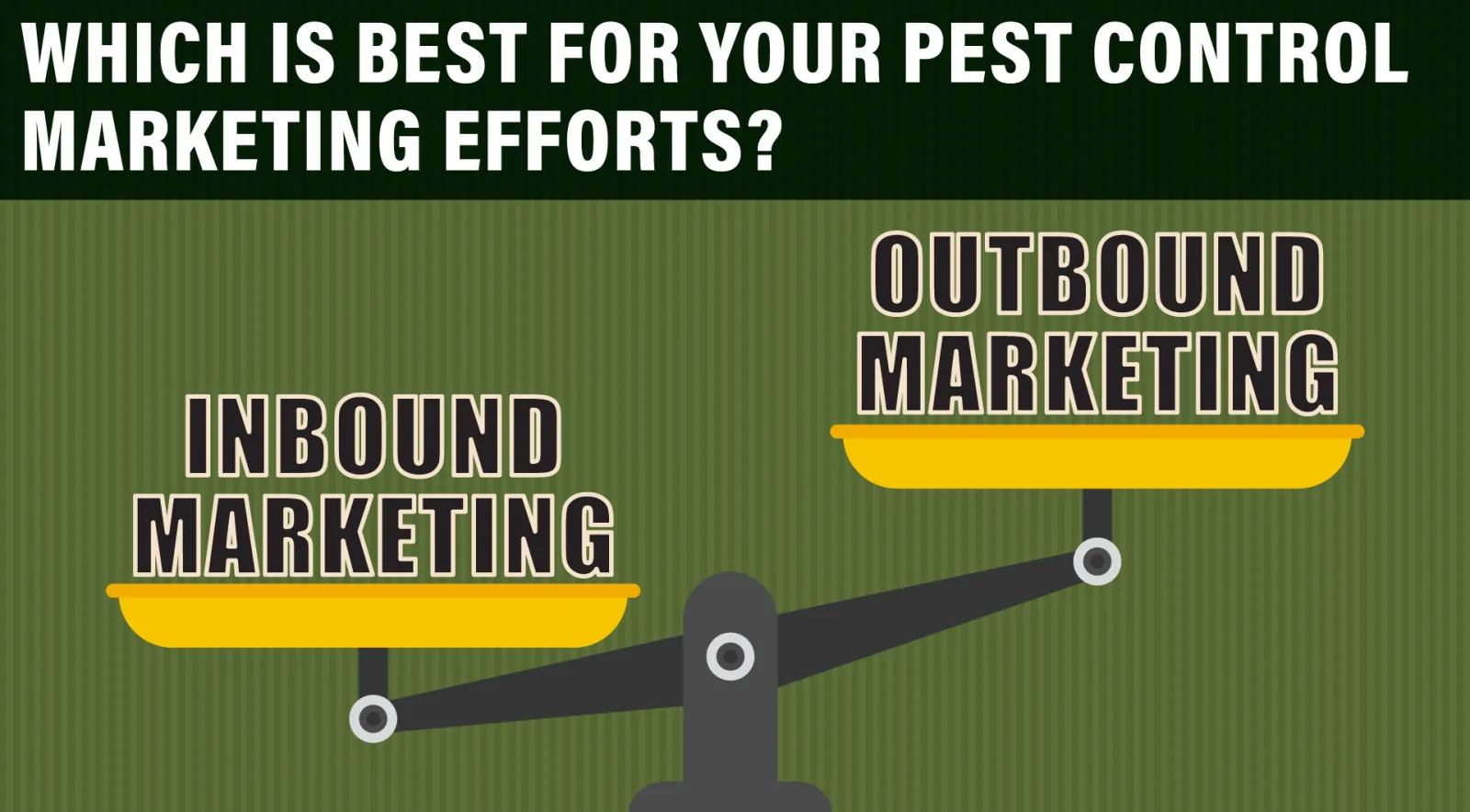
In the complex landscape of modern marketing, determining how to optimize your budget between differing strategies can feel like traversing a maze — simple in concept yet extremely complicated in reality. As a small pest control business owner or manager, you likely grapple with this question often: how do I capture more leads - should I focus on inbound tactics or traditional outbound methods?
This blog will explore the winding routes of inbound and outbound marketing to guide you toward higher lead generation and growth.
Written By: Chad J. Treadway | February 21, 2024
Chad is our Chief Smarketing Officer. He will help you survey your small business needs, educating you on your options before suggesting any solution. Chad is passionate about rural marketing in the United States and North Carolina. He also has several certifications through HubSpot to better assist you with your internet and inbound marketing.
When it comes to growing a pest control business, word-of-mouth marketing can be one of your most valuable tools. There’s simply no better advertising than a glowing recommendation from a satisfied customer. Not only is it free marketing, but referrals also come with built-in trust since they come directly from someone your potential customer already knows and trusts.
However, referrals don’t just happen on their own. You have to proactively cultivate them through strong relationships and top-notch service. The good news is that it’s not as difficult as you think. By focusing on customer care, follow-up, and keeping your happy customers in mind, you can maximize the number of referrals your company receives.
In this post, we’ll explore some tried and true tactics for getting more customers to spread the word about your company.
Written By: Chad J. Treadway | February 21, 2024
Chad is our Chief Smarketing Officer. He will help you survey your small business needs, educating you on your options before suggesting any solution. Chad is passionate about rural marketing in the United States and North Carolina. He also has several certifications through HubSpot to better assist you with your internet and inbound marketing.
Building meaningful relationships with customers is critical for service-focused businesses like pest control. In today's digital age, email marketing has become an essential tool for pest control companies to effectively connect with target audiences amidst fierce competition. While traditional flyers and door-knocks remain somewhat relevant, according to studies, email marketing drives around 38% revenue growth for pest control companies. Additionally, email marketing has a median return on investment (ROI) of 122% for every $1 or $36 for every $1 spent. With stats like those, it's clear that email marketing is one of the most powerful tools in a pest control marketer’s arsenal.
Email offers a personalized, direct route to engage prospects and existing customers through valuable educational content, promotions, and company updates that can reach subscriber inboxes instantly. By mastering professional email marketing techniques, your pest control businesses can nurture leads, drive growth, and strengthen customer loyalty over the long run.
In this post, we’ll explore proven strategies and best practices specifically tailored to the needs of pest control businesses. From building an email list and segmenting your audience to sending automated campaigns and analyzing success metrics, we’ll cover everything you need to know to harness the full potential of email marketing in the pest control industry.
Written By: Adam Bennett | February 21, 2024
Adam is the president and founder of Cube Creative Design and specializes in private school marketing. Since starting the business in 2005, he has created individual relationships with clients in Western North Carolina and across the United States. He places great value on the needs, expectations, and goals of the client.