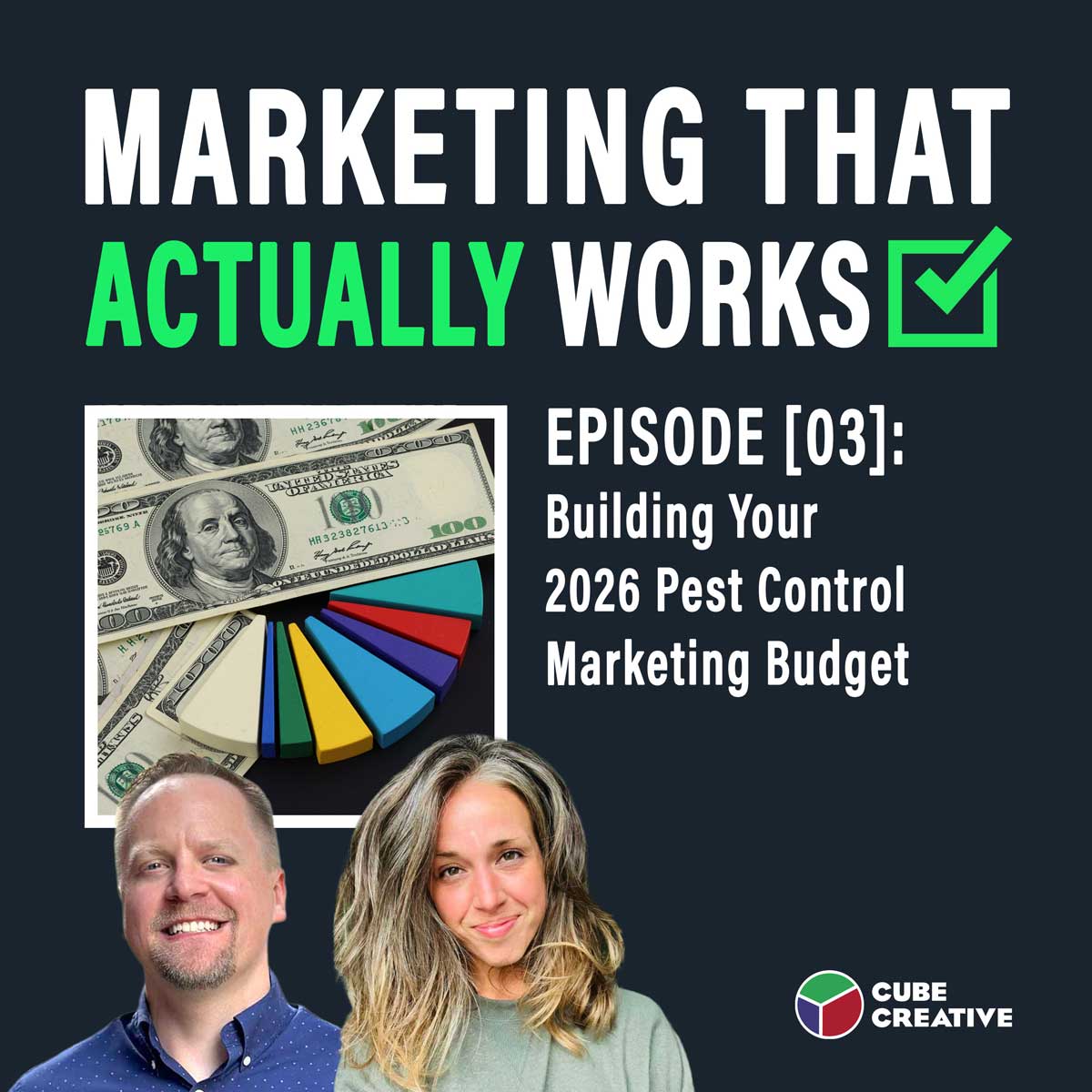
Adam: Welcome to Marketing That Actually Works. I'm Adam Bennett.
Elisabeth: And I'm Elisabeth Pallante. We're from Cube Creative Design, and for over 20 years now we've helped pest control companies stop wasting money and start growing.
Adam: Today's episode: Building Your 2026 Pest Control Marketing Budget. Here are your three key takeaways.
Elisabeth: Budget stuff isn't that much fun, but we're going to simplify it as best we can. Three things:
- Why most pest control companies underspend and what industry benchmarks actually say
- How to allocate your budget across attract, convert, and retain based on your revenue stage
- What ROI to expect and how to track whether your marketing is actually working
Adam: Let's dive in.
Elisabeth: Let me take out my crystal ball and define your budgeting process. Take whatever you spent last year, add 10%, and divide by 12. Done.
Adam: Or worse: "We'll spend whatever's left over after we pay all our bills." Marketing becomes the remainder, not the driver of growth.
Elisabeth: But that's not a strategy. That's just what happens. You're making last year's mistakes with 10% more money.
Adam: And then you wonder why your competitor down the street has 15 trucks and you're stuck at five. It's because they're investing in growth. You're hoping for growth.
The Reality of the Pest Control Market in 2026
Elisabeth: Here's the reality of the pest control market in 2026. The industry is growing 5% to 6.4% annually. That's good news. Different sources give different total market sizes, but the growth rate is consistent.
The translation: the pie is getting bigger. But if you're not investing to capture that growth, you're mathematically losing market share.
Adam: Customer acquisition costs have surged over 222% over the past eight years. What cost $9 to acquire a customer in 2013 now costs $29. It's obvious when you go to the grocery store—it's affected everything.
For pest control specifically, keywords like "exterminator near me" cost $34 per click. That's just the click. That's not even turning into a customer. If somebody clicks on that link, it costs you $34.
Elisabeth: Here's what this means: your competitors who invested in marketing early built their customer bases when acquisition was cheap.
Adam: Every month you wait, you're paying the latecomer tax. The longer you wait to invest seriously in marketing, the more expensive it gets.
Elisabeth: I hate to say this, but the best time to invest in marketing was five years ago. That's not where we are though—you're here now. The second best time is today, because next year it'll continue to get more expensive.
Adam: Growth requires investment. You can't cut your way to $5 million. You have to spend money on marketing to generate the leads that drive growth.
Industry Benchmarks: What You Should Be Spending
Elisabeth: Let's start with the industry standard for service businesses. The Small Business Administration says business-to-consumer companies typically spend 7% to 12% of revenue on marketing.
Adam: For pest control specifically, companies focused on growth trend towards the higher end—10% to 12%.
Elisabeth: In other words, if you're doing $500,000 in revenue, you should be spending $50,000 to $60,000 per year. That's $4,000 to $5,000 per month.
Adam: If you're doing $1 million in revenue, that's $100,000 to $120,000 per year—$8,000 to $10,000 per month. That seems high, doesn't it?
Elisabeth: It does, but it pays its way.
Budget Allocation by Stage
Stage 1: Early Stage ($250K-$500K Revenue)
Elisabeth: At this stage, you're probably running one to two trucks, maybe just you and a helper. Budget minimum: $2,000 to $4,000 a month.
How that breaks down:
- 40% Foundational: Website, Google Business Profile setup, basic SEO
- 40% Paid Leads: Google Local Service Ads, Google Search Ads
- 20% Retention: Email setup, email marketing, anniversary messages, review generation
We talked about retention in our first episode—how it pays off to retain a client versus obtain a new one.
Adam: At this stage, you're focused on proving the business model and getting initial traction. You need leads fast, so paid advertising gets equal weight with foundation building.
Stage 2: Growth Stage ($500K-$1M Revenue)
Adam: Now you've got three to five trucks, a proven business model, and you're ready to scale. Your budget: $5,000 to $8,000 a month.
Elisabeth: At this point, your allocation shifts. Different amount of money, different situation:
- 50% Organic Growth: SEO, content marketing, authority building
- 35% Paid Acquisition: Google Ads, Local Service Ads, maybe Facebook
- 15% Retention and Referrals: Email automation, referral programs
Adam: Why the shift to organic SEO? At this stage, you need to reduce acquisition costs. You can't scale to $2 million paying $300 to $400 per lead with Google Ads.
Elisabeth: Investing in SEO and content now means in 6 to 12 months, you're getting free organic leads. When we say "free," we mean you've invested the money upfront, but it's not an ongoing per-lead cost like Google Ads.
You're still running paid ads, but you're diversifying your lead sources so you're not dependent on just one way of getting clients.
Stage 3: Scaling Stage ($1M-$2M Revenue)
Adam: You're growing more. Now you have 6 to 12 trucks, multiple techs, maybe a sales manager. Your budget: $10,000 to $20,000 per month.
Elisabeth: How that breaks down:
- 55% Organic and Brand: SEO, content marketing, brand building
- 30% Paid Acquisition: Multi-channel paid ads
- 15% Retention and Expansion: Customer marketing, upsells, referrals
Adam: At this stage, you should be dominating your local search organically. If somebody's searching "pest control near me," you should show up at the top. Your brand should be recognized by name in your service area. Paid ads become supplemental, not primary.
Elisabeth: What a relief—you can still use paid ads to help grow, but it feels good to not be so dependent on just that one source.
Stage 4: Established Stage ($2M+ Revenue)
Elisabeth: Now you're running 12 to 20 trucks or more. You've got an established brand, a mature business. Budget: $20,000 to $50,000 per month.
Adam: Your allocation:
- 50% Brand and Authority: High-level SEO, digital content, community sponsorships
- 30% Paid at Scale: Sophisticated multi-channel campaigns
- 20% Customer Growth: Upsells, retention, referrals, customer marketing
That sounds like a lot going on.
Elisabeth: It is a lot. You can't think about all this at once. This is stage by stage, working to different points.
At this stage, you should own your local market. When someone thinks "pest control" in your city, they think your name.
Adam: The ROI is beautiful here. Your acquisition cost is lower because of brand awareness. Retention is higher because you have systems in place. Lifetime value per customer is higher because you've built trust and you're taking care of their needs.
The Three Buckets: Attract, Convert, Retain
Elisabeth: No matter your revenue stage, your budget should be split across three buckets: Attract, Convert, and Retain. If you want more detail on each bucket, go back to episode one where we covered them in depth. Same framework, but now we're putting exact dollars behind it.
Bucket 1: Attract
Adam: This is everything that brings new people to you—SEO, content marketing, Google Ads, Local Service Ads, social media advertising.
For a $5,000 marketing budget, that's about $2,500 to $3,000 on attraction:
- $1,000 for SEO and content creation
- $1,500 to $2,000 for paid advertising
Elisabeth: This is the biggest allocation. Why? Because without new leads, you don't have a business. Industry average customer churn is 20% to 30% annually. You need new customers to replace them, plus more to grow.
Bucket 2: Convert
Adam: This is everything that turns traffic into leads—website, landing pages, forms, chat, call tracking, conversion optimization. For a $5,000 budget, that's around $1,000 to $1,500 on conversion tools.
Elisabeth: The conversion bucket is about improving efficiency. If you can increase your website conversion rate from just 2% to 4%, you doubled your leads without spending another dollar on traffic. This is the highest ROI bucket, but it's often the most neglected.
Bucket 3: Retain
Adam: This is everything that keeps customers—email automation, review generation, referral programs, customer newsletters. For a $5,000 monthly budget, that's around $500 to $1,000 on retention programs.
Elisabeth: This one often gets skipped. The amount seems small, but email alone has a $36 return on investment per dollar spent. It's the highest return channel.
Remember: acquiring a new customer costs five to seven times more than retaining an existing one.
Adam: Even a small investment in retention has massive impact. An automated email sequence that reactivates 10 dormant customers per month at $500 each—that's $5,000 in found revenue just from an automated system
Elisabeth: When you compare that to trying to cut costs, retaining clients is so much easier than cutting, cutting, cutting.
What ROI Should You Expect?
Elisabeth: You set your budget, you're spending $5,000 a month. What should you expect in return? Let's talk about ROI.
Adam: Here are realistic expectations by timeframe—because this is what everybody asks: "How quickly will this work?"
Months 1-3
Adam:
- Paid Ads: Should start generating leads immediately after a brief warm-up period. Expect 20 to 50 leads per month depending on budget and market.
- SEO and Content: Don't expect much yet. You're planting seeds.
- Email and Retention: Setting up automation. You'll start seeing reactivations as emails go out.
Months 4-6
Elisabeth:
- Paid Ads: Optimized by now. You've figured out what works and what doesn't. Lead quality is improving, cost per lead is decreasing.
- SEO and Content: Starting to rank for long-tail keywords. Organic traffic increasing 20% to 30%.
- Email Automation: Running smoothly with measurable reactivation revenue.
Things are coming into focus between months four and six.
Months 7-12
Adam: Here's where the fun really starts.
- Paid Ads: Mature campaigns consistently generating leads. You have good data and known ROI.
- SEO and Content: Significant growth—50% to 100% traffic increase. These are the "free" leads coming from people searching and finding you organically.
- Email and Retention: Numbers improving, referrals increasing.
Between months seven and twelve, things are really cooking.
Elisabeth: As we talk about honing in on what's specific and important in your market—it really does change based on where you are and what's needed. It could be the difference between running an ad for "rodent control" versus "get rid of the gopher problem in your yard." Certain areas we've seen where just a slight tweak in verbiage makes a huge difference in getting found.
That's part of the discovery phase—trial and error—and by month 12, you know your audience better with the specific words that work on your site and in your ads.
Adam: Between months seven and twelve, you'll get great data from Google Ads for what people are actually searching. A great content plan working with your SEO can be tweaked around that time to get the best bang for your buck.
Year One Results: The Numbers
Elisabeth: By month 12, a $5,000 per month budget should generate:
- 50-80 leads per month total
- 15-25 new customers per month (assuming 30% close rate)
- At $500 average customer value: $7,500 to $12,500 per month in new revenue
Adam: Multiply that times 12: $90,000 to $150,000 annual revenue from a $60,000 investment. That's 1.5 to 2.5 times ROI in year one. And you can only guess how that improves in year two.
Elisabeth: It just gets better from there.
What to Track
Elisabeth: What you want to track:
Lead Metrics:
- Total leads per month by source (simple question—just a matter of doing it)
- Cost per lead by channel
- Lead to customer conversion rate
- Cost per acquisition by channel
Adam: Revenue Metrics:
- New customer revenue per month
- Customer lifetime value
- Marketing ROI (revenue generated divided by marketing spend
Elisabeth: The key metric: customer acquisition cost versus lifetime value. If your acquisition cost is $300 and your lifetime value is $2,000, you're golden. That's a 6.7 times return—almost 7 times.
Adam: Most pest control companies should target a 3:1 lifetime value to cost of acquisition ratio minimum. For every dollar you spend acquiring a customer, they should be worth at least three dollars.
Recap: Three Key Takeaways
Elisabeth: There's a lot of information and numbers here. Let's consolidate.
Number one: The industry benchmark is 10% to 12% of revenue. Companies underspend because acquisition costs have surged 222%. Waiting costs more each year—better to start now than later.
Number two: Allocate your budget across three buckets: Attract, Convert, and Retain. Percentages shift by stage—from 40/40/20 early stage to 50/30/20 at scale. But the attraction bucket is always the biggest.
Number three: Expect 1.5 to 2.5 times ROI in your first year, improving to 3 to 5 times in year two. Track your customer acquisition cost versus lifetime value with a minimum 3:1 ratio.
Next Steps
Adam: We've created a marketing budget calculator for pest control companies just like you. Plug in your revenue, and it tells you what to spend and how to allocate it. Check it out at marketingthatactuallyworks.ai.
Elisabeth: And if you'd like, you can book a strategy call with us for a custom budget for your specific situation
Adam: Next Tuesday, we're talking about "Your Website Is Losing You Money and Here's How to Fix It." We'll walk through the seven must-have elements every pest control website needs
Elisabeth: Subscribe and please leave us a five-star review.
Adam: Thanks for listening to Marketing That Actually Works. We'll see you next Tuesday.
Elisabeth: Bye bye.