 use Joomla\CMS\Uri\Uri;
In today’s highly competitive environment between brands and companies, that common ‘lowest offer bait may not be enough to convince people to buy your products or services. Market places are now dominated by content creation that aids businesses to gain traffics for their websites. Therefore, growing a business in a content-dominated space without content marketing is like writing without a pen—you’re merely exerting efforts but achieve no result. Digital problems require digital solutions and one way of solving online marketing problems is by moving closer to what people really need, like what search engine marketing strategy does.
This article is a comprehensive guide about search engine marketing and how it works.
Fundamentals: SEM Definition, Structure, Concept, And Process
SEM Meaning
Search engine marketing or SEM is a digital marketing strategy used by companies in order to increase their visibility on search engine results page (SERP) through paid advertisements. It helps websites appear on top of the list whenever one of the typed-in keywords is linked to these sites.
SEM begins when people browse the internet with the intention of buying a product or service. They enter words to look for relevant results, and when a keyword matches their search, an ad appears on the landing page of search results.
The Power of Keywords
Keywords are the main player of search engine marketing. As people browse for products or services, they are likely to enter words related to them. Good and effective keywords put the product or service in front of potential clients. That is why a keen and careful selection of keywords to utilize should be done before the actual advertisement.
In doing so, here’s a quick guide on how to select the right keywords for your business:
Research
Create a list of possible words you might use. Sit down and talk about ideas that are relevant to your potential buyers. What are their needs, and how will they phrase them? Will they directly type for a single word, or will they use a more detailed phrase? For this matter, it is advisable to include both short-tail keywords (using one or two words) and long-tail keywords (using three or more words).
Pros and cons
Long-tail keywords usually have a lower volume but give a more definite result. On the other hand, short-tail keywords tend to gain a higher search volume but with the indefinite result.
Create a comprehensive list
To create a comprehensive list, consider all types of keyword terms:
Generic terms
These are the actual description of a particular product that buyers might enter in a search engine. It has a broad scope that caters to clients' vague ideas and shows possible services or products that might meet his or her needs. For example, when you enter the word ‘education,’ a large number of results will appear from the simple definition, terminologies, and related libraries to a more insightful page such as educational sites, blog posts, and content articles.
Related terms
These are words that do not directly refer to the product or service that buyers might be searching for but is relevant to the searched word. Terms can be related either by semantic category (or variation of the meaning) or through primary keyword. For example, using the term ‘education,’ some related terms that might be displayed are teaching, schooling, lesson, tutoring, curriculum, and the likes.
Brand terms
These are the keywords that contain the business or brand’s names. It may also include product names, product details, or descriptive phrases. For example, a user might enter ‘Jabra bluetooth earphone with mic business’ as he/she searches for this particular item.
Competitor terms
These are the terms that include the business or brand’s name of possible competitors. It is beneficial in a way that a company might attract similar audiences or clients using the same terms. For Sony, a competitor term can be Plantronics-noise reduction headphones.
Attest
The second step is to narrow down your list and omit redundant words. One way of trimming your list down is to determine whether a term is relevant to your buyer’s needs or not. In doing so, you must understand that intent affects keyword analysis.
Keywords should, at the utmost part, address the concern of a searcher and not just carry the word at the search bar. Another thing, keywords can mean differently from your client’s perspective. For instance, a user searches for the “how to start a blog” keyword phrase for an article he wants to write. In this matter, a blog can mean two things: the actual blog to be posted and the website where it will be posted.
The question here is whether the user wants to learn how to start a blog or how to launch a website for a blog post? One effective way to have a more personal touch of the user’s intent is to type in the keyword yourself and see the result. (Source: Research for SEO: A Beginner’s Guide)
Tools
Now that you have a specified list of keywords to include in your ads, it's time to refine those terms using research keyword tools. All research tools work the same; once you enter keywords in these tools, it will automatically generate a wide range of keyword ideas.
A well-analyzed keyword can:
Gain traffic and attract potential clients
Selecting keywords that are relevant to your client’s needs will likely put your website at the top of the search engine result page (SERP).
Increase in conversion
Keywords that match the user’s intent will not only gain attention from visitors but also attract traffic. Meaning, content should address people’s concerns or solve their problems. Otherwise, they’ll be just an additional searcher of your site.
Bring a deeper understanding of marketing trends
Analyzing words to include in your advertisements will give you a closer look at your target market’s behavior, current trends, and preferences.
Types of SEM Keywords
SEM keywords are the actual terms or phrases that businesses include in their search engine campaigns. As users enter those keywords, their advertisements land on the result page. For example, if a company uses the term ‘marketing agency’ in its target, their ads may show when people match this praise.
That is why knowledge in the basic types of SEM keywords is important to choose the right keyword and avoid terms that will not gain any traffics.
Broad match keywords.
As the name suggests, these terms give a wide range of reach on the clients’ end. Broad match keywords have the highest reach among the four types. This may cover almost everything in the search bar, including synonymous words of the target term, similar phrases, stemming, singular or plural forms of the searched term, and even misspelled words.
Phrase match keywords
These show the exact phrase result, including phrases with words before and after the target search.
Exact match keywords
These have the lowest reach but show high-accuracy result ads for closely related target keywords.
Negative match keywords
These are the strategic way of intentionally excluding search campaigns in google ads. It is named negative keywords for the reason that they are not directly related to the ad copy.
Keywords and Account Structure
Another essential aspect of a search engine marketing campaign is the account structure. It is the way in which SEM campaigns are set up. Google Ads help desk created a chart that shows how account structure works.
Campaigns
Placed at the highest level, campaigns are used to achieve a specific goal, like organizing accounts into a larger cluster related to specific target audiences, promotions, products, and services. For example, a platform for a ‘marketing agency’ might have two campaigns, one is to target people looking for digital marketing, and one is to target digital marketers.
Ad Groups
Campaigns are divided into smaller units called Ad Groups. This smaller division under the umbrella of a campaign breaks the ad into narrower themes. For example, an ad campaign that targets digital marketing might have two ad groups: one targets website designing, and one targets social media management.
Keywords and Ads
Each ad groups contain its own designated target keywords addressing the ad group’s particular audience or theme. For example, the ad group for website designing might use keywords related to web-output design and development.
Search Engine Marketing Glossary
- Keywords are the terms and phrases that clients enter in a search engine like Google, which generates a particular result.
- Concordance is the process of defining the degree of correspondence between people’s terms to use when looking for a product or search engine and the keywords a company selected for the advertisement.
- Text Ads are the featured text and text links that marketers and advertisers use in promoting a product or service.
- The landing page is the designated web page where users are redirected as they click an advertisement.
- Search networks are places where advertisements appear.
- Impressions pertain to how frequently advertisements were shown.
- Clicks are the counts an advertisement was clicked on.
- Click-Through Rate or CTR refers to the percentage of people who clicked a certain advertisement.
- Cost Per Click or CPC is the actual cost a marketer pays for each click on a digital ad.
- Quality Score refers to the rating that Google gives for the overall experience that an ad and the landing pages provided to its users after matching the keywords search.
Process of Search Engine Marketing Ad Auction
Since talking about search engine marketing involves paid advertisements, many can easily misunderstand its natural process that whoever pays the most wins the top spot. Although having a larger budget can be a leading factor, but it isn’t the only requirement in winning search marketing. It is because all ads undergo a selection process called an auction whether it will appear in SERP or not. To explain furthermore, take into account the ad auction in Google AdWords.
How does the auction work?
- The process begins when a user searches for a product or service. The Google Ads system then finds all ads that match the keyword entered.
- When ads are shown that are not eligible, for example, the ads have a different target country, the system will ignore those.
- From the remaining ads, the Google Ads system will show those that have sufficient high Ad Rank. Ad Rank includes the bid, ad quality, the condition of the user’s search, and other ad formats.
Another way to win the auction, even if other businesses offer a higher bid, is to have highly relevant content keywords in the ads.
History of Search Engine Marketing
The arrival of search engine marketing (SEM) has improved business transactions in both brand and client’s end. Search engines have made the marketing process more convenient as it draws the market closer to potential buyers. Now their desired product or service is just a fingertip away from them.
This practice of advertising online, known today as search engine marketing (SEM), dates back to 1991 when Tim Berners-Lee, a British computer scientist, publicized the first-ever invented browser, the ‘World Wide Web. Initially, it is designed to share automated information between universities around the globe but was later used by several sectors as a medium of data transfer. So, to establish a standard communication between clients and servers, Tim and his colleagues created the HyperText Transfer Protocol or HTTP.
The following year, Gopher, a retrieval information network, releases ‘Veronica’ that is able to retrieve titles and file names stored in its index system.
The following year, 1993, Matthew Gray made the debut of the first web search engine, ‘World Wide Web Wanderer’ invented specifically to count networks during those times. Three more ‘bot-fed’ search engines exist in the same year—Jump Station, World Wide Web Worm, and RBSE Spider.
In 1994, a significant change came into place as Eric Ward realizes the need to provide people a specific URL that gives way to link building. This update allows web browsers to link URLs in the browsing results making the process more convenient and accessible for users. This year, several big companies also launched web browsers, including Netscape, Alta Vista, and Yahoo search engines.
Coming in 1995 is another significant update as Microsoft enter the browsing field introducing the Internet Explorer. It has a graphic user interface (GUI) which allowed the user to incorporate both graphics and text on a single page. LookSmart joins the competition of search engines, and Alta Vista provides more advanced searching techniques, unlimited bandwidth, and the first web browser to allow natural language queries.
Google, a leading search engine today, entered the field of browsing in 1996 with the name BackRub. It ranked pages and utilized backlinks during that time. In the same year, search engine companies find a way to monetize their service, which fueled the idea of pay-per-click ads. The resulting page was then named as ‘preferred listings. Two years later, in 1998, it marks the big year for search engines as Larry Page and Sergey Brin founded Google.
A TED presentation was conducted to discuss the first recorded auction-based pay-per-click program in which whoever pays the most will rank the highest on the result page while lower bidders will be placed further on the following pages.
Today, Google tops the global market share of search engines with 92.47% as of June 2021. The majority of Google revenues came from advertising. (Source: Worldwide desktop market share of leading search engines from January 2010 to June 2021)
SEM vs. SEO
Most of the time, business industries tend to use Search Engine Marketing (SEM) and Search Engine Optimization (SEO) interchangeably. Although both are used to increase traffic and market a product or service, there’s still a fine line that separates the two.
On a general note, search engine marketing pertains to a paid search marketing where companies pay search engines like Google and Bing to show their advertisements in the SERP. While search engine optimization (SEO) is a freeway of ranking up in traffics.
Regardless, both SEM and SEO are essential in online marketing. SEO is a powerful tool in driving your business at the top of search engines, while paid advertisements or SEM are highly effective in converting potential clients into sales.
Advantage of SEM
A recent study shows that 81% of people search online for a product or service, 90% visited online sites or stores, and 74% purchased a product online. What’s more surprising is that 40% of these figures are made by search engine marketing or SEM. (Source: Search Engine Marketing Statistics 2020)
This just proves that SEM is a cost-efficient paid search engine marketing strategy that converts target clients into an actual sale.
If you are still not confident about using search engine advertising, here are some reasons why search engine marketing fits your business.
SEM draws the attention of the right buyers.
Most of the time, people are already decided on what they will look for before browsing the internet. Otherwise, they will not be able to hit that keyword you placed in search engines. Meaning, your keywords should serve their purpose of giving them what they need, unless you will lose those highly engaged and ready-to-buy clients in an instant.
SEM increases brand awareness
Aside from bringing your page on the top funnel once users match your keyword, these paid ads allow your brand name to be displayed anywhere in the display URL, description, or headlines.
SEM increases the traffic of your website
Since paid advertisements are placed on top pages above the organic results, your website is likely to be visited first. Simply put, as soon as users search on the internet, your ads are placed right before them, which makes it an effective short-term strategy with a long-term effect.
SEM helps you to narrow down your target audience
By understanding the client’s intent, you can easily make your ads appear to users who are searching for your product or service. It saves both your time and effort in bringing content to people who can’t give your conversion. Another useful factor of using SEM is its ability to set up advertisements for its target market within the vicinity of your business. This is helpful in filtering out searchers whose location is too far to make an actual deal.
SEM allows you to pay only per action
On the surface, your ads are visible to the users for free unless clients takes action and clicks your ads. Without them clicking the ads, businesses still benefit from it. It gives them unrestricted exposure to the public searching for keywords that match their service of the product and increases the visibility of the website.
Pay-Per-Click (PPC) Advertising
No matter how big or small your business is, without knowledge and familiarity in different advertising models will drag you down. Alongside search engine marketing and search engine optimization, PPC or pay-per-click advertisement is a widely-used model that dominates the market online.
In its simplest definition, PPC is a marketing strategy in which advertisers are charged a fee each time people click their ads. The concept focuses more on buying potential buyers’ attention than waiting for them to visit your page.
Basic Concepts of PPC
Cost-per-click or CPC
CPC refers to the actual amount charged to the advertisers for each click in their ads. CPC serves as your offer in a search engine auction which determines your placement in SERP. Basically, the higher the amount, the better the rank you will get.
Ad Rank
Ad Rank is a value used to know whether an ad placement and whether it will be shown a search engine result page (SERP) or to a page relative to another ad. Google Ad system calculates ad rank primarily using the bid amount, the quality of the bid, and the competitiveness of the actual content taking into account the searcher’s demographic background such as location, nature of the terms (intent), and other relative attributes on the user’s end.
Quality Score
This refers to the score that search engines give to an ad based on CTR (clickthrough relevance).
Maximum Bid
This is the amount marketers are willing to pay for a PPC ad.
The campaign refers to the overall theme a company wants to feature in its advertisements.
Ad Group
Ad Group pertains to the series of smaller ads under the umbrella of a campaign targeting a specific community or group of people.
Keywords
Keywords are the detailed terms or phrases that a company includes in each ad, so once a user search for these keywords, their ad will appear on the search engine result page.
Ad Text
This refers to the actual content of an advertisement. Advertisers promote products and services using this marketing communication.
Landing Page
A landing page is a web page used in a marketing campaign where visitors ‘land’ once they click a link or ad redirecting to a business website.
Optimizing Pay-Per-Click Campaigns
Reaching the top of the result page can be achieved by allocating a large amount for bidding and creating highly relevant keywords. However, maintaining that rank is another topic. An efficient campaign should continuously provide both information and solution to a searcher’s need.
Here are some adjustments you can make to further improve the performance of your ads:
Improve your Landing Pages
Modify and update the content of your ads. Boost your ranking by making call-to-action features to your landing page.
Divide your Ad Groups accordingly
Pay more attention and address your target market on time by splitting your ad groups into smaller ones. Doing this will send traffics into a more definite page that particularly handles a specific concern of your clients.
Refine and update your PPC keywords
Don’t just randomly include keywords that will not actually help to increase your conversion. Instead, edit and modify the current ones based on the trends in the marketplace. This can be done by regularly monitoring your ads and continuously researching more about your product or service.
By continuously managing and analyzing your ads, you’ll be able to create more traffic and convert those into sales.
Developing your PPC Strategy
Often disregarded, but marketing strategy is one of the determiners of a successful business. Companies should focus more on online advertisements now that almost everything is found online—personal items, apparel, kitchen items, and many more.
Recent statistics show that 70% of marketers are actively investing in content marketing such as search engine marketing (SEM) and search engine optimization (SEO). (Source: The Ultimate List of Marketing Statistics for 2021). Given these figures, having a strategic way of executing the PPC method is critical to ensuring your business's success.
Brand awareness, product and brand consideration, leads, sales, and repeat sales are the most common goals of PPC, and a logical way of maximizing your PPC is to target these goals.
Brand Awareness
At this stage, you may want to maximize your visibility in the market and expose your product to relevant audiences regardless for the purpose of letting them know about what you offer. This can be done by using general terms to have a wider reach of potential buyers. Social media platforms such as Facebook and Instagram are a good medium for spreading awareness of your brand as the general public is likely to use it daily.
Product and Brand Consideration
At this phase, users are now considering to have a purchase of a product or service. Therefore, it is advisable to reintroduce your product or service with a detailed description. This is the best time to include persuasive languages and call-to-action content.
Leads
When generic terms don’t move the client to purchase, the next step is to initiate and collect contact with your ‘prospect’ clients known as leads. Follow up with your potential client and engage them in a conversation by offering free trial courses, suggest a demonstration, and other call-to-action tactics.
Sales
Most consumers who are ready to pay for a product or service will use higher intent keywords in search of their desired items. These queries might include information like specific model descriptions, shipping information, coupons, and some other pertinent information in regards to purchasing a product.
Repeat Sales
Businesses should not end after a person avail of service or buy a product. When not handled properly, set aside clients after conversion can make a backslash on your profit in the long run. They have tried using your product or have experienced your service personally. That is why retargeting them must be part of the overall plan. After their actual transaction with your company, they become an asset of marketing in the sense that they have significant testimonials. In return, you can grow your business without increasing your budget in marketing.
Final Thoughts
In this guide, we have covered how to win the competition of online advertisements and grow your business. We have discussed search engine marketing and search engine optimization. We also explained the fundamentals of SEM, SEO, how keywords function and keyword terminologies, ads account structure and pay-per-click advertising. Hopefully, you have learned more about marketing your business online, and you are better equipped with the tips and strategies. However, if you would like some help with your search engine marketing or would like to have a conversation to see if it is a good fit for you and your business, then contact us for a free consultation.

Written By: Adam Bennett | September 03, 2021
Adam is the president and founder of Cube Creative Design and specializes in private school marketing. Since starting the business in 2005, he has created individual relationships with clients in Western North Carolina and across the United States. He places great value on the needs, expectations, and goals of the client.
Vectors are, frankly, awesome, and their flexibility is unmatched! They can be utilized to add flair to your user interface, interest to your hero images. You may utilize them to breathe new life into a tired landing page. They are simple to apply to items and merchandise.
In appreciation of the modest vector image, we've compiled a list of 43+ websites with free vector images and a basic rating between 1 and 5 stars, with five being the best. You'll find a little bit of everything in this list, so you won't have to spend hours searching the internet for the vector image that suits your fancy or project. Let's get started.
Written By: Adam Bennett | September 01, 2021
Adam is the president and founder of Cube Creative Design and specializes in private school marketing. Since starting the business in 2005, he has created individual relationships with clients in Western North Carolina and across the United States. He places great value on the needs, expectations, and goals of the client.
If your business is still stuck with traditional marketing (non-digital marketing), this is a stern warning you need to heed. Traditional marketing does not work anymore in today’s modern world.
Excuse the word, but being traditional in marketing may just be a sign of incompetency, or worse, stupidity.
Online is where most customers are. The latest reports placed the ratio of B2B buyers who do research online at 94%. On the other hand, B2C buyers research online 97% of the time before deciding to purchase.
That places your chances of making sales at about 5% because you are stuck with the old ways, and to think that such a small portion is not yours alone. You have to fight with your competitors, and competition is even stiffer than before.
Shift to Online Marketing to Succeed
The better approach for any business nowadays is online marketing, online advertising, and online customer engagement. These new strategies are kicking away traditional practices for good (brochures, mailers, radio, and billboards). That is because, for the most part, they are costly and a waste of resources.
Marketing is telling the world you’re a rock star. Content marketing is showing the world that you are one.
So why send mailers when you can place your ads right in front of customers online? Why spend money on creating brochures that usually end up in the trash when you can attract huge numbers of potential customers to your website online?
Likewise, why put up billboards that only car owners can see when you can attract multiple demographics by content marketing online?
The latest word from Google is that website content, social media content, and advertising content are top factors to rank number 1 in organic searches and search rankings.
Thus, you have no better choice but to put up a website and rank it number 1 in Google to succeed. Remember, the top priority is content, not keywords, not branding, and not links. Other strategies may also be helpful, but building valuable and relevant content should be your top priority. How?
Content Is King
Quality content has been a big deal since Google rolled out an algorithmic update called Panda in 2011. The update’s triggers include elements, such as:
- Duplicate, thin, or low-quality content
- Content that lacks authority or trustworthiness
- Low-quality, user-generated content
- High ad-to-content ratio
- Content farming
Google is still making sense of what it means to generate quality content, but experts say there are indicators for that, including:
- Long-form content – Content that presents topics and ideas in-depth
- Bounce rate – High bounce rates can mean low-quality content.
- Usefulness for queries – content that provides the most standout solution to searchers’ queries
- Page-to-page transition – users that stay longer browsing from page to page of a website means higher rankings for that site.
To check if you have high-quality content on your website, perform a content audit. A content audit will reveal if you miss relevant keywords, or lack of information fails to satisfy queries, or there is something wrong with content formatting.
Content auditing takes only a few steps:
- Extract links on your web page and export them to a file.
- Merge all the files created for the extracted links.
- Review content and modify.
Google is emphatically underscoring that content is the great equalizer. It even added a discussion on EAT (Expertise, Authoritativeness, and Trustworthiness). Check out the inclusion of EAT in their 2018 search guidelines manual.
Influence Google with Your Content
Have you heard about content marketing being the rock star in marketing? In other words, content marketing is your way of showing Google and the people you are targeting that:
- You have the needed knowledge.
- You have the solution.
- The solution to people’s problems is right there in your content, and it is accessible NOW.
If you can come up with that kind of content, Google will not think twice about positioning your website and its pages on SERPs for the keyword you are ranking.
So, what kind of content does Google like? Ask these questions:
- Is my content relevant?
- Is my content valuable?
- Can my content drive profitable customer action?
Relevant Content
How do you know your content is relevant?
Here’s a stat cited by Blue Corona: 34% of business buyers said the leading reason they have limited engagement with B2B vendors is that marketers send them too much irrelevant content.
One way to check if your content is relevant is by gauging customer engagement, and Google can provide the analytics for you about that.
- Do your site visitors read your pages and stay longer on your site?
- Do people share your posts and links across multiple channels?
Now, look at your content and score it based on the ff. criteria:
- Does it provide value for the target market?
- Does it provide solutions to problems?
- Does it address current challenges people face?
- Is the content fresh and free of obsolete information?
Constantly update your content, and when it comes to blogging, be consistent. According to HubSpot, B2B companies that more than ten times per month have three times more traffic than companies that provide fresh content 0 – 4 times a month.
However, fresh content is not all there is to it. Whatever you want to put there, make sure that it is relatable and resonates with your audience.
If you are talking to entrepreneurs, you can talk about long working hours, which leads to low productivity. Talking about drinking coffee too much might resonate with this market segment, too.
For those targeting busy moms, they can post about quick snack ideas, or they can share tips on accomplishing more house chores with a toddler. Find those topics your audience can easily relate to and write about them. Content about sports is not for busy moms. Neither is content about gardening directly relatable to an audience of entrepreneurs working long hours.
If you need more stats to inspire you in creating relevant content, access this HubSpot post on the ultimate list of marketing statistics for 2021.
Valuable Content
Here you ask: What is high-value content?
High-value content is content that gives your readers a key point, fact, or idea to be remembered. You provide a material that has substance for your audience to consume. Your content can be educating, entertaining, or engaging.
Content marketing is your way of showing Google and the people you are targeting that:
- You have the needed knowledge.
- You have the solution.
- The solution is right there in your content and it is accessible NOW.
Educational content
Educational content serves for teaching about a product or service. For example, you are not only saying that your shampoo product is chemical-free. You also talk about common chemicals in shampoos that are harmful to a person or the environment.
Adding that extra info can help your readers avoid shampoos with harmful ingredients the next time they shop.
Entertaining content
The goal here is to evoke emotion. Inspirational quotes, motivating stories, funny memes, and viral videos fall under this category.
Engaging content
Your goal is to get your audience to participate by commenting or sharing their two cents on the topic at hand. Ask questions:
- What’s your take on “pineapple on pizza”? Comment here.
- Schwinn elliptical machines are easy to assemble? Do you agree?
- Britney is pressing charges against her father. On whose side are you?
The possibilities are endless to engage your audience with your content.
The Importance of Content Marketing
Content marketing is the best opportunity for your business to attract, engage, convert, and retain your customers. There are compelling reasons for businesses to invest in this marketing strategy.
Content Marketing Creates Awareness and Attracts Customers
People have no way of knowing you if they do not know that you exist. For people to discover you, the best strategy is to put your content out there.
Have you heard about Ahrefs, a company that helps people get more traffic to their websites? If you are looking for such a solution, likely, you will not search directly for “Ahrefs” as you have not heard about Ahrefs’s tool yet.
However, because Ahrefs’s website has content for keywords “how to increase website traffic” and similar keywords, there is a good chance that you will come across their website if you search using the keywords for which the company’s website ranks. That is how content marketing works for SEO.
Here’s a piece of advice. Create content that is related to the interests of your audience. If it is possible, create personalized content. People love to read content about their interests, and the more personalized your content is, the better.
Besides humanizing your brand, personalization allows you to make people feel closer to your company and core values.
Content Marketing Is the Best Way to Earn Your Industry’s Respect
Competition breeds hostility. But if you can lead the pack for the right reasons, you earn respect rather than breed animosity.
One leading digital marketing agency, Moz, says that building respect and admiration takes time as it also requires earning trust first. Prove to your industry that you have knowledge and integrity.
Specifically, create content to build authority. When you create such content, consider these strategies:
- Create content that answers common questions people ask.
- Present newsworthy research and reports. Get the message across: We keep track of the latest developments and are ready to deliver fresh updates.
- Associate with authoritative brands. Include these brands in your content to show people that industry leaders trust you.
- Share what you know that your audience should also know.
Tell people about your unique experiences and how you have helped others in their quest for a better life. With that, you can make your content shareable and helpful. In return, you boost your authority.
Content Marketing Supports Other Types of Marketing
Create quality content that you can feel confident sharing across multiple channels of marketing. When you are ready with such content, you can think about social media and email campaign integration.
For instance:
We saw your recent post about [topic] and are delighted to let you know we have more tips and tricks you can share with your own audience. In case you are interested, click this link.
Facebook ad
What Is Stopping You from Ranking Number 1 in Google. Read here.
Outreach email
I wonder if you can allow us to post on your site. We have pages with quality content that rank high in Google.
Additionally, we can help boost your keyword ranking. We also use the keywords you are using on your site. Check out this example post.
From social media to email, linking strategies, guest blogging, to forum comments, there are hundreds of ways to integrate engaging, relevant, and helpful content.
Content Building Strategies
To create great marketing content, refer first to the core mission and value of your company. What problems are you trying to help people about? That is the reason you are creating content.
Define Your Goal
Every content marketing campaign starts with a goal. What is your gauge for success? Is it increased traffic? App downloads? Social shares? Etc. Understanding the objective of your campaign early on can help guide you on the decisions you will make down the road.
Find the Right Audience
Do the following:
- Check your current base of customers. Also, check your competitor’s customers.
- Analyze customer demographics. Who can benefit from using your products?
- Analyze your products. Are your products the best solution for your chosen demographics?
Create Interesting Content
Here are a few tips:
Write catchy headlines that generate curiosity and interest.
You can include keywords sparingly. Experiment with high-intent keywords to put in your titles.
Be interesting.
Always ask the question, why should people read my text? Perhaps you always have something new to say or a great idea to impart. Or is it the way you express things that holds your readers' attention and keeps them coming back for more?
Avoid fluff. It can dampen the interest of your audience.
Make Your Content High on Readability
Quality content is readable content. You want your readers to experience ease in reading and not be confused.
Use short paragraphs
Short sentences are more urgent. With shorter paragraphs to read, your readers can concentrate on the point you are trying to make in one or two sentences.
Long paragraphs bore readers.
Put information in bullet points.
Use adverbs sparingly
Adverbs are often long words to read. Instead of occasionally, you can use the phrase “now and then.”
Cut long sentences into shorter sentences
Long sentences are vulnerable to grammar mistakes and can easily confuse.
Make Your Content Actionable
For many readers, the best content is content that gives them a sense of using your material. Such a strategy honors your readers and gives them confidence that they know they can use your content to take some action.
With your content, give your readers helpful advice and suggest better ways of accomplishing their daily tasks.
Conclusion
As a marketer, you should connect with your audience in a meaningful way, and your most powerful tool for achieving that is through your content.
So when you make a video to tell your story, you think about the benefits and welfare of your audience. When you craft your ads, you would choose words and strategies that will help inspire your target market.
Overall, your audience is the reason why you are doing business. Make sure that you do not create the impression that you are out there only for profit.
Written By: Adam Bennett | August 30, 2021
Adam is the president and founder of Cube Creative Design and specializes in private school marketing. Since starting the business in 2005, he has created individual relationships with clients in Western North Carolina and across the United States. He places great value on the needs, expectations, and goals of the client.

I will be the first to admit that in the web and online marketing space, we love our acronyms and abbreviations almost as much as the military and big business. With that being said, what the heck is a CRM? CRM stands for Customer Relationship Management (CRM) software.
It is a database that is used to keep track of client actions, leads, and sales opportunities. Logging this critical information gives insights to your sales, marketing, customer support, and financial teams or simply allows you to help keep track of everything and adjust interactions to improve your client relationships.
CRM software is frequently confused with comparable business programs such as content management system (CMS) or customer data platform (CDP) software. CMS software is used to create and publish website content. CDP software gathers consumer data from many sources, such as web forms and social media accounts, in order to evaluate and anticipate customer behavior.

Written By: Chad J. Treadway | August 25, 2021
Chad is our Chief Smarketing Officer. He will help you survey your small business needs, educating you on your options before suggesting any solution. Chad is passionate about rural marketing in the United States and North Carolina. He also has several certifications through HubSpot to better assist you with your internet and inbound marketing.

You may find this shocking, but most new home building contractors and home remodelers aren’t utilizing their websites to generate viable leads. Unfortunately, there is a stark reality between the number of possible leads generated each month and the percentage of contractors that can accurately track marketing ROI.
Cube Creative Design is an inbound marketing agency specializing in helping contractors and subcontractors in the new home construction and remodeling space. While we recognize that not all marketing initiatives can be performed immediately, to help you out, we have compiled a list of three quick marketing techniques that you or anybody on your team can implement in about 30 minutes.
Written By: Chad J. Treadway | August 18, 2021
Chad is our Chief Smarketing Officer. He will help you survey your small business needs, educating you on your options before suggesting any solution. Chad is passionate about rural marketing in the United States and North Carolina. He also has several certifications through HubSpot to better assist you with your internet and inbound marketing.

Local search engine optimization (Local SEO) is a branch of search engine optimization (SEO) that focuses on optimizing a website to be found in local search results on Google (being the primary and the focus for most of this post), Bing, Yelp, Trip Advisor, Waze, Apple Maps, etc.
You may be asking why I need to be concerned with this; I have been here for 10, 20, or 50 years?
Unfortunately, it doesn't matter how long you have been in business. What matters most is can you be found online for what you offer. I often tell clients that I know you have been there for 20 years and are an expert. The problem is the search engines don't, and that's all that matters now. Also, some techniques used in traditional SEO work for local SEO; however, there are other significant differences that need to be addressed.
Therefore sit down and buckle up as we take a journey through Local SEO.
- How have the search engines evolved into what they are today?
- How does Google work?
- What is local SEO?
- Why local SEO is important
- How does local SEO work?
- What are local SERPs?
- How does the Google local algorithm work?
- Who Doesn't Benefit from Local SEO?
- Who Benefits the Most From Local SEO & Why?
- Urban versus Rural Local SEO
- What Are the Key Elements of Local SEO?
- 11 Tips to improve your Local SEO
- Conclusion
- Additional Resources
1. How have the search engines evolved into what they are today?
Imagine a time where there were only a few thousand websites. Accessing the internet was considerably simpler in the early days of the web. However, as the internet grew, search engines were developed to help people discover the sites they were looking for and, ultimately, the content they were looking for.
When you put a term into a search engine, it was matched to web pages that included the keywords in your search term. Google used a similar method, but it quickly outpaced the competition by being the first search engine to analyze links between websites to identify which websites were credible and authoritative.
Google now considers hundreds of indicators, both on and off your website, to evaluate if it is relevant enough to appear as a search result. Your "digital footprint" is made up of factors, each with a distinctive weight or value that the search engine uses to provide results. As a result, your digital footprint influences whether or not you appear as a top result in a Google search.
2. How does Google work?
When you go to Google and search for a word, phrase, sentence, or even a question, it searches its database of websites and looks for patterns and website signals. These are also known as ranking factors. Depending on how relevant your site is to the user's query determines how likely your is to show up along with all the other pages and sites it deems relevant.
Most people don't realize that Google doesn't conduct a live search of the whole internet every time they enter something into the search field. Instead, it is essentially browsing a cached version of all the sites it has in its database or within the "Google Index."
Google and all other search engines use pieces of software called "spiders" to "crawl" the internet and create the index. Each time your site is crawled, the spider begins on a single page, then follows the links on that page, then looks at information on subsequent pages, and so on.
As websites are crawled, the pages are saved on Google's servers, and the index is constructed. The spiders operate on a massive scale, traversing billions of pages at breakneck speed. This keeps the index as up-to-date as possible, and new sites are discovered quickly.
3. What is local SEO?
Several years ago, Google discovered that users were looking for specific sorts of businesses in proximity to them. In other words, people were searching for phrases such as "oil change near me" or "coffee shop [location]." Because the folks at Google are smart, the access to billions of searches, and the ability to search the web from our phone, they realized they needed to provide better results focused on these types of searches. Enter local search results and the birth of local SEO. Thankfully, Google's algorithm now contains a proximity factor, which is a fancy way of saying that Google considers your location when you search for a local phrase.
Google and the other search engines will use a user's location based on geolocation (for mobile) and IP address (for desktop) to determine what results to show the user. So when someone performs a local search for a mechanic, plumber, or handyman, the search engine will display local businesses relevant to their location even when the searcher does not mention a city name or the phrase "near me" in their query. This is because Google assumes that you are looking for a local business.
4. Why local SEO is important
Depending on your business determines what and how you need to handle your local SEO. If you own or run a brick-and-mortar business such as an automotive repair or auto body shop, then optimizing your site for these types of searches are key as you want to be found when someone searches for your business. On the other hand, if you are a local service area business such as a plumber, residential or commercial cleaning business, etc., local SEO is critical for you.
Need a bit more proof that it is crucial, take a look at these stats:
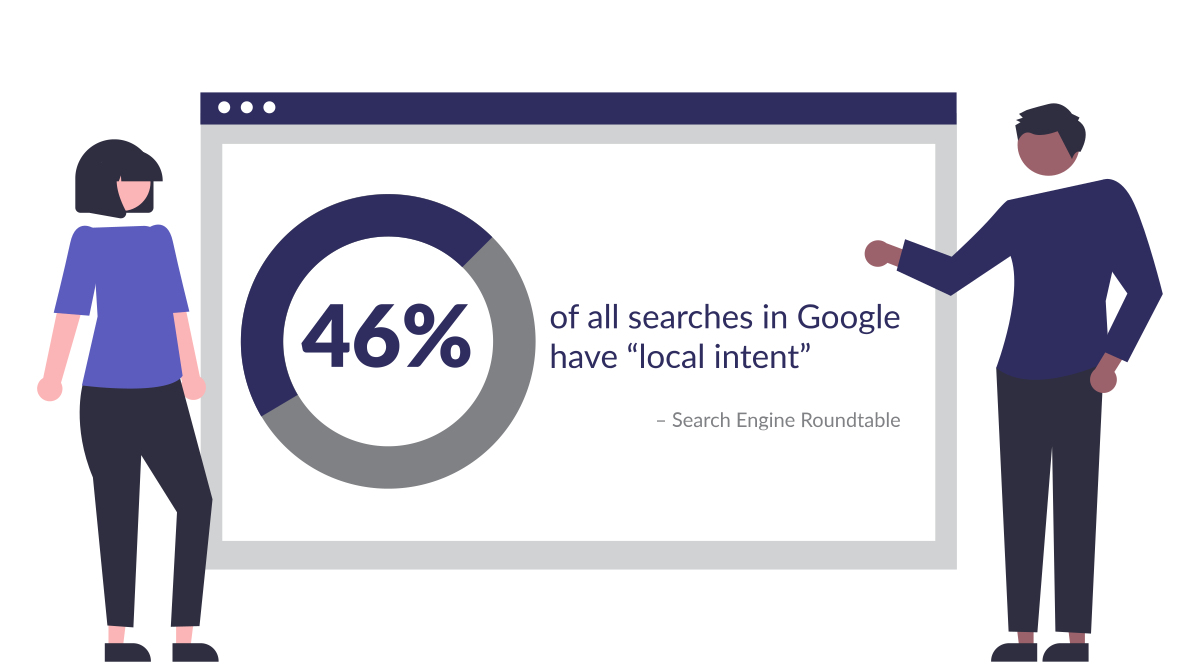
- 46% of all searches in Google have “local intent” (Search Engine Roundtable).
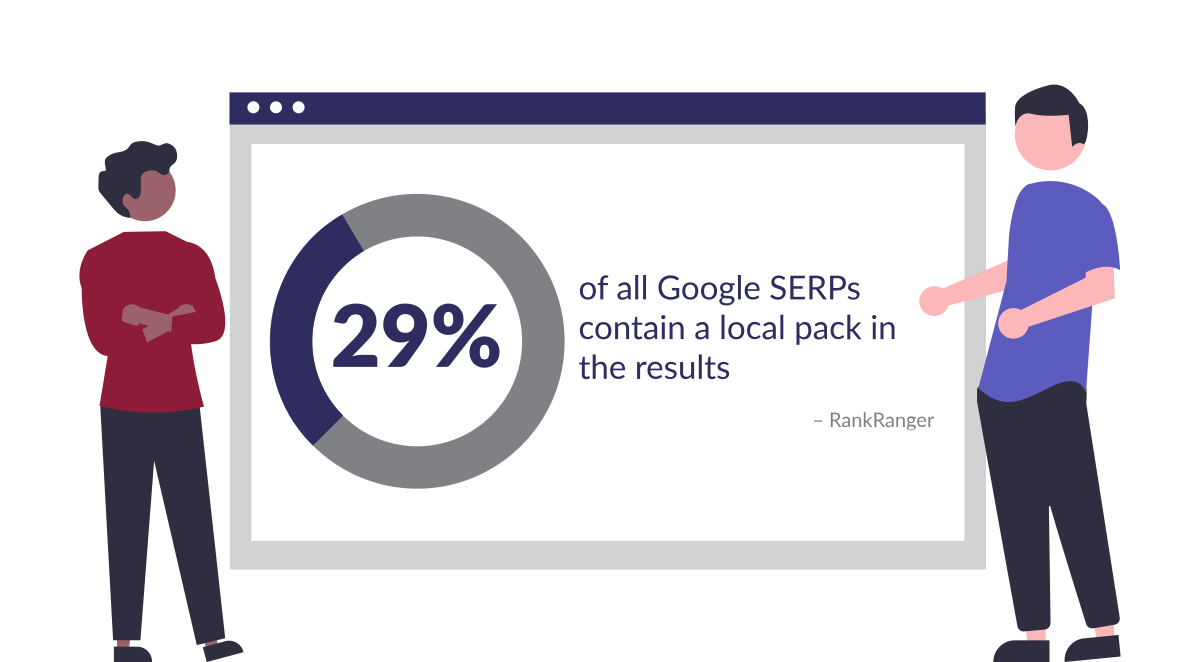
- 29% of all Google SERPs contain a local pack in the results ( RankRanger ).
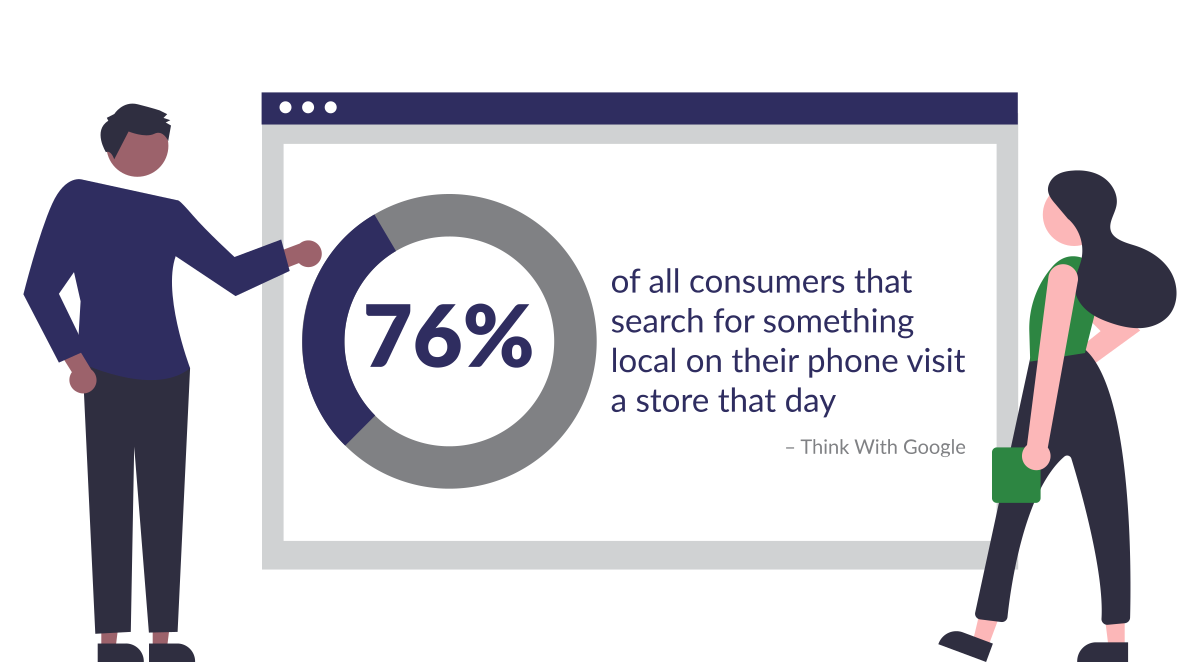
- 76% of consumers that search for something local on their phone visit a store that day (Think With Google).
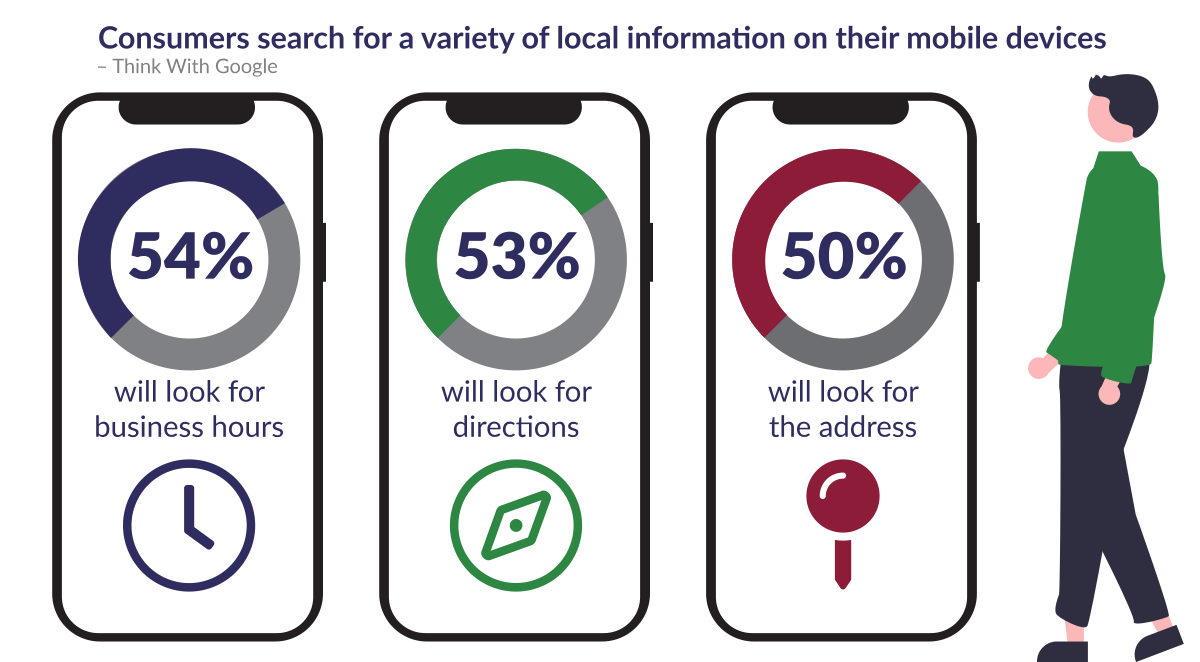
- Consumers search for a variety of local information on their mobile devices. 54% will look for business hours, 53% for directions, and 50% for the address. (Think With Google)
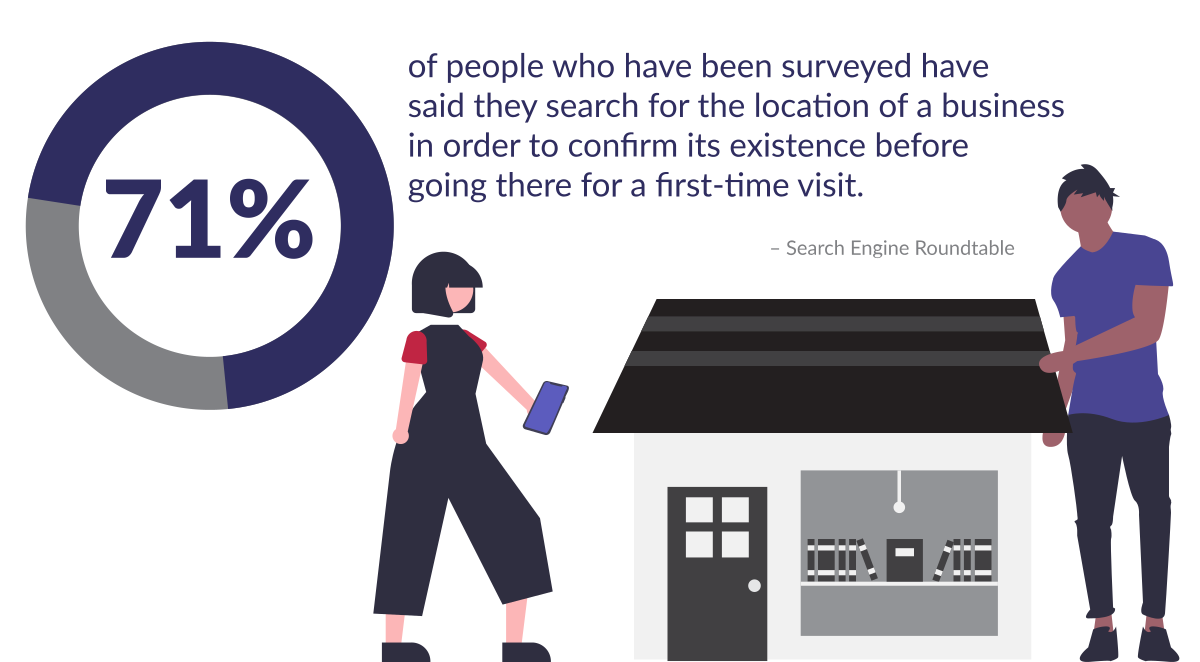
- 71% of people who have been surveyed have said they search for the location of a business in order to confirm its existence before going there for a first-time visit. (Search Engine Roundtable)
5. How does local SEO work?
When you optimize for local searches, you focus on informing Google and the other search engines via the various signals, where your business is located and what you want to be found by your clientele in your area or the area you serve. These days, the general rule is that if you have a proper address in an area/city, it is by far the easiest to optimize.
One of the most essential aspects of your website is the proper local business Schema markup, which will help you communicate to Google that you are a local business and what area(s) you service. Depending on what your site is built on will determine how far down the rabbit hole you need to go in addressing Schema markup. Typically there are plugins that will help you handle this. Aside from technically optimizing your website for local searches, writing for your local audience and mentioning local landmarks and information is also a good idea.
However, ranking for local searches necessitates more than just optimizing your website. One of the first things you should do is to claim and optimize your Google My Business listing and populate it with as much detail as you can. Also, think about making an effort to get industry-relevant and local relationships might be beneficial. Like a good local social media strategy, citations and even print brochures and word-of-mouth can contribute to local SEO.
6. What are local SERPs?
Now that you better understand what local search is, why it is important and how it works, let's focus on the search engine results pages or SERPs.
Local SERPs are the results that show up when a user performs a search with local intent. Depending on what the user is searching for, they will see differing results. However, they will typically look something like this:
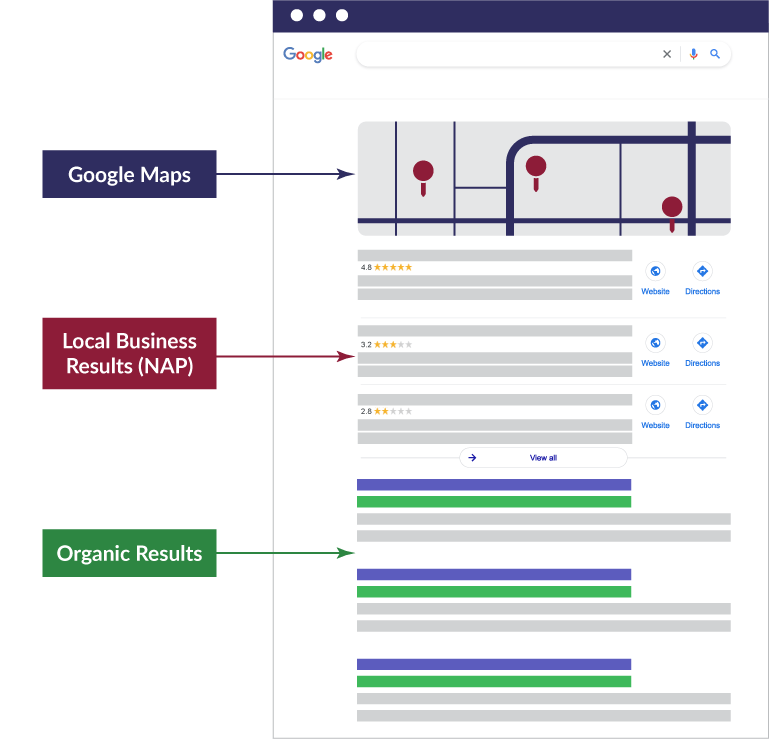
For the majority of results, they will contain the "local map pack," localized organic results, and even rich results. Rich results consist of images, image carousels, videos, answer cards, app packs, 'People Also Ask,' or top stories.
Local map pack vs. organic results
If you own a local small business, then getting in the 'local pack' is critical. You may also hear it called the '3-pack,' or even the 'snack pack.'
Regardless of what you refer to it, this group of three company listings will appear below the map on a Google SERP when there is a local intent behind the search.
Here you can see the local pack that results from the search “plumber statesville.”
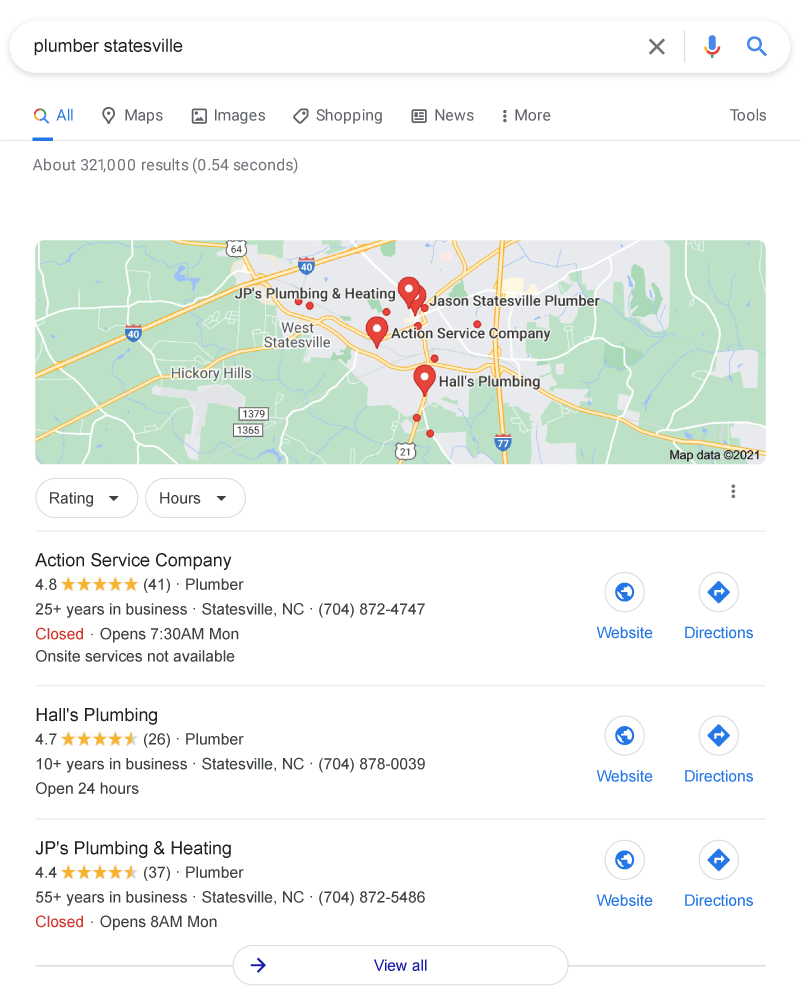
Depending on what device you search from, be it a computer or a mobile device, you will see slightly different results as well.
Regardless of what device, there are some common elements that appear, such as:
- business category
- opening times
- contact information
- review ratings
- website
- directions
Now you may be wondering where all this information comes from? Google is smart, so most of it can come from various sources around the web. However, most is pulled from your Google My Business listing. If you want to learn more about the Google My Business listing, I have two blog posts about it, 20,000 Leagues Under The Sea: A Deep Dive Into Google My Business and Building The Arch: Google My Business Is The Keystone. The 20k goes over step by step what you need to do to claim and optimize your listing, and I highly recommend it if you haven't claimed it already. If you need help, then reach out to us. We will help you claim and optimize it for FREE! (make this a pop up link with GMB module)
7. How does the Google local algorithm work?
We have already learned how the Google algorithm works. When it comes to local searches, it takes it a step further and considers even more factors.
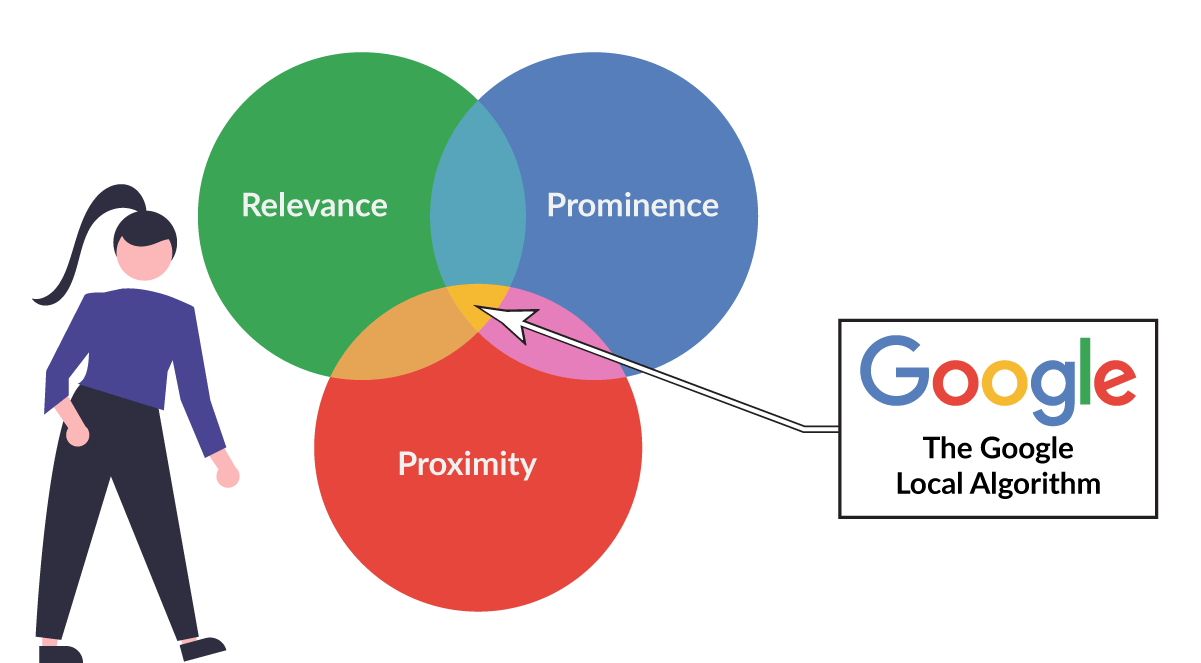
For any local search it relies on three key things:
- Relevance – is the business or businesses being shown appropriate to the search query at hand
- Prominence – is the business or businesses being shown trustworthy
- Proximity – is the business or businesses nearby to the searcher
Relevance
Relevance is a key factor in Google's main algorithm as well as in the local. This is because Google wants to show the most relevant results for what the searcher is looking for, searcher intent. So to ensure that Google and the other search engines consider your business relevant enough to show the user, you have to make sure you're targeting keywords and phrases that your potential clients are searching for.
For example, if you own a cleaning business in Asheville, you want to make sure that Google relates your business to keywords such as “residential cleaning Asheville,” “best residential cleaners;” or maybe even “green home cleaning Asheville,” if that's your USP.
Here are a few tactics you can use to better educate Google on what your business is and about:
- Choose the correct category for your business on directories
- Include your business's keywords in descriptions and in content
- Create relevant content such as blogs, landing pages, and geo-landing pages that help illustrate your business's expertise
- Use title tags and meta descriptions appropriately
- Schema markup
- Get links from local and industry-relevant websites
Prominence
The word prominence is the noun version of the adjective prominent. Merriam-Webster.com defines prominent as "readily noticeable." Therefore think of prominence as how well does your business stand out from your competitors.
To rank on the search engines such as Google, you need to demonstrate trust and expertise. As I said in the opening of this post, it doesn't matter how long you have been in business. If the search engines don't think you are an expert by the online signals, then it doesn't matter. The greater amount of content that exists online about you for Google and other search engines to find, the better off you will be.
Brands with a higher internet visibility appear more legitimate and trustworthy to the local algorithms.
Let's take a look at some crucial methods for increasing and sustaining your small business's prominence:
- Build local links
- Create and share relevant content and articles
- Get listed in relevant and local-focused directories
- Build up more mentions of your business online
- Develop and encourage clients to leave reviews, thus building your review profile
- Be active on social media platforms
- Try to get mentions by local media, schools, or government sites
Proximity
With your small business being relevant and prominent in the eyes of the search engines, we can move into proximity.
Google prefers to show you results as close to you as possible. For searchers in an urban or densely populated area, this is great; it becomes more difficult for those who live in more rural areas. More on that later.
As a result, proximity is often regarded as the most significant local ranking factor. It is also a ranking element that is specific to the local area. While prominence and relevance are important in conventional SEO, you don't need to be nearby to buy online.
A user may do a local search in three ways:
- non-geo-modified
- geo-modified
- 'near me.'
Non-geo-modified Searches
A non-geo-modified search doesn't include the location such as city or town name in the search. For example, “plumbers” or “best plumbers.’

Geo-modified Searches
A geo-modified search does include the location such as city or town name in the search. For example, “plumbers in statesville” is a geo-modified search.

Searches
“Near me” are searches where the user specifies it wants nearby results. For example, “plumbers near me” or “plumbers nearby.”

8. Who Doesn't Benefit from Local SEO?
While we all wish that every business could benefit from local SEO, the truth is that it doesn't work that way. As I alluded to previously, if you are an online business only, then chances to rank locally are much more challenging if non-existent.
9. Who Benefits the Most From Local SEO & Why?
Service Businesses
Today, most Service Businesses have two storefronts to manage. Two, you might say? Yes, your physical storefront and your digital storefront. Local SEO helps make your digital storefront more visible to searchers and, in turn, will gain you more clients, in addition to other advantages such as:
- Driving foot traffic to a brick-and-mortar store
- A boost in traffic to websites
- Increasing the number of phone calls and/or leads
- Building trust, loyalty, and engagement with potential clients
If you own a service business, you can gain a lot from local SEO. Some of these types of businesses may include:
- Hair salons and barbershops
- Automotive repair shops
- Auto Body repair shops
- Medical (Doctors and Dentists)
- Law offices
In other words, if your product or service is done at your physical location but then leaves, you would benefit from local SEO.
Service Area Businesses
Service Area Businesses (SABs) have the most to gain from local SEO. These businesses may include:
- Plumbers
- Homebuilders and remodeling companies
- Handymen
- Fence installation
- Residential and Commercial cleaning
- Pressure Washing
- Landscaping
- Pest control
In other words, if your product or service is done at another location, such as your client's home or business, then you are most likely to benefit from local SEO.
10. Urban versus Rural Local SEO
In terms of minutes versus miles traveled can mean different things to people. For example, traveling a mile in Charlotte, NC, can take significantly longer than traveling a mile in a suburb or rural community. Given the enormous differences in urban traffic, congestion, and proximity of consumers to business, among other factors, travel time is a more universal statistic. It enables for fair comparison of urban, suburban, and rural environments.
This begs the question of what is the definition of a rural area. According to The United States Office of Management and Budget (OMB), an urban area has 50,000 or more inhabitants. On the other hand, Micropolitan statistical areas are somewhere in the range of 10,000 to 50,000 residents. Therefore, it might be easier to think about a rural area as anyone that is outside of the Metropolitan and Micropolitan statistical areas.
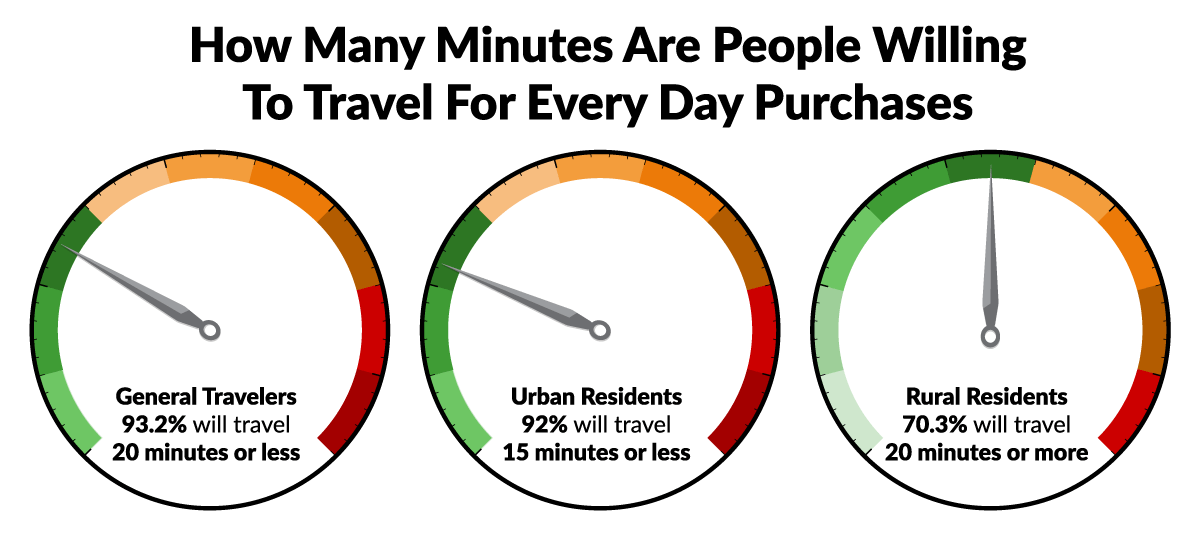
In a report by Access Development, they state that “93.2% of consumers typically travel 20 minutes or less to make their everyday purchases.” They go on to say that "92% of urban and city dwellers will typically travel 15 minutes or less to make their everyday purchases.” For those of us living in a rural area, 70.3% will travel 20 minutes or more to make their everyday purchases.
Think about this, if you live in an urban area, then the above statistics should come as no surprise. You care much more about the proximity factor than your rural counterparts.
For those of us who live in rural areas, we know that driving 20 minutes is nothing! I often joke that I will pass seven churches to go to the one I want to go to, and I will not hesitate to drive 45 minutes to eat at the restaurant my family loves. Therefore it is difficult for Google to accurately show those of us in rural areas the business closest to us simply because we don't fit the mold.
Therefore for those living in a rural area, we have to educate the search engines even more about where we are and what we do. I have found that rural areas need as much if not more content focused on the areas they serve instead of their counterparts.
11. What Are the Key Elements of Local SEO?
In addition to the relevance, prominence, and proximity, there are several other things that can be done to help your local SEO, many of which are derived from "traditional" or organic SEO techniques. These include:
- Keyword research
- Localizing Content
- Link Building
- Web localization
- Optimizing for mobile
- Technical SEO and Improving Site Speed
- Page titles
- Meta descriptions
Keyword Research
When it comes to keyword research, there is very little difference between national and local. The only slight difference may be when it comes to regional or local sayings. For example, you may say "yard sale" or "garage sale" or "rummage sale." They all mean the same thing in context, but different regions might say one over another. Therefore if you are targeting a local area, then be sure to use the keywords that your prospects are using.
Voice Search

In a report by OC&C Strategy Consultants, "55% of households are expected to own smart speaker devices by 2022." These include devices such as Amazon Echo and Google Home. Add in access to smartphones, and the growth of voice search is about to skyrocket.
When you are planning your keywords and keyword phrases, think about local queries based on conversational voice search. According to seoClarity, "Voice search users tend to use specific, long-tail search phrases." They will also 'typically ask proper questions." For example, when looking for a restaurant to eat at, a desktop user might enter "Mexican restaurant." However, when utilizing voice search, users are more likely to ask or say, "Where is the nearest Mexican restaurant?"
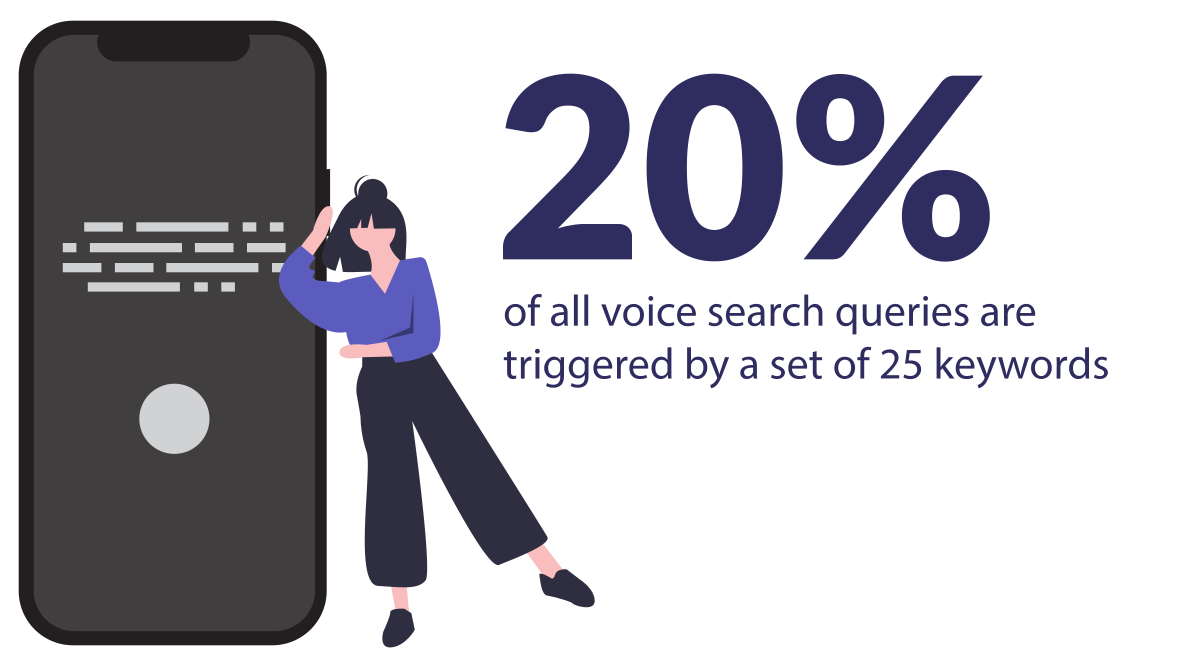
In the same report, seoClarity says that "Nearly 20% of all voice search queries are triggered by a set of 25 keywords. These consist mainly of question words like 'how' or 'what' and adjectives like 'best' or 'easy.'"
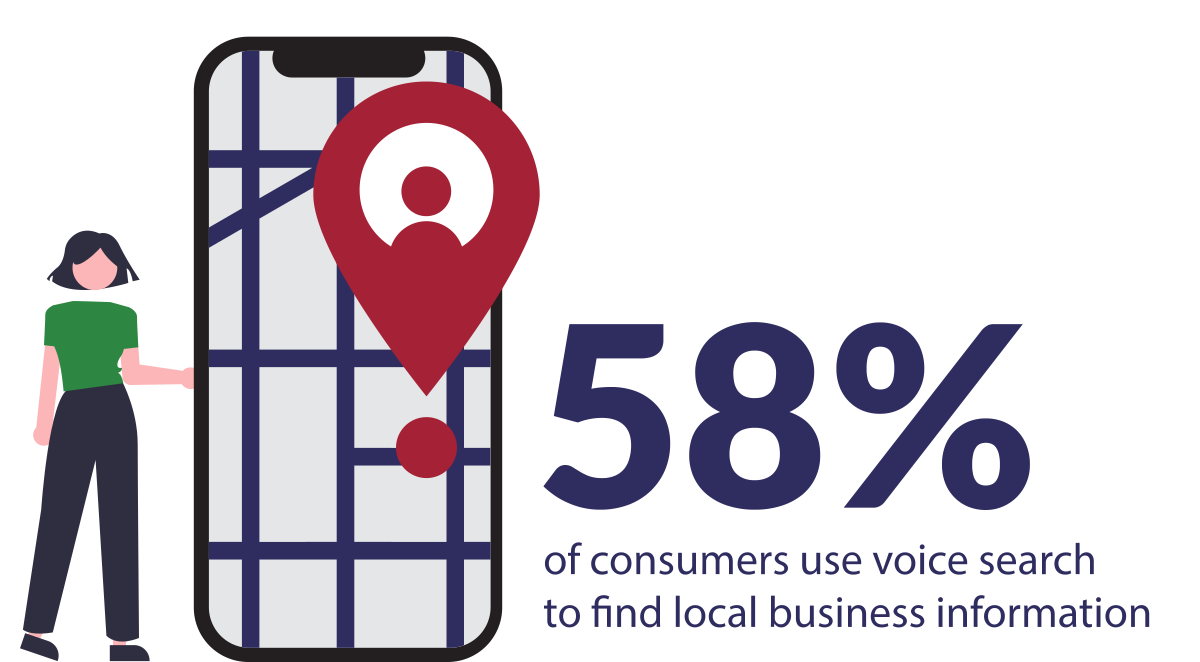
Of the users using voice search, "58% of consumers use voice search to find local business information. Moreover, [they] are often used to research and locate local businesses because of their convenience for on-the-go customers (Source: Search Engine Journal).
While voice search is still coming of age and as the search engines get smarter, voice search will become more and more prominent for local businesses, especially service businesses.
Localizing Content
'Localizing' your website content means including the communities, towns, cities, counties, or regions you serve or pull from naturally throughout the content on your website.
When it comes to generating content for local businesses, there are several options at your disposal. Here are X that we like and have found to work well.
- Helpful content to help tourists and visitors in your area. A strong word of caution, don't treat this as a clickbait type page or blog post. You want to actually add value to the conversation.
- Start a “Meet the Team” series. Have your staff and employees recommend their favorite local restaurants, shops, or favorite places to hang out on the weekends!
- Use your blog to answer questions you have gotten from your clients.
- Create landing pages focused on your keyword research. Include words such as "best"
- Create geographic landing pages that talk about one area you service and one thing you do there. An example might be “residential deep cleaning,” and your location might be "Biltmore Village."
While that is not a comprehensive list, it should help you to show Google that you should be ranking for searches in your local areas.
Link building for Local SEO
Link building is the quintessential part of both organic and local SEO. Unfortunately, it is also the hardest part to do. We all want other people to find and link back to our content. However, the problem is there is so much out there. With that said, here are some tips on building a link strategy for your local SEO.
First and foremost, you have to stick to and follow Google's Webmaster Guidelines when acquiring all links. You don't want Google to take a manual action (i.e., a penalty) as a result of your link acquisition activities.
Google will ultimately discover links that violate any of their guidelines, and then you run the risk of your entire website vanishing from organic search results in the blink of an eye.
Here are a few safe places and ideas to jump-start your local link building strategy:
- Niche business listings that specifically cater to your industry
- Trade associations
- Local Chambers of Commerce
- Suppliers and Distributors
- Businesses you have a working relationship with. An example might be a Plumber, Electrician, and HVAC company.
- Charities your business supports
- Sponsoring the local sports team
- Free online directories
I can't stress enough the importance of following the guidelines. I have seen it happen time and time again. A client will reach out because they have been "called on" about a link exchange or, as Google refers to them, a link scheme. The bottom line with these is if it sounds too good to be true, then it probably is. If in doubt, reach out to your marketing agency or us, and we will help you decide if it's legit.
Optimizing for mobile
If you want to do well in local SEO, you must have a mobile-friendly website – after all, when people search on the move, they do so using their smartphones.
If your site has been developed since 2015, there is a good chance your site is mobile-friendly or has a responsive design. If you don't know, then pull out your phone and check your site for yourself or use Google's Mobile-Friendly Test tool. First off, does your site load on your phone? Is everything showing up? Now a word of caution, just because it loads on your phone doesn't mean it is mobile-friendly. If you have to zoom in to read the text, then it is not mobile-friendly! The other question you need to ask yourself is how fast does it load? Our call to action items (CTAs) or popups hiding vital information? Is it easy to find or see your contact information on your website? Now place yourself in your visitor's mind; if your site has an issue with the aforementioned list, then it's time to make some changes.
Technical SEO and Improving Site Speed
Site Speed
First and foremost, we live in a time when it comes to the internet everything should be fast. Long gone are the days of dial-up where we waited 30 seconds to connect. If a page takes more than about 3-6 seconds to load, users become frustrated and likely to leave.
Google has now incorporated into the search algorithm away "to judge web pages based on how users perceive the experience of interacting with a web page," said Barry Schwartz on Search Engine Land. He also said, "That means if Google thinks your website users will have a poor experience on your pages — measured by a new set of metrics called Core Web Vitals — Google may not rank those pages as highly…").
For the sake of brevity and not to get into the technicalities of it all, if you are concerned about your load time or what you need to improve on, contact us about performing a FREE audit of your website.
Page Title and Title Tags
Depending on the context of your page, you should include your location or location you are targeting, ideally within your H1 tag. Of course, you can also use this strategy in the page titles (what users see in SERPs). But, again, try to keep your titles within 60 characters or less. Anything more, and it might get cut off in the SERPs.
Use Title Tag Cliffhangers
One "trick" you can use is to start your title tag with a powerful, benefit-driven phrase, then check that the statement exceeds Google's title tag limit (currently 500-600 pixels or 50 characters).
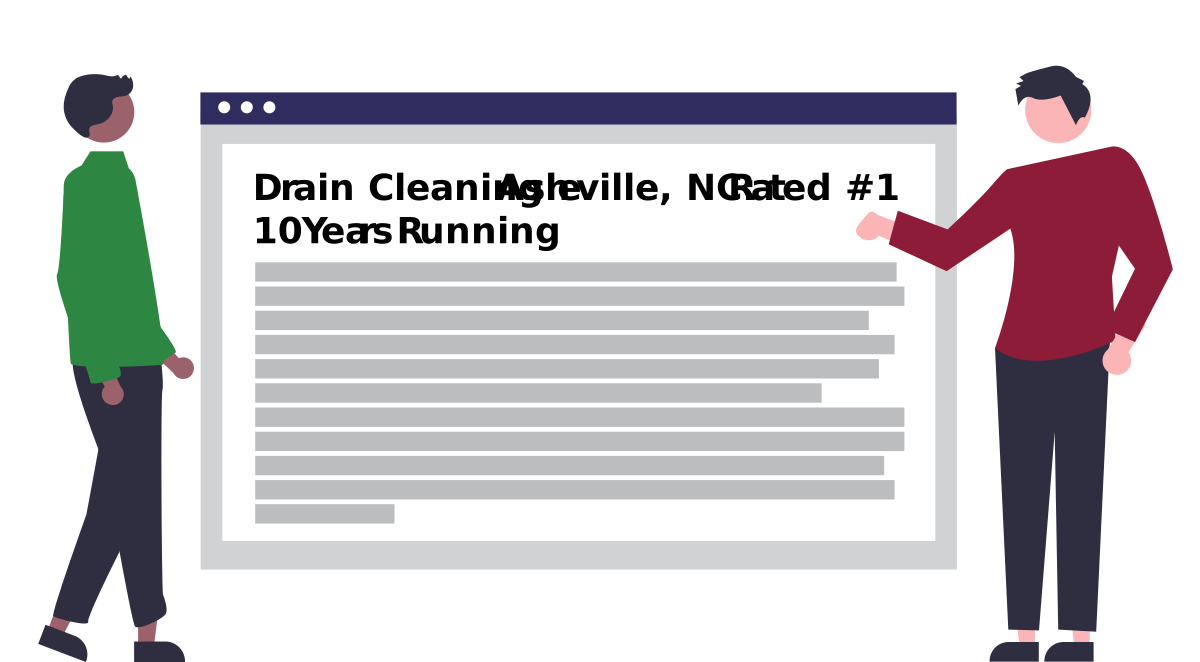

Why this works is there is a psychological effect in play as an ellipse traditionally implies that words are omitted or that something is lacking.
It turns out that the brain has a powerful need to finish what it starts. When it can't complete something, it gets stuck on it. Intrusive thoughts about what we could not finish may pop into our heads as a way to remind the cognitive system that something still needs to be completed.
Stephanie A. Sarkis Ph.D. via Psychology Today
Therefore if you work it right, you can get a significant click-through rate (CTR).
Meta-Descriptions
Think about your meta description as a brief synopsis of your web page. It may also be helpful to think of it as a call to action in approximately 160 characters. These will show below the page title on the SERPs and is what users will skim to help determine if your site might have the answer to what they are looking for.
12. 11 Tips to improve your Local SEO
Up to this point, we have covered a lot about Local SEO. Now it's time to put some of these ideas into an actionable list. Therefore here are eleven things you can do to help improve your local SEO.
1 & 2. Geographic Landing Pages and Blog Content
When it comes to local SEO, you need to ensure that the search engines know where you are and what you do. There are two major ways to accomplish this, those being geographic landing pages and blogging.
If you are a local service area business, then you should spend a bulk of your content plan around geographic landing pages until you have exhausted your top or most profitable services and areas combined. If you are in a rural area, think about doing pages around the counties you serve as well. Just try to keep things within about a 60 mile - 1-hour radius of your physical address, as it can be harder to rank in the extremities.
Also, consider maintaining an active blog as it too will help you boost your results.
Take, for example, Jody's Automotive Repair & Lube Shop. Jody Rushbrook is the owner of the shop in Jonesville, NC. While he is located just off Interstate 77, the area is the definition of a rural community, yet he consistently outranks others in the area for the services he offers. In addition, his GMB analytics are statistically consistent with national averages. How does this happen? For one, we consistently post on his blog and create geographic landing pages with topics related to the services he offers. This, in turn, bolsters his GMB listing. Let me also be clear that Jody is an excellent mechanic and has a great reputation in the area as well. However, reputation will only get you so far. He has several physical cards lining his counter and countless reviews praising him for helping traveling motorists. Therefore this begs the question, would this be possible without this?
3. Claim, optimize, and use your GMB listing to your advantage
Looking back at the example of Jody's, his GMB is both optimized, and we post there weekly. I have said it before that your GMB listing is the keystone to everything and is the digital front door to your online presence. The best part about your GMB is it is FREE!
4. Photos on Google My Business Page
Photos will give legitimacy to your small business and act as a local ranking signal. Therefore, take pictures of your business, action shots of your services, your employees, and even your clients (with permission, of course).
5. Keep mobile in mind
Let's face it, smartphones are a part of our everyday lives. I saw this when my dad moved from a flip phone to an iPhone. Therefore, it's only logical that people use them to look for local information and businesses. Uberall commissioned a study that discovered that 82% of respondents had used their mobile devices to do a "near me" search. This proves without a doubt how frequently individuals use their phones for local searches.
6. Collect plenty of customer reviews
According to a Moz study, review signals also play a critical role in your local search and the 3-pack ranking. Having a lot of reviews, particularly positive ones, will work wonders to boost and increase your visibility in local search. It will also help you to enhance your reputation.
You will want to concentrate your efforts on places where Google would expect businesses like yours to have reviews. As a result, it will collect reviews from social media such as Facebook, directories, and in addition to your website and your own GMB listing. That means you should concentrate on gathering and monitoring reviews across the web. Also, remember that reviews are a converter, not just a ranking factor!
Positive Reviews
When it comes to getting positive reviews, Google says,
Respond to reviews that users leave about your business. When you reply to reviews, it shows that you value your customers and their feedback. High-quality, positive reviews from your customers can improve your business visibility and increase the likelihood that a shopper will visit your location.
Reviews that mention Location(s) and Keywords
According to a Local SEO Guide research, the wording used by reviews is important. For example, when reviews include the city or keywords, Google receives indications that you are a trusted and reliable local business.
Reviews with Responses Count Too
According to the same Local SEO Guide research, the quantity of reviews with a response also influenced Local SEO signals. So, in a double whammy, the quantity of positive reviews with comments is important, but so are bad reviews with no responses.
These final three indicators make it apparent that you must have a strategy in place for responding to any online reviews, but especially those from Google.
Word of Caution
Keep in mind that asking for reviews in return for something or setting up review stations is against Google's review policy. All of their review policies may be seen here. Similar rules apply to Yelp and other review sites.
7. Ensure NAP/citation consistency
Moz discovered that citation signals such as citation volume and name, address, phone number (NAP) consistency are taken into account by Google for local search results. This implies that your information should be available on key reference websites, such as Bing Maps, Yelp, and Facebook, in addition to GMB. Concentrate on directories with larger domain authority rather than lesser listed directories.
More importantly, ensure that your business's NAP is consistent across all platforms and websites. Look for misspellings, address and phone number inconsistencies, and duplicate listings to enhance your local SEO.
8. Create a Facebook Business Page
Because so many people use Facebook as a search engine, it has its own number in this list. So, in addition to your GMB listing, you will want to create or claim one on Facebook. Be sure to keep it up to date with your website, hours, and a description. Just don’t let your Facebook page be your website.
It should be noted that social signals have a limited influence. However, Google does say that they do have an impact on social SEO.
When people search for your business on Google, they may see links to your business's social profiles included with your other business information in the knowledge panel in Search. Google gathers business information from a variety of sources and may include it to give customers a more detailed overview of your business.
Source: Google Support
9. Participate in your local community.
The more you become involved in your community, the more digital PR you'll get. For example, having a volunteer day at your business, allowing your staff a day to volunteer, sponsoring an event, or appearing in the local media as an authority in your field are all methods to garner press, brand recognition, and inbound links.
10. Embed a Google Map on Your About Us and/or Contact Page
Embedding a Google map on your site simple way to signal to Google that you're located in a specific area. If you are a service area business, then embedding one showing the area you serve can also be helpful.
11. Optimize Meta Descriptions for Local Searchers
It's no secret that optimizing your meta description is a great way to boost your organic CTR. But, unfortunately, many small businesses either don't optimize them, or they try to stuff their phone number and the city they service. The bottom line is that this doesn't help the searcher or the business.
Instead, try this formula:
- Have [problem] We can help!
- We are [company type] based in [area] who [what your do]. Click here to learn more.
One thing you can do is to use Google Ads to find appealing descriptions, keywords, and keyword phrases. After all, this text has been shown to get clicks (otherwise, they would not use it in their advertisements). You can't go wrong by including part of their material into your description.
13. Conclusion
While we have covered a lot in this post, this honestly just scratches the surface of Local SEO. If you are looking for help with your local SEO, please contact us for a free consultation!
14. Additional Resources
If you are looking for more information on Local SEO, I highly recommend the following sources:
- Search Engine Journal: What Is Local SEO & Why Local Search Is Important
- Bright Local: What Is Local SEO? The Complete Guide to Local Search
- Ahrefs: Local SEO: A Simple (But Complete) Guide
- HubSpot: A Comprehensive Guide to Local SEO in 2021
- Backlinko: Local SEO: The Definitive Guide (2021)
Written By: Chad J. Treadway | August 16, 2021
Chad is our Chief Smarketing Officer. He will help you survey your small business needs, educating you on your options before suggesting any solution. Chad is passionate about rural marketing in the United States and North Carolina. He also has several certifications through HubSpot to better assist you with your internet and inbound marketing.

The first thing that should come to mind in marketing your private school is higher-quality learning, followed by a high-quality social environment. If those two have been established, the next thing to do is build an audience.
Here are eight techniques you can tap to market your school. Make sure to consult a school marketing specialist to help you out. Your consultant will work with you on the following:
- Building a Facebook community
- Improving your website
- SEO – Improving your organic visibility
- Using Google Adwords to drive search traffic
- Engaging with students and alumni via LinkedIn
- Communicating through email newsletters
- Learning from competitors
Written By: Adam Bennett | August 12, 2021
Adam is the president and founder of Cube Creative Design and specializes in private school marketing. Since starting the business in 2005, he has created individual relationships with clients in Western North Carolina and across the United States. He places great value on the needs, expectations, and goals of the client.

Let’s face it, as a small business owner; it can be a challenge to develop a marketing plan, let alone a digital marketing plan. How do you know if your plan is as thorough and effective as it could be?
To alleviate some of that anxiety, we've produced this guide to help you the small business. It will walk you through the process of developing a marketing plan that leaves no stone untouched.
Let's take a look at the five most important components of a complete marketing plan for 2022.
Written By: Chad J. Treadway | August 10, 2021
Chad is our Chief Smarketing Officer. He will help you survey your small business needs, educating you on your options before suggesting any solution. Chad is passionate about rural marketing in the United States and North Carolina. He also has several certifications through HubSpot to better assist you with your internet and inbound marketing.

Most home builders and remodelers pay very little attention to content when it comes to marketing their business through a website, blog, e-book, or any other online platform. It is probably because we have a common perception that good content is all about having a good design to attract more audiences. Although a good design and a picture gallery are essential for marketing the business of home building and remodeling. Did you know that you also need good content to rank higher in search engine results?
Content Marketing for home builders and remodelers is a tricky task as your field is highly technical and requires knowledge of engineering, architecture, design, and other technical specialties. Due to the inherent technical nature of your field, it becomes difficult to market your content as your target audience may not necessarily have all that technical knowledge. This blog will talk about the lessons we have learned that can make your marketing content attractive enough to help you get more homeowners.
Written By: Chad J. Treadway | August 03, 2021
Chad is our Chief Smarketing Officer. He will help you survey your small business needs, educating you on your options before suggesting any solution. Chad is passionate about rural marketing in the United States and North Carolina. He also has several certifications through HubSpot to better assist you with your internet and inbound marketing.

No one wants their website hacked. As web developers and website hosts, we do our best to prevent it from happening. However, it seems inevitable that hackers will strike, and even government is not immune. No matter the size of your business, you need to be risk-averse and have a risk management plan in place so that if and when it happens, you are ready to get the website working again as soon as possible.
Written By: Chad J. Treadway | July 26, 2021
Chad is our Chief Smarketing Officer. He will help you survey your small business needs, educating you on your options before suggesting any solution. Chad is passionate about rural marketing in the United States and North Carolina. He also has several certifications through HubSpot to better assist you with your internet and inbound marketing.

Chances are you have heard the phrase “content is king.” It makes perfect sense: people want information before making decisions or forming opinions. So, where does this content originate? What happens if you’re not a writer or particularly good at marketing? What happens when your audience tunes you out?
Larger companies may have the resources to invest in an in-house content creator(s). Smaller businesses typically don’t have the resources to bring on an extra person. Regardless of whether you have the staffing to create your own branded content, a content bottleneck prevents content from getting to clients as fast as you’d like. The top five content bottlenecks we typically hear are, I don’t know how, a lack of time, an inability to produce enough, an inability to produce the right kind of content, or a lack of budget.
Written By: Adam Bennett | July 22, 2021
Adam is the president and founder of Cube Creative Design and specializes in private school marketing. Since starting the business in 2005, he has created individual relationships with clients in Western North Carolina and across the United States. He places great value on the needs, expectations, and goals of the client.

Recently we had a couple of clients who wanted to move their services to another vendor. This may not seem like a big deal, but moving your website or performing a website migration can be a bigger task than one might think. This is especially true if you have engaged in any type of content marketing. In this post, I want to provide you with four examples of clients who moved, the mistakes they made, and how they could have been remedied and provide you with a checklist of what you should do and look out for if you want to move your website and marketing efforts to another agency.
What not to do when moving services
Here are four examples where the former clients made some big mistakes when they moved their services.

Example 1: I am scared of a recession
At the start of the COVID-19 pandemic, we worked with a client who was an interior designer. They were about four months into our content marketing efforts, and we were starting to see traction. However, they decided to pull out for fear of a pending recession and because they thought people wouldn’t want them in their homes. I even told them, “Why would you want to stop now, as we are going into lockdown? People will be staring at four walls, and there will be pent-up demand once things open back up.” Of course, they could only see the money going out and not seeing the gains they could have made if they had stayed in. Instead of transferring the site that was already built and optimized, this client had a new site built and didnt’ bring over any content that was already created and designed to start ranking.
Example 2: I have a friend who is going to do Google Ads and take over the website
In this instance, we were told by this 12-year client, who we recently increased services for and was seeing great success in increased traffic, that they were going to move to their “friend” and “spend *expletive* amount of money on Google PPC Ads.” Over the next few months, we discovered that they had a major falling out with the “friend.” By that time, we had already transferred the domain away to the friend and shut down our site that had over six years of optimized content bringing in a fair amount of traffic each month.
Flash forward six months, they recovered the domain after months of work, and they have a “new site,” that was an incomplete copy of the site we had built from a copy at the Internet Archive. The new vendor didn’t bring over any of the optimized content that was created specifically for the client and now Internet traffic to the site, that was down for over 5 months, must start from scratch.

Example 3: I need to save money, so I am moving services
This client recently moved to the area and set up a new business, and hired us to design, develop and perform content marketing services for them. When they contacted us to tell us they were leaving; they said it was a cost factor. I understand cost can be an issue for some clients. However, if they had contacted us before hiring another vendor, we could have gladly worked with them to review goals and suggest service changes to meet their budget, while still being successful online. Instead, this client’s new vendor didn’t bring over any content created for them that was building rank in the search engines, and started essentially from scratch with Internet rankings.

Example 4: I go to church with this guy who is going to do the website
By now, you probably see a pattern in my examples. Therefore I won’t go into the details. But this example has a twist; as this client came back, we restored their original site (as we keep a backup of all the files, just call us digital packrats). And I am happy to report they are seeing significant gains in their business to the point they have had to hire more staff to handle all the work that has come in.
The common thread
There are two common threads between all the examples mentioned.
The site was recreated from scratch, or the design was copied. Now we have no problem with another vendor copying the design, as it is your site, and it follows your business’s branding. In each example, the issue is the new vendor didn’t do their due diligence in performing a proper website migration. They all have failed to move most of the content on the site. At best, they might have moved the top pages. However, we have monitored these sites, and none of the blogs, landing pages, or geographic landing pages have reappeared. Therefore all the gains we had made for them are sense long gone.
Think about this - in the first three examples, clients invested several thousands of dollars over several years, and now they have nothing to show for it. I am reminded of the words spoken by the Grail Knight in Indiana Jones and the Last Crusade, of which he said, “He chose... poorly.” All three made poor business decisions and essentially rented the content. Now I have often said, “don’t build your business on rented land,” which is essentially what the business in the first three examples did; they chose to rent versus buy now have nothing to show for it. Obviously, I have a vested interest in keeping the client.
However, if I am objective, I feel like it was a poor business decision not to have a conversation with us, or if you are considering moving, not to have a conversation with your current agency about costs if that is the real issue. When someone talks to me about cost, I am often reminded of the phrase attributed to by inventor, patriot, and founding father of the United States, Benjamin Franklin. That phrase is:
“The bitterness of poor quality remains long after the sweetness of low price is forgotten.”
With that being said, let’s look at what to do if you want to move forward with a website migration.

Website Migration Checklist
Website migration is one of those time-consuming tasks that might help your site in the long run, but it may also go horribly wrong. Failure to move content, improper redirects, sitemap issues, problems with robots.txt files, and even broken internal links and images can wreak havoc and cause a significant drop in organic search traffic.
Use this list to double-check how to do a proper migration.
1. Take an inventory of your current site
The first thing you will want to do is take an inventory of the current site. While this can be time-consuming, some tools can help build a visual sitemap for you. SEM Rush has a round-up of the 10 of the Best XML Sitemap Generator Tools. I would also suggest doing a page-by-page inventory and using Google Sheets to help you organize it.
2. Check for Non-indexable content
I have heard of this happening. A business wants to move from one agency to another. The current employed agency hands over the site but has set it to no-index and no-follow. Now what they have done is turned off your site to Google and all the other search engines. If this has happened, your search traffic will drop like a rock!
3. Check existing pages are moved
If you are moving content management systems, then often times you may have to move each page by hand. While this is a laborious process, it is necessary and something that a good agency should do. This should include blogs, landing pages, geographic landing pages, and any other pages identified in the inventory.
4. Check page redirects
Page redirects are very much what they sound like. If a site has been around for a few years, chances are there will be internal links and external sites linking to pages and content. If a site has been moved, all-new pages are created, you must ensure that all the old pages redirect to the current one if the URL has changed. We will often see this happen with sites where the menu is restructured, pages combined or removed.
5. How are you handling email
Let’s face it email vital to a business these days. One of the biggest challenges you may face when moving your website is email. Suppose you are using a cloud-based email provider such as Google Workspace, formerly known as Google Apps for Business, Google Apps for Work, G Suite, or the artist formally known as G-Sw33t (ok, I confess I made the last one up), or Office 365. In that case, you don’t have to worry about it much. However, if you are using email addresses hosted on your web server, then moving hosts and moving your website just got a lot harder. Most agencies know what to do and can help you with it.
One side note, if you are using a consumer-based email service such a G-mail or Yahoo, you are fine as well. If you are using an AOL address or an email address provided by your internet service provider, you may want to consider another option. We can help you with that as we are a Google Workspace Reseller.
6. What other assets are on your website
Most small businesses don’t realize what all is on their website and what isn’t. In most cases, this happens with videos as they are not hosted on your website. It is much more efficient to load them from a third-party website such as Vimeo or YouTube. At Cube Creative Design, we much prefer Vimeo to host video for a variety of reasons. If you are moving your website, you will need to make sure that you have a copy of those videos as the agency you are moving from may remove access or delete your videos once the switch is made.
Other items we often see not being moved are pdf documents and downloadable files. These can be a little harder to track down, but there again, it all goes back to the site inventory.
7. Other items and accounts
When moving agencies, you will also want to take an inventory of your social media accounts, Google My Business, Google Analytics, Google Ads, Facebook Ads, and accounts, usernames, and passwords of any other software integrated into your marketing efforts. Make sure that you have ownership of them, and you can add your new agency while removing or revoking access to the old one.
Final thoughts
When Cube Creative Design started in 2005, moving your website from one agency to another was a much simpler process. As time went on sites, have gotten more complicated, asked to do much more than just be an online version of your brochure. They have since become an integral part of many small businesses and may be your biggest marketing effort. If you are considering moving agencies, I implore you to be cautious and consider all your options. Have a conversation with your current agency about what you want to do and where you want your business to go to ensure you are both on the same page.
Now, if you are looking to move your website and marketing efforts to an agency that thrives on helping small businesses grow, then reach out to us for a free consultation. We will be happy to discuss your options and see if moving is the best option for you and your business.
Written By: Chad J. Treadway | July 20, 2021
Chad is our Chief Smarketing Officer. He will help you survey your small business needs, educating you on your options before suggesting any solution. Chad is passionate about rural marketing in the United States and North Carolina. He also has several certifications through HubSpot to better assist you with your internet and inbound marketing.