The primary purpose of your small business website is to attract the right customers and motivate them to take action. The call to action might be to contact you, find out more about you and your offerings, or referring others to the business. A mere entertaining site is simply noise and is no real value, ahem social media sites. Your website needs to work just as hard for you as you do; consider the following suggestions:
Define your buyer persona
A buyer persona is just a semi-fictional representation of your ideal customer base. This is based on your market research and real data about your existing customers. This will help you in not only identifying the target audience for your website, ads, or social media, but it can also help identify who are ideal people for your sales team to go after.
Make your content skimmable
News flash, searchers will not read all your copy. Crazy, I know! I bet you are skimming this right now, which just proves my point. You need to make it easy for people to scan or skim your content. Numbered and bulleted lists will help people digest your content. Add a few well-placed headlines, and you are well on your way to building a great page.
Be clear and succinct
You need to make it crystal clear what you do and even what you don’t do. A little transparency can go along way in actually building your credibility. Make sure you also describe the characteristics, parameters, or capabilities of what you can do.
I don’t want to use a GPS on your site
Your website should be easy to navigate and find the information people need. Nothing is worse than coming to a site and not finding the information you are looking for. Unless it is a landing page where you only want them to focus on the one call to action, make sure your navigation is prominent. I often tell clients that you won’t want to switch the gas and the brake on your car, what would you want to change where your navigation is?
Social Proof
Searchers want and need reviews and/or references in the form of social proof. It comes in many forms.
Here are a few impressive statistics about social proof:
- According to Voices.com, placing the logos of business customers on a company website can increase conversions by as much as 400%. I also refer to this as the NASCAR section.
- The average consumer reads ten online reviews before making a purchase decision.
- 57% of consumers will only buy or use a business service if it has at least a 4-star rating.
- 88% of consumers trust user reviews as much as personal recommendations.
Don’t Ghost Your Prospects
While ghosts may be ok at Haloween or a graveyard, the bottom line is they have no business being around your website. Just as they shouldn’t be around your website, you shouldn’t ghost a prospect. Be sure to promptly answer all inquiries and/or respond immediately with automated e-mails stating when you will follow up.
Keep The Vegas Strip In Vegas
The goal of your site is to attract prospects. If you have too much flash, sound, and fury, then you will alienate them before you even have a chance to convert them. While it might be nice to win a design award, that might not mean you win over visitors. Often less is more.
Too much detail
I will admit, I am passionate about what I do, and I tend to over-explain things. I have realized that, just like the design, less is often more. The 3,000-word blog post with 50 images may say what you need to say, but what will your prospect say about it? Will they wait for all the images to load? Can they find what they are looking for? Or would it be better to trim the fat and the number of images to better convey the message? Hint, its the latter!
It’s Not Hide And Seek
In other words, don’t hide the essential information from searchers. Make sure you present information in order of its importance. Make things clear and concise.
Your small business website can be your single best sales tool if you let it. You simply have to give it the attention it deserves.

Written By: Adam Bennett | October 09, 2020
Adam is the president and founder of Cube Creative Design and specializes in private school marketing. Since starting the business in 2005, he has created individual relationships with clients in Western North Carolina and across the United States. He places great value on the needs, expectations, and goals of the client.
I have a couple of confessions to make; I used to hate reading! I would often read the Cliff Notes versions if one was available. In college, I would do my best to skim what I had to read and fake my way through the discussion. In hindsight, not the best decision, but I passed, right? However, as I have gotten older, I have forced myself to read more. My thoughts are I already have a master’s degree, reading sales and marketing books is cheaper than an MBA, less time-consuming, and I don’t have to do accounting classes! I am happy to report as of writing this, I have read 14 books just this year.
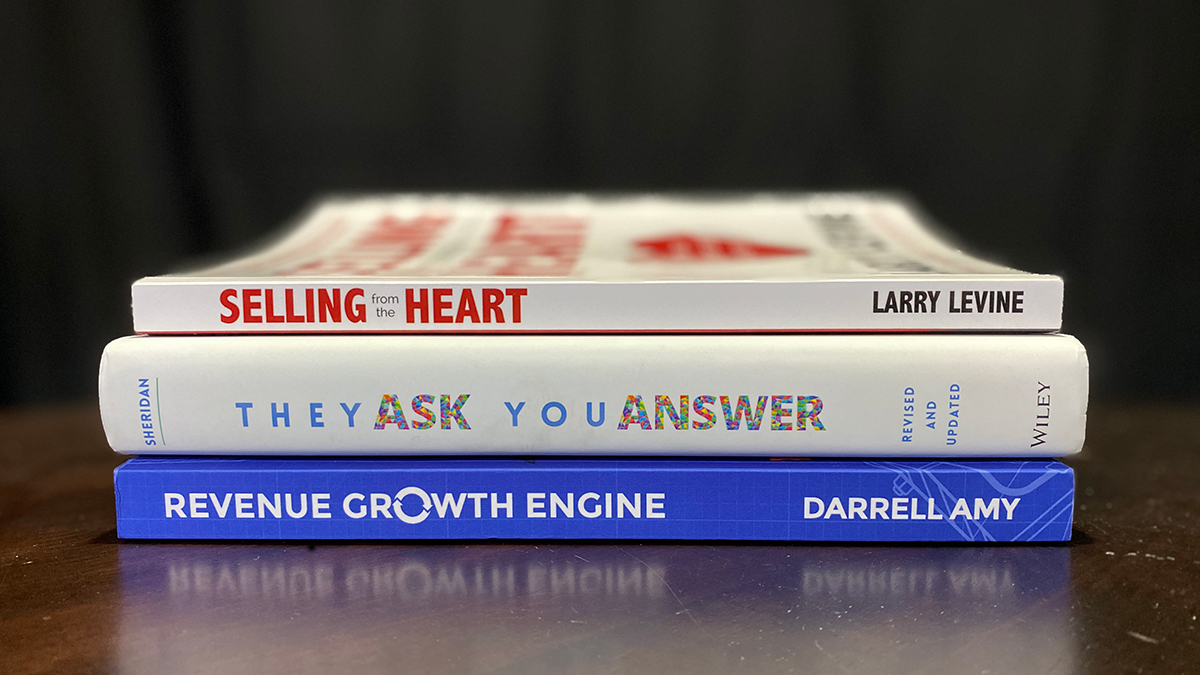
Some have been short, some have been longer. Some I struggled to get through, a few I could take or leave, while others really spoke to me. Of all that I have read in the past few years, there are three maybe four that I think every entrepreneur and small business owner needs to read. I call it the sales and marketing trifecta. Without further ado, here is the order I think you should read them.
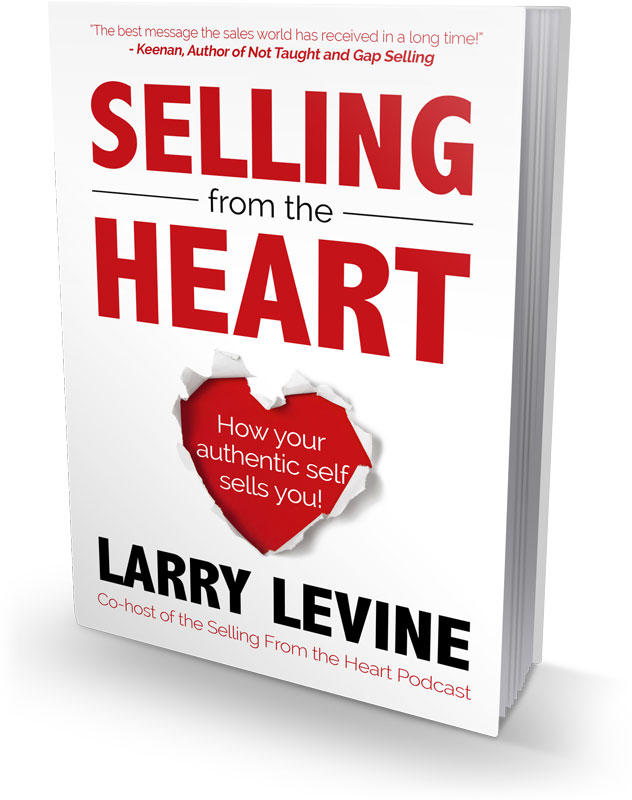
1. Selling From The Heart by Larry Levine
If you are unfamiliar with Larry, he was a copier salesman in LA and really built strong relationships with his clients. I first learned about him through a couple of podcasts and started following him on LinkedIn. When he started up his podcast, I started listening to it, and I still listen to it weekly. When I heard the “Selling From The Heart: How Your Authentic Self Sells You!” came out, I ordered a copy and put it in the reading queue.
Larry exudes what a good salesperson should be. He often says, don’t be “an empty suit.” What that means is you need to be authentic and genuine, don’t walk in with the sole purpose of making a sale, or as he says, “having commission breath.” Ultimately you want to come to a place where you want to help clients, or in other words, “sell from the heart.” To do this, you have to build relationships with clients, be it in person, over video, or on social. Larry says you have to build relationships before you can sell someone. Your clients need to make sure that they know who you are, and you know who they are.
You don’t want to be the person who walks through the door once a year at renewal or just at the holidays who is dropping off the tin of cookies. Even worst, they think that you are there just there to sell them something.
What I took away and what I try to do with my clients is that I want to know you by name. I want to know about your family. If you see me in the grocery store, I want you to come up and speak to me, and I want to feel like I can do the same thing. Not like, "Oh God, there's that Chad guy. He's going to try to sell me something here in the middle of Walmart."
2. They Ask, You Answer by Marcus Sheridan
“They Ask, You Answer: A Revolutionary Approach to Inbound Sales, Content Marketing, and Today's Digital Consumer” (TAYA) has to be one of the books that changed my thought process and outlook on what I do. If you have been around me longer than 10 minutes and the subject of content marketing or what I do, you will probably hear me reference it.
To me, the book is one of the best marketing books out! If you do any kind of research or a poll on social, you might see Seth Godin’s “Purple Cow” pop up as a must-read. I have read both TAYA and “Purple Cow.” However, having read TAYA, I would read a passage and be like, ok, this is the TAYA concept. I am thankful that I had checked the book out from the local library while it was on order. Needless to say, I shipped the book back because I didn’t care for it. Now I don’t mean to discount “Purple Cow.” What Seth Godin says may resonate with you. However, I have deep blue-collar roots. While Marcus has risen to be an influential figure in the sales and marketing world, he is still a pool guy, so he says!
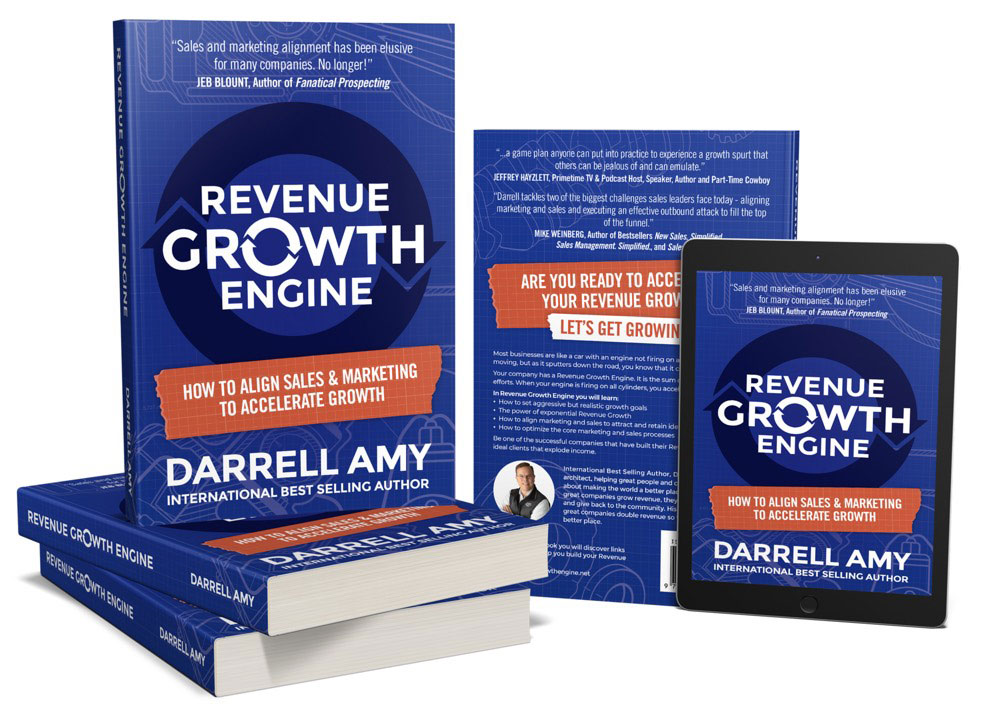
3. Revenue Growth Engine by Darrell Amy
The third book in my trifecta is “Revenue Growth Engine: How To Align Sales & Marketing To Accelerate Growth.” Darrell co-hosts with Larry on the Selling From The Heart Podcast. I like Darrell’s book because it is a culmination of the two previous books I mentioned.
The bottom line is that “Revenue Growth Engine” gives you a good summary and consolidation of “Selling From The Heart,” and “They Ask, You Answer” with a healthy dose of how to bring it all together to really get a good return on your investment which will help a business grow.
Bonus: Start With Why by Simon Sinek
“Start with Why: How Great Leaders Inspire Everyone to Take Action” by Simon Sinek has completely changed my mindset on how I approach a prospect. I have always felt like I had a “givers gain” or pay it forward mindset because I don't want to just sell anybody my services. The book helped me clarify my mission and it has helped Cube Creative solidify the company as a whole. I can proudly now say that I help small businesses grow by helping them to build and manage their online presence. I even start conversations with prospects by asking if they want to grow their business, why they exist, and why they do what they do.
Essentially if you're starting a business or thinking about starting a business, you need to read “Start With Why” so so that you can ultimately decern and know why you want to do what you do. If you're struggling in your career or in a company where you feel like you're struggling, you should also give it a read.
Final Thoughts
Depending on your role or background I would recommend starting with “Selling From The Heart,” then “They Ask, You Answer.” If you are short on time, then you should read “Revenue Growth Engine.” However, I think you will get more out of it by reading it last as it will help tie in the key aspects and topics that you may not realize when you read the others.

Written By: Chad J. Treadway | September 22, 2020
Chad is a Partner and our Chief Smarketing Officer. He will help you survey your small business needs, educating you on your options before suggesting any solution. Chad is passionate about rural marketing in the United States and North Carolina. He also has several certifications through HubSpot to better assist you with your internet and inbound marketing.
On the surface, Google My Business (GMB) is a FREE tool from Google that helps businesses manage their online presence on the search engine results page and maps. It is the vessel that allows the local search to be more accurate. The only stipulation is that you must meet people in person. In other words, you can’t operate 100% online.
For example, if you chartered Nautilus trips, you could have a Google My Business listing, however, if you just sell seashells online, it's a no go.
Before we dive too much into GMB, let's look at how people search.
Written By: Chad J. Treadway | July 28, 2020
Chad is a Partner and our Chief Smarketing Officer. He will help you survey your small business needs, educating you on your options before suggesting any solution. Chad is passionate about rural marketing in the United States and North Carolina. He also has several certifications through HubSpot to better assist you with your internet and inbound marketing.

It’s a competitive market for today’s small business owners. You aren’t only competing against other small business owners but depending on your area you might also be competing with larger companies and franchise operations. But there is good news, much like a David and Goliath, being smaller and also help make you more nimble allowing you to act quicker. If you know how and what information to monitor, your business can be as successful as any.
Here are seven tips for helping your small business save time and money and making your business more profitable.
1. To sell right, you have to buy right
One way small businesses can compete is by being competitive with your prices of physical products. The best way to do that is to buy competitively. Try to buy factory direct where possible, attend wholesale auctions, and consider establishing a buying co-op with other small but noncompeting businesses.
2. Cost: It’s everyone's concern
Make every attempt to help motivate your staff to be mindful of costs and the net profit. The goal being they are as concerned with controlling costs as with generating sales. One way you could encourage participation would be to implement a bonus program based on a percentage of costs saved.
3. Treat your customers right and they'll keep coming back.
Ben Franklin is credited with saying that “The bitterness of poor quality remains long after the sweetness of low price is forgotten.” This goes along with your customer service. While watching the cost is a factor, you don’t want to sacrifice your quality or customer service to do it.
4. Build a network and be mentored
Finding a good mentor be it someone local, regional, or thousands of miles away, will help you navigate the journey of business ownership. Build out a network of professionals in your industry you will find out what others are doing to manage problems with inventory, receivables, personnel, fixed assets, technology, marketing, etc.
5. Change isn’t a bad thing
Legend has it that Henry Ford said, “If I had asked people what they wanted, they would have said faster horses.” Think about that, if it had not been for creative ideas and innovation we wouldn’t have the mobility we do today. See change isn’t a bad thing! Just because its the way its always been down doesn’t mean there isn’t a better way.
6. Ask your employees and your customer service reps
Businesses shouldn’t be afraid to ask the staff and customer service reps for suggestions. These are the folks that are directly involved with both your product and your customers. They are in the perfect position to suggest improvements and give you an insight into what is working and what’s not working.
7. Examine your current marketing strategy
For smaller companies a yearly marketing plan may be efficient, for larger ones, it may be better to look at doing something quarterly or monthly. If you are focusing on content and digital marketing its much easier to pivot and make changes.
Conclusion
Hopefully, these seven tips will help you set up your small business for success! If you are interested in a free review of your current website or would like a consultation on what we can do to help you with your website, content marketing, and digital marketing needs, please be sure to reach out!
Written By: Chad J. Treadway | July 07, 2020
Chad is a Partner and our Chief Smarketing Officer. He will help you survey your small business needs, educating you on your options before suggesting any solution. Chad is passionate about rural marketing in the United States and North Carolina. He also has several certifications through HubSpot to better assist you with your internet and inbound marketing.