If you've been running a home service company for any length of time, you've probably had someone tell you that you need to be making videos. And someone else has told you that you need to be blogging. They're both right, and they're both wrong, because the answer depends entirely on what you're trying to accomplish.
Video content and written content aren't competing strategies. They're different tools for different jobs, like a pipe wrench and a multimeter. You wouldn't use one where the other belongs, and you'd be foolish to only carry one in your truck. The question isn't whether to use video or written content. It's when to use each one and where to put it so it actually works for your business.
Here's a practical breakdown of video vs written content for home service companies, based on what actually drives results for plumbing, HVAC, roofing, and electrical businesses.

Written By: Chad J. Treadway | March 25, 2026
Chad is a Partner and our Chief Smarketing Officer. He will help you survey your small business needs, educating you on your options before suggesting any solution. Chad is passionate about rural marketing in the United States and North Carolina. He also has several certifications through HubSpot to better assist you with your internet and inbound marketing.
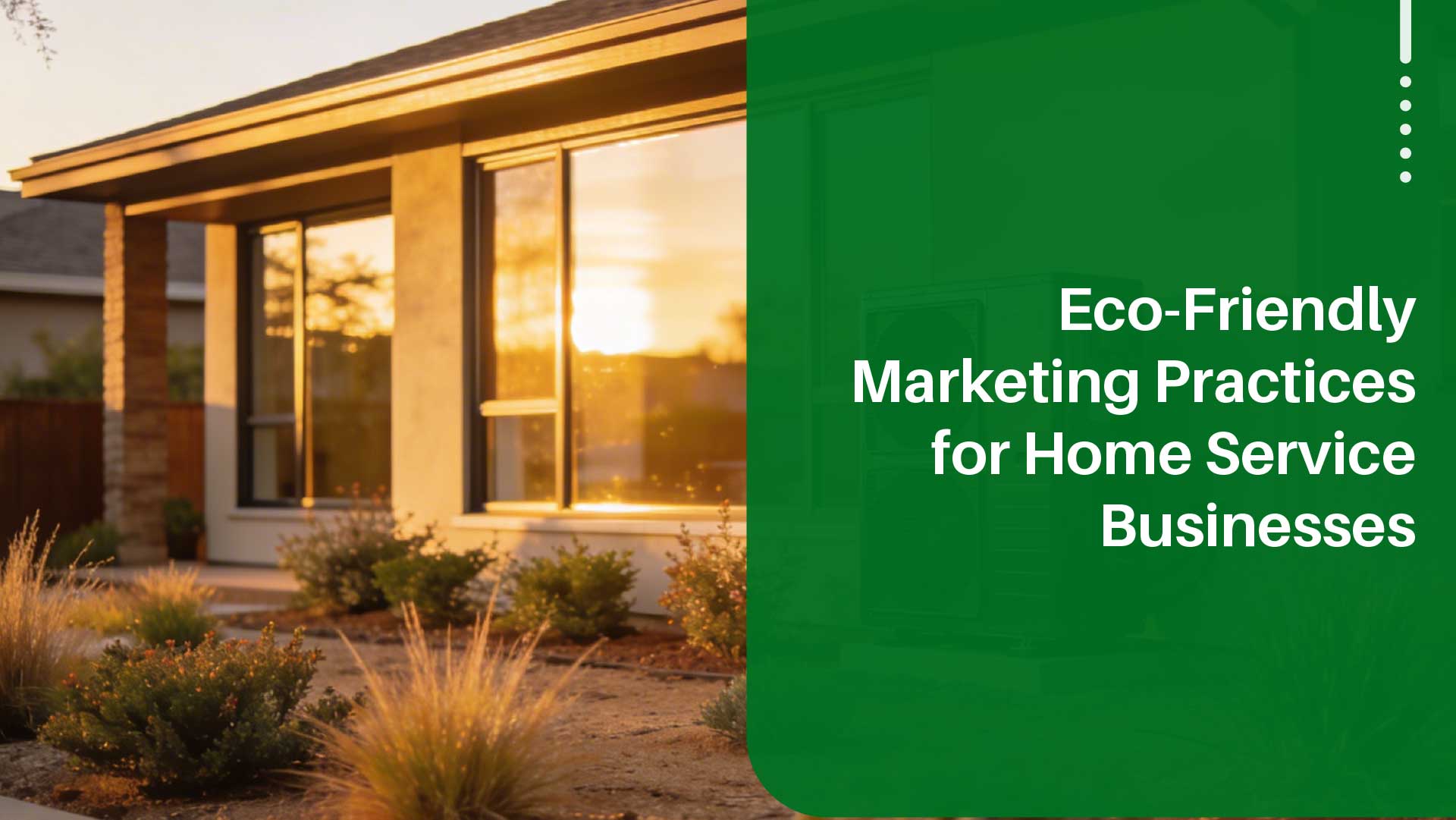
A plumbing contractor in Charlotte spent six months building her local brand before she realized something: three out of four people calling to ask about her services mentioned they were interested in water-saving fixtures. She hadn't marketed that angle. They'd found it themselves.
That contractor discovered what market data has been quietly saying for a few years: homeowners aren't just willing to pay for eco-friendly services—they're actively seeking them out. The National Association of Home Builders reports that 9 out of 10 homebuyers prefer a home with energy-efficient features that lower energy costs. Research from Optimove's 2023 consumer survey found that 70% of consumers consider buying from environmentally responsible companies important when making purchase decisions.
If you're a home service business owner offering any kind of green option—energy-efficient HVAC installs, low-flow plumbing, water-conserving landscaping, integrated pest management, or organic lawn care—you've got a built-in marketing advantage. Homeowners want what you're offering. The question isn't whether to market eco-friendly practices. It's how to position them so potential customers find you instead of the contractor down the road.
This post covers why homeowners care about green services, what they're actively searching for, and how to make eco-friendly practices the centerpiece of your company's marketing strategy.
Why Homeowners Care About Eco-Friendly Home Services
Homeowners choose eco-friendly services for three reasons: lower utility bills, environmental responsibility, and long-term property value. Understanding these motivations shapes how you market your services.
Lower Energy Costs Drive the Decision
A homeowner upgrading from a 15-year-old HVAC system to an ENERGY STAR-rated unit can see significant annual savings on cooling and heating. That's not a philosophical choice; that's a spreadsheet decision. The same logic applies to water-saving plumbing fixtures. A family with low-flow toilets and showerheads can meaningfully cut water usage, reducing both water and sewer bills. Over five years, that's real money—the kind homeowners notice in their monthly statements.
Environmental Responsibility Matters More Than You Might Think
Research from Today's Homeowner shows that a significant portion of homeowners feel motivated by sustainability concerns when upgrading their homes. They're not making a sacrifice for the environment; they're making an investment that pays them back while reducing their carbon footprint. That's a win-win they feel good about.
Property Value Increases When Homes are Green
Data from an American Home Shield survey reveals that 77% of homeowners believe green homes will retain their value better than traditional homes, with green homes commanding an average purchase price of $359,000 compared to $240,000 for conventional homes.. A homeowner knows that eco-friendly upgrades improve both their immediate lifestyle and their long-term investment.
These aren't soft motivations. They're hard business reasons. That's why homeowners search for eco-friendly options in the first place.
What Homeowners Are Searching For Right Now
Search volume tells the real story. Look at what people are actually typing into Google, and you'll see your opportunity.
Energy-efficient HVAC Searches are Surging
Search interest for "energy-efficient HVAC systems" continues to climb. Homeowners aren't casually wondering about efficient air conditioning. They're actively looking to upgrade. They want to know about SEER2-rated systems, heat pumps, smart thermostats, and how much they'll save. If your HVAC company markets those solutions, you're answering a question people are already asking.
Water-saving Plumbing is Top of Mind
Search volume for "low-flow plumbing installation" continues to rise. Add searches for "water conservation" and "leak detection," and you're looking at a growing market of homeowners researching plumbing upgrades specifically for sustainability and savings. This is an easy win for plumbing contractors offering these services—you just need to make sure people can find you.
Sustainable Landscaping and Pest Control Queries are Increasing Too
Homeowners search for "organic lawn care," "integrated pest management," and "sustainable landscaping" with regularity. The data shows that people want to know about alternatives to traditional chemical treatments. If you offer these services, your ideal customers are literally searching for what you do.
The practical insight: your potential customers are actively searching for the exact services you offer. You're not creating demand. You're capturing demand that already exists. Your job is visibility.
How to Market Eco-Friendly Practices: Four Strategies
Strategy 1: Lead with the Economics, Not the Environmentalism
The mistake most home service companies make is leading with environmental benefits. They say things like "We care about the planet" or "Sustainable practices are our mission." That's nice, but it's not what sells. What sells is the financial benefit.
When you market energy-efficient HVAC systems, lead with the savings: "Our ENERGY STAR-rated systems reduce cooling costs by $400-$500 annually." That's real money. The environmental benefit is a bonus that comes with the financial advantage.
The same approach works for plumbing: "Low-flow fixtures reduce water usage by 30%, cutting your monthly water and sewer bills." And for landscaping: "Organic soil amendments improve drainage and reduce watering frequency, lowering your monthly water bills by 20-30%."
In your marketing messaging, put the dollar amount first, the environmental benefit second. Homeowners want to know how eco-friendly practices put money back in their pocket. Give them that information prominently, and they'll choose your company over one that only talks about "going green."
Strategy 2: Highlight Long-Term Savings in Every Quote and Proposal
Eco-friendly services cost more upfront. A high-efficiency HVAC system costs more than a standard unit. Low-flow fixtures cost more than regular fixtures. Integrated pest management takes more time than spray-and-pray chemical treatments.
Counter that price concern by showing the long-term savings in every customer interaction. In your proposal, include a simple table:
Standard HVAC System vs. Energy-Efficient HVAC System:
- Standard unit: $3,500 installed, $125/month average cooling cost
- Energy-efficient unit: $4,500 installed, $75/month average cooling cost
- 10-year savings: $6,000 (even after the $1,000 premium)
Or for plumbing:
Standard Fixtures vs. Low-Flow Fixtures:
- Standard toilets/showerheads: $800 installed, $50/month water/sewer cost
- Low-flow fixtures: $1,200 installed, $35/month water/sewer cost
- 5-year savings: $700 (even after the $400 upgrade premium)
When customers see that the eco-friendly option actually saves money over time, they choose it. The environmental benefit seals the deal, but the numbers make the sale. Include these comparisons in every quote you give.
Strategy 3: Optimize Your Google Business Profile and Content Marketing for Green Service Searches
Your Google Business Profile is where customers find you when they search "energy-efficient HVAC near me" or "low-flow plumbing installation." Optimize for these specific searches:
Update your service descriptions to include eco-friendly terminology. Instead of "Air conditioning repair," use "Energy-efficient HVAC repair and installation, including SEER2-rated units and smart thermostat setup." Instead of "Plumbing services," use "Water-conservation plumbing, including low-flow fixture installation and leak detection."
Add eco-friendly keywords to your Google Business Profile content. Create posts about seasonal maintenance tips for energy efficiency. Share before-and-after photos of eco-friendly installations with the customer savings highlighted. This gives your profile both visibility and credibility.
Create short blog posts or content marketing pieces that answer the questions homeowners are actually searching for. "How much can you save with energy-efficient HVAC?" "What are low-flow fixtures and how much water do they save?" "Does organic pest control work as well as chemical treatments?" These posts pull organic search traffic and position your company as the knowledgeable expert.
Strategy 4: Feature Customer Results and ROI in Your Marketing
Homeowners respond powerfully to proof. Show them real customers who saved real money.
If a customer saved $400/year with an energy-efficient HVAC system, get their permission to use that story. Create a brief case study: "Sarah upgraded her 2002 HVAC system to a SEER2-rated unit. Her cooling bills dropped from $120/month to $75/month. Over 10 years, she'll save $5,400."
If a plumbing customer saved on their water bill, quantify it. "The Johnson family installed low-flow fixtures throughout their home. Their water bill dropped from $85 to $60. At that rate, the $1,200 upgrade pays for itself in under two years."
Feature these results in your ads, on your website testimonials, and in any sales conversations. Prospective customers believe other customers' results more than they believe marketing claims. Show them the money, and they'll become your next client.
Why This Matters for Growing Service Companies
If you're Sarah, the marketing coordinator at a growing HVAC, plumbing, or landscaping company, eco-friendly practices represent an enormous opportunity. Your target customers—homeowners concerned about both their budgets and their impact—are actively looking for these services. You're not inventing a market. You're tapping into one that already exists.
The contractors who win are those who market eco-friendly practices not as an afterthought or a nice-to-have, but as a central business strategy. They lead with savings. They show long-term ROI. They optimize for the searches homeowners are already making. They prove the value with customer results.
That's not complicated. It's just a different angle from what most service companies emphasize. And it's an angle your customers are actively searching for.
Conclusion: Eco-Friendly Services Are a Competitive Advantage, Not a Trend
Homeowners are seeking eco-friendly home services—energy-efficient HVAC installs, water-conserving plumbing, sustainable landscaping, and integrated pest management. The demand is real, measurable, and growing. The search volume is there. The customer preference is documented.
The companies winning in this space aren't doing anything complicated. They're simply making eco-friendly practices visible in their marketing. They lead with financial benefits, not environmental ideology. They show long-term ROI in every proposal. They optimize their online visibility for the searches homeowners are making. They feature customer results and real savings.
If your company offers any kind of green service, you have a built-in marketing advantage. The only question is whether you're capturing the customers who are already looking for what you offer.
Ready to build your marketing strategy around eco-friendly practices? Contact me to discuss how to position your services for the homeowners who want them.
Frequently Asked Questions
How Do I Know If My Target Customers Care About Eco-Friendly Services?
Start with your own customer data. Review the last 20-30 customer conversations. How many mentioned energy efficiency, water conservation, or environmental concerns? If the number is more than a few, your customers care. You can also search Google Trends for eco-friendly keywords in your industry and service area. If search volume is climbing, demand exists. The simplest test: ask your existing customers in a follow-up survey why they chose your company. Include a question about eco-friendly practices. You'll get direct feedback about what matters to your audience.
Is Eco-Friendly Marketing More Expensive Than Traditional Marketing?
No. Marketing strategy is free; execution costs money. You're not paying more to emphasize eco-friendly practices—you're just changing what you emphasize. Your Google Business Profile optimization, blog content, and proposal templates cost the same regardless of whether they highlight green services or other benefits. The ROI is actually higher because you're marketing to a defined audience (people actively searching for these services) rather than broadcasting to everyone.
What If My Company Offers Both Eco-Friendly and Standard Services?
That's fine. Market the eco-friendly option to customers who search for it, and the standard option to those who prioritize cost or convenience. Your customer segments have different priorities. Sarah, the homeowner who installs energy-efficient HVAC, is willing to spend more upfront for long-term savings. Mike, with limited cash flow, might prefer the cheaper option despite higher operating costs. You can serve both by clearly positioning both options and letting customers choose based on their values and budgets.
How Long Does It Take to See Results from Eco-Friendly Marketing?
SEO and organic visibility take 3-6 months to show meaningful results. Google Business Profile optimization and local search improvements typically show results within 30-60 days. Customer word-of-mouth from eco-friendly installations compounds over time. If you implement all four strategies (economics-first messaging, ROI proposals, Google Business Profile optimization, and customer results), you should see increased call volume from eco-conscious homeowners within 60-90 days.
How Do I Track Whether Eco-Friendly Marketing Is Actually Working?
Ask new customers: "How did you find us, and why did you choose our company?" If eco-friendly practices come up in 3 out of 10 new customer conversations, you know your eco-friendly marketing is working. You can also tag phone numbers or web forms to track which keywords bring in calls, and segment your customer database by reason for choosing your company. Google Ads and local search advertising also provide direct attribution data showing which eco-friendly keywords drive phone calls and bookings.
Written By: Chad J. Treadway | March 24, 2026
Chad is a Partner and our Chief Smarketing Officer. He will help you survey your small business needs, educating you on your options before suggesting any solution. Chad is passionate about rural marketing in the United States and North Carolina. He also has several certifications through HubSpot to better assist you with your internet and inbound marketing.
Your truck wrap looks sharp. Your technicians show up on time. Your work is solid. But none of that matters if the first thing a potential customer sees when they Google your company is a one-star review from someone who was upset about scheduling.
For home service companies, your online reputation is your storefront. Before a homeowner ever calls you, they've already looked you up, read your reviews, and compared you to at least two other companies. One bad review sitting unanswered on your Google Business Profile can undo months of great work.
The good news is that online reputation management for home service companies isn't complicated. It takes consistency, a simple process, and the willingness to respond when things go sideways. Let's walk through what it looks like in practice.
Why Your Online Reputation Matters More Than You Think
You might assume that doing good work speaks for itself. And to your existing customers, it does. But for the homeowner who's never heard of you, your Google reviews are the only evidence they have that you're worth calling.
BrightLocal's 2026 Local Consumer Review Survey found that 97% of consumers use online reviews to evaluate local businesses. And 49% of those consumers trust online reviews as much as personal recommendations from friends and family. That's the equivalent of a stranger trusting your Google profile as much as they'd trust their neighbor saying, "Yeah, call these guys. They're good."
On the flip side, research from Sixth City Marketing shows that a single negative review can drive away up to 30 potential customers. For a plumbing company averaging $300 per service call, that's $9,000 in potential revenue from one unhappy review. One review. Nine thousand dollars.
Now think about what two or three unanswered negative reviews cost over a year. That math should make every home service business owner pay attention.
How to Respond to Negative Reviews (Without Making It Worse)
Here's the reality: negative reviews are going to happen. You can't please everyone every time, and some people will leave a bad review over things you can't control. What you can control is how you respond.
BrightLocal's 2026 Local Consumer Review Survey found that 80% of consumers are more likely to use a business that responds to all of its reviews, both positive and negative. And 42% say they're unlikely to use a business that never replies at all. Your response isn't just for the person who left the review. It's for every future customer who reads it.
The Formula for a Good Response
When responding to a negative review for your HVAC, plumbing, or roofing company, follow this pattern:
Acknowledge the concern. Start by thanking them for the feedback and acknowledging their experience. Don't be defensive. Even if you disagree, the goal is to show future readers that you listen.
Take responsibility where appropriate. If your company made a mistake, own it. Homeowners respect honesty. Saying "we dropped the ball on communication and we're sorry" goes further than making excuses.
Move it offline. Provide a phone number or email and invite them to continue the conversation privately. This shows you're serious about resolving the issue without airing every detail publicly.
Keep it professional and short. Three to five sentences are plenty. Avoid long, defensive paragraphs. The calmer and more professional your response, the better you look to everyone else reading it.
What Not to Do
Never argue with a reviewer in public. Never blame the customer. Never ignore the review and hope it goes away. And never, under any circumstances, delete or hide legitimate reviews. BrightLocal's 2026 data shows that 50% of consumers are put off by generic or templated review responses, viewing them as a sign of subpar customer care. And attempting to delete or hide legitimate reviews only makes things worse. That's worse than the bad review itself.
Building Review Volume: Your Best Defense
The best way to deal with negative reviews is to have so many positive ones that the occasional bad review barely makes a dent. If you have 150 reviews and a 4.7-star average, one two-star review doesn't change the picture. If you have 12 reviews and a 4.2-star average, that same two-star review drops you to a territory where homeowners start scrolling past you.
BrightLocal's 2026 survey also found that 68% of consumers will only use a business with four or more stars, and 31% require a 4.5-star rating or higher. Additionally, 32% of consumers only pay attention to reviews written within the past two weeks, a significant jump from 20% the year before.
That means you need both volume and recency working in your favor.
How to Get More Reviews Without Being Annoying
Make it part of your process. After every completed job, your technician or office manager sends a follow-up text or email with a direct link to your Google review page. Keep the message simple: "Thanks for choosing us. If you have a minute, we'd appreciate a quick review on Google. Here's the link."
Don't offer incentives for reviews. Google prohibits it, and it undermines the authenticity of your review profile. Instead, make it easy and make it timely. The closer the request is to the completed service, the more likely the customer is to leave a review.
For a practical guide to building your Google review volume, we've put together a step-by-step process that works for service businesses of any size.
Monitoring Your Online Reputation
You don't need expensive reputation management software to keep tabs on what people are saying about your company. For most small home service businesses, a simple monitoring routine works just fine.
Set Up Google Alerts
Create a Google Alert for your business name. You'll get an email anytime your company is mentioned online. It's free and takes about 30 seconds to set up.
Check Your Google Business Profile Weekly
Make it a habit. Every Monday morning, check your Google Business Profile for new reviews, questions, and messages. Respond to everything within 24 hours. BrightLocal's 2026 data shows that 19% of consumers expect a same-day response to their review, and 81% expect to hear back within a week.
Monitor Facebook and Yelp
Even if Google is your primary review platform, homeowners also check Facebook recommendations and Yelp. Make sure your information is accurate on both, and respond to reviews there, too.
Watch for Patterns
If you're seeing the same complaint from multiple customers (long wait times, communication gaps, pricing confusion), that's not a review problem. That's an operational problem that reviews are helping you identify. The smartest home service companies treat negative reviews as free consulting.
Turning a Bad Review Into a Business Win
This might sound counterintuitive, but a negative review handled well can actually earn you customers. When a homeowner reads a bad review followed by a calm, professional, empathetic response from the business owner, it builds confidence. It tells them, "Even if something goes wrong, this company will make it right."
Think about your own buying behavior. Would you rather hire the company with nothing but five-star reviews (which can look suspicious) or the one with a 4.6 average that clearly handles problems with grace? Most people choose the second one. Authenticity beats perfection.
Your Reputation Is an Asset. Treat It Like One.
Your online reputation is working for you or against you every single day. Every review, every response, and every unanswered question on your Google profile shapes how your next potential customer sees you.
The home service companies that win at reputation management aren't doing anything complicated. They're asking for reviews after every job, responding to every piece of feedback (good and bad), and monitoring their profiles weekly. That's it. Consistency beats complexity every time.
If your review game needs work and you're not sure where to start, contact me, and I'll give you an honest assessment of where your online reputation stands and what to do about it.
Frequently Asked Questions
How Many Google Reviews Does a Home Service Company Need?
There's no magic number, but more is always better for building trust and buffering against the occasional negative review. Aim to always have reviews from within the last two weeks, since 32% of consumers only pay attention to reviews written in that window. A good benchmark for a small home service company is to add at least two to four new reviews per month. If you complete 20 to 30 jobs a month, a 10% to 15% review capture rate gets you there.
Should I Respond to Positive Reviews Too?
Absolutely. Responding to positive reviews shows that you value all customer feedback, not just the complaints. Keep it simple: thank them by name if possible, mention the specific service you performed, and let them know you appreciate their business. Research from BrightLocal's 2026 survey shows that 80% of consumers are more likely to use a business that responds to all its reviews, not just the negative ones.
Can I Remove a Fake or Unfair Google Review?
You can flag a review that violates Google's review policies (spam, fake reviews, conflicts of interest). Google will review the flag and may remove it, but the process can take time, and there's no guarantee. In the meantime, respond professionally to the review so other customers can see your side of the story. Never engage in a public argument with the reviewer.
How Fast Should I Respond to a Negative Review?
As fast as you reasonably can. BrightLocal's 2026 data shows that 19% of consumers expect a same-day response, and 32% expect one by the next day. Aim to respond within 24 hours. A quick, thoughtful response demonstrates that you take customer feedback seriously and signals to future customers that you're attentive.
Does Online Reputation Management Affect My Google Rankings?
Yes. Google considers review signals (quantity, velocity, diversity, and response rate) as part of its local search ranking algorithm. Businesses with more reviews, higher ratings, and active owner responses tend to rank higher in local search results and the Google Map Pack. Your reputation management efforts directly support your local SEO performance.
Written By: Chad J. Treadway | March 19, 2026
Chad is a Partner and our Chief Smarketing Officer. He will help you survey your small business needs, educating you on your options before suggesting any solution. Chad is passionate about rural marketing in the United States and North Carolina. He also has several certifications through HubSpot to better assist you with your internet and inbound marketing.

A growing HVAC contractor with 18 technicians was losing market share to a competitor down the street. Both companies charged similar rates, both had solid reputations, and both served the same geographic area. The difference? When a homeowner searched "emergency HVAC repair near me" at 9 PM on a Sunday, the competitor appeared in the top three Google map results. The HVAC contractor didn't show up until page two of the regular search results. That visibility gap meant the competitor got the urgent call—and the $3,000 service visit. This scenario repeats itself thousands of times daily across plumbing, roofing, electrical, and other home service companies searching for a way to reach more customers.
Most home service business owners treat SEO as a mystery. They hear the acronym and think of blogging, keywords, and technical jargon that have nothing to do with their actual business. But SEO for service area businesses isn't about chasing Google traffic from across the country. It's about appearing first when someone in your geographic market is actively looking to hire you right now.
This guide explains how to build a practical SEO strategy designed specifically for home service contractors. You'll learn what local search optimization actually means, how Google's ranking system works for service businesses, what Google Business Profile optimization can do for your visibility, and how to implement a system that generates qualified leads from your area.
How Does Local SEO Work for Home Service Companies?
Local SEO is the process of optimizing your online presence so that your home service company appears in local search results. When someone searches "plumber near me," "emergency electrician in [town]," or "HVAC repair service," they're conducting a local search. Google's algorithm then pulls businesses that match the search query, are located near the searcher, and are verified and optimized in Google's systems.
The difference between local SEO and traditional SEO is critical. Traditional SEO focuses on ranking nationally or globally for broad keywords. Local SEO focuses on dominating the geographic service area where you actually operate. For home service companies, local SEO is where almost all your marketing ROI lives.
Research from Google shows that 76% of consumers who search for something "near me" on their smartphone visit a business within a day. Additionally, research shows that the local pack captures 44% of all clicks in local search results, meaning visibility in Google's local pack—the map results that appear at the top of search results—is non-negotiable. (Source: Moz).
What Are the Core Components of Home Service SEO?
Successful SEO for home service companies rests on five core components: a claimed and optimized Google Business Profile, a local keyword strategy built around service area and specific trade, well-structured service pages on your website, review signals and reputation management, and consistent business information across citation sources.
Google Business Profile (GBP)
Your Google Business Profile is the digital storefront that appears when someone searches for your business or service type in your area. It's where your phone number, address, hours, photos, and customer reviews live. According to Whitespark's Local Search Ranking Factors survey, GBP-related signals account for 32% of local pack ranking factors—making this the single highest-impact area for your investment.
Local Keyword Strategy
Home service keywords are geographic and specific. You don't compete for "plumbing services." You compete for "emergency plumber in [your town]" and "water heater repair [service area]." These keywords have lower search volume but dramatically higher conversion intent. David Chen knows: the homeowner searching "plumber near me" at midnight is ready to book a service call.
Service Page Structure
Each service you offer should have its own page on your website, optimized for the geographic area you serve and the specific problem you solve. A plumbing company should have dedicated pages for "Emergency Water Line Repair in Charlotte," "Water Heater Replacement in [Town]," and "Drain Cleaning Service Area." This structure helps both search engines and customers find exactly what they need.
Reviews and Reputation Signals
Google's algorithm treats reviews as a primary ranking and conversion factor. Businesses with more than 200 reviews on Google are more likely to appear in the top three positions, with these businesses averaging nearly 250 reviews. Reviews also influence conversion: a 4.8-star business with 150+ reviews converts far better than a 4.2-star business with 12 reviews.
Citations and NAP Consistency
A citation is a mention of your business name, address, and phone number (NAP) on another website—whether that's a directory like Yelp, HomeAdvisor, or Google, or an industry resource. Consistent citations across all these sources tell Google that your business is legitimate and trustworthy.
How to Optimize Your Google Business Profile for Local Rankings
Your Google Business Profile is the foundation of local SEO. Here's what matters most:
Complete Every Section
A fully optimized GBP includes your business category (choose the most specific category for your trade—"Plumbing Contractor," not just "Plumber"), service areas (list all areas you actually serve), photos (minimum 10-15 high-quality photos of your work, your team, and your vehicles), business description, phone number, hours, and website URL. Incomplete profiles signal to Google that your business is less established than competitors with complete profiles.
Choose the Right Category
Google's algorithm prioritizes the primary category associated with your business. A roofing company should use "Roofing Contractor," not "Home Improvement" or "General Contractor." The more specific your category, the better you'll rank when someone searches for that specific service.
Post Regularly
GBP Posts (updates about special offers, promotions, or recent projects) keep your profile active and visible. Businesses that post regularly appear more frequently in search results compared to those that don't. Aim for at least one post per week or one every two weeks.
Upload Before-and-After Photos
Service photos (finished roofing jobs, completed HVAC installations, etc.) provide social proof and help prospective customers understand the quality of your work. More importantly, they give Google fresh content to index and display.
What Keywords Should Home Service Companies Target?
Most home service business owners make the same keyword mistake: they chase high-volume, broad keywords that are impossible to rank for and don't reflect how customers actually search.
Your keyword strategy should include three tiers:
Tier 1 (High Intent, Local Keywords)
These are the searches that matter most: "emergency plumber near me," "HVAC repair [town name]," "roofing company in [service area]." These keywords have lower volume than national keywords, but conversion intent is extremely high. Someone searching "emergency electrician in Charlotte" is ready to book today.
Tier 2 (Problem-Specific Keywords)
These focus on specific problems homeowners are trying to solve: "water heater repair," "AC repair cost," "how to fix a leaky faucet," "why is my furnace making noise." Customers at this stage might not be ready to call today, but they're moving toward a decision.
Tier 3 (Informational Keywords)
These are broader questions: "signs your plumbing needs repair," "how often should you service your HVAC," "roof inspection checklist." These rank longer-term, build authority, and can drive organic traffic to your website.
Your blog posts, service pages, and website content should target all three tiers, but your primary budget and effort should focus on Tier 1: the urgent, local searches where homeowners are actively looking to hire.
How to Build a Citation Strategy for Service Area Businesses
Citations are mentions of your business name, address, and phone number on other websites. Google uses citations to verify that your business exists, is legitimate, and operates in the areas you claim to serve.
Start by auditing your current citations. Search your business name on Google and check Yelp, HomeAdvisor, Angi, Google My Business, industry-specific directories, and local chamber of commerce listings. Make a list of every site where your business is mentioned.
Then standardize your NAP (name, address, phone number) across all citations. If your business is listed as "ABC Plumbing LLC" on one site and "ABC Plumbing, Inc." on another, Google sees these as potentially different businesses. Inconsistency hurts your local ranking.
Next, claim and optimize major directories:
- Google Business Profile (already mentioned, but this is the most important citation)
- Yelp (a major review platform where homeowners actively search for services)
- Angi (formerly Angie's List; popular for home service reviews)
- HomeAdvisor (large home services marketplace)
- Industry-specific directories (PHCC for plumbers, ACCA for HVAC, NRCA for roofing, etc.)
- Local chamber of commerce (establishes local credibility)
Practical Application: SEO Implementation for a Growing Home Service Company
Let's apply this framework to David Chen's 18-person HVAC company serving a four-county area.
Current situation: David's company ranks on page two of Google for "HVAC repair near me." His main competitor—a company of his size—appears in the top three map results. Both have similar pricing and reputations, but the competitor gets twice as many emergency calls because of visibility.
The issue: David's Google Business Profile was incomplete (missing service area descriptions and photos), he was posting maybe once per quarter, reviews were building slowly, and he had no structured local keyword strategy for the multiple counties he serves.
The implementation plan:
Month 1 (GBP Optimization): Complete the entire GBP profile. Upload 20 photos of completed jobs, team members, and HVAC equipment. Add service area descriptions for each county. Write a detailed business description focused on emergency repair availability and 24/7 response. Set up a monthly GBP posting schedule (twice per month for the first month, then ongoing).
Month 2-3 (Local Keyword Strategy): Create landing pages for high-intent local keywords: "Emergency HVAC Repair [County]," "AC Repair Near Me [County]," "Furnace Repair Service in [Town]." Each page targets specific geographic areas and emergency-focused language. Optimize existing website for Tier 2 keywords: "AC unit not cooling," "furnace maintenance schedule," "heat pump repairs."
Months 2-4 (Reviews and Reputation): Implement a post-service text and email request asking customers to leave Google reviews. Set a target of 10 new reviews per month. Respond to every review (positive and negative) within 24 hours with specific, detailed responses that mention the service and customer name.
Ongoing (Citation Building): Claim profiles on Yelp, HomeAdvisor, and Angi. Ensure NAP consistency across all platforms. Update directories quarterly to maintain accuracy.
Results: Within 90 days, David's GBP appears in the top three map results for emergency HVAC searches in all four counties. He receives 25-30% more emergency calls. His average review count grows from 60 to 120. His website traffic from local search increases 40%. His cost per qualified lead drops by 20% because leads come from high-intent local searches, not generic marketing channels.
This isn't rapid transformation—it's methodical, system-based optimization that works because it's built on how Google's algorithm actually ranks service businesses.
Conclusion: SEO Is a System, Not a Magic Trick
SEO for home service companies isn't complicated—it's systematic. You're not trying to rank nationally or compete with huge companies. You're trying to appear first when someone in your geographic service area is actively looking to hire you.
The core strategy is straightforward: optimize your Google Business Profile completely, build a local keyword strategy focused on your service area, structure your website around the specific problems you solve, generate and respond to reviews aggressively, and maintain consistent business information across all directories.
The companies that win at local SEO aren't the ones with the fanciest websites or the biggest marketing budgets. They're the ones that recognize a simple truth: homeowners searching for a plumber at midnight want to see a verified, well-reviewed, easily reachable business in their area. When you optimize for that reality, everything else follows.
Ready to build an SEO strategy that works for your home service business? Contact me to discuss how to dominate local search in your service area.
Frequently Asked Questions
How Long Does It Take to See Results from Local SEO?
Local SEO is not overnight. Google Business Profile optimization and initial ranking changes can take 4-6 weeks to show a significant impact. Review accumulation and reputation building take 3-6 months to meaningfully affect conversion. Most home service companies see measurable results—increased calls, improved visibility, better conversion—within 90 days if the strategy is properly implemented and maintained consistently.
Should Home Service Companies Blog About Their Services?
Blogging serves two purposes for home service companies. First, it targets Tier 2 and Tier 3 keywords that support your Tier 1 (emergency/local) searches. A plumbing company that blogs about water heater maintenance, pipe problems, and seasonal maintenance attracts homeowners who aren't yet ready to call but are moving toward a decision. Second, regular blog content keeps your website fresh and gives Google new content to index. Blog 2-4 times per month, focused on problems your customers actually search for—not general industry updates.
Is Google Ads Worth It for Home Service Companies?
Google Ads (paid search) can drive immediate calls and serves a different purpose than organic SEO. If local SEO is a long-term investment, Google Ads is an immediate ROI. For home service companies, Google Local Services Ads and geographic-targeted search campaigns deliver higher conversion rates than traditional display ads because they target urgent, local, high-intent searches. For a growing company, combining organic local SEO with Google Ads creates a complete local search strategy.
What's the Relationship Between Reviews and SEO Ranking?
Google treats reviews as both a ranking factor and a conversion factor. Businesses with more reviews, higher average ratings, and recent review activity rank better in local search. But reviews also influence whether people actually call you. A 4.8-star business with 200 reviews converts differently than a 4.0-star business with 20 reviews. Your review strategy should focus both on volume and quality—request reviews after every completed job and respond to every review to show prospective customers that you take feedback seriously.
How Do I Handle SEO for Multiple Service Areas?
If you serve multiple counties or towns, create service-specific landing pages for each geographic area. A plumbing company serving three counties should have pages like "Emergency Plumber in County A," "Water Heater Repair in County B," and "Drain Cleaning Service in County C." On your Google Business Profile, list all service areas in the dedicated service area section. In your NAP citations, use your primary address and phone, but mention all service areas you cover.
Written By: Chad J. Treadway | March 17, 2026
Chad is a Partner and our Chief Smarketing Officer. He will help you survey your small business needs, educating you on your options before suggesting any solution. Chad is passionate about rural marketing in the United States and North Carolina. He also has several certifications through HubSpot to better assist you with your internet and inbound marketing.