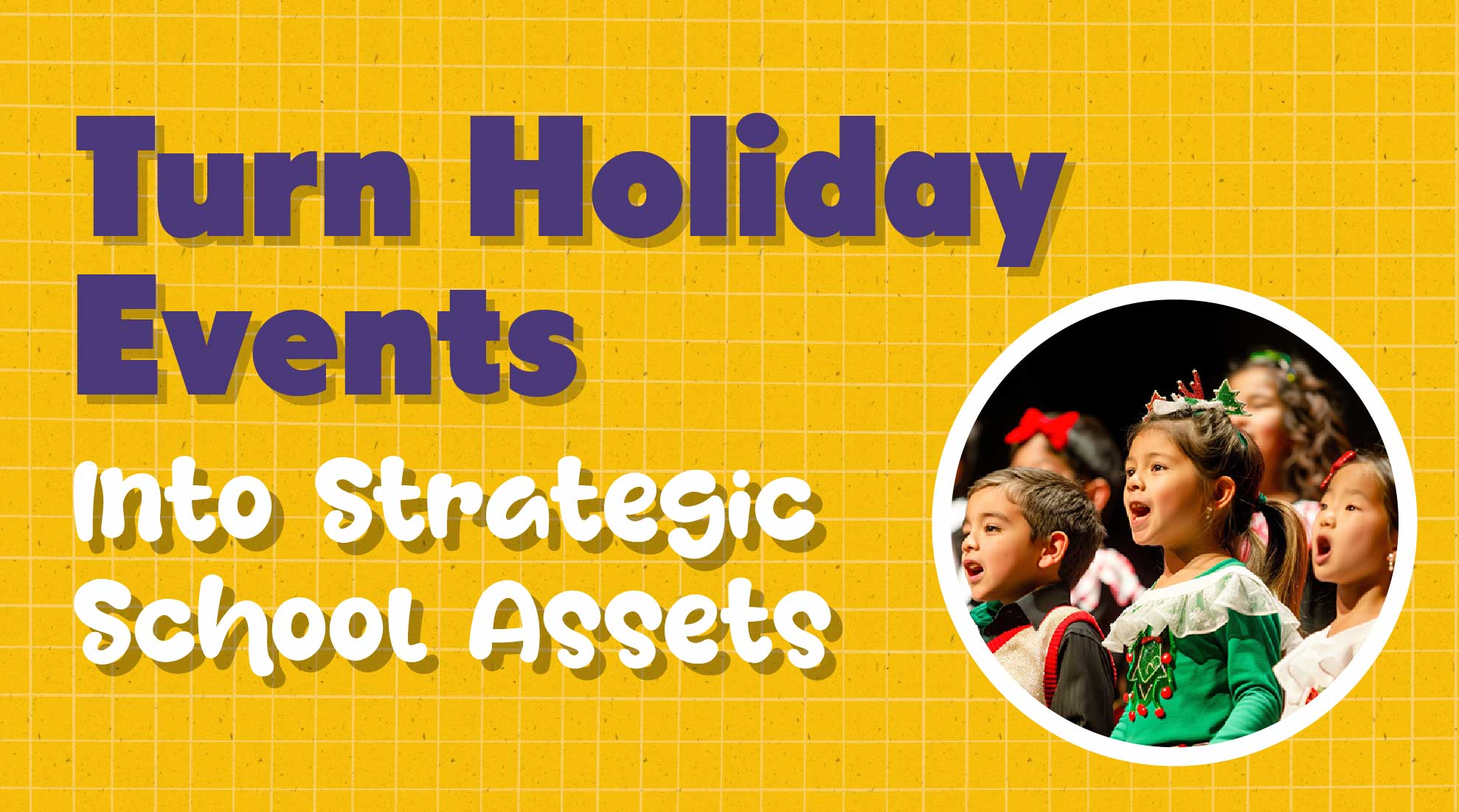
Ah, the holiday season at your private school. The cheerful chaos of Winter Concerts. The frantic last-minute preparations for the annual fundraising gala. The slightly-too-warm gymnasium full of parents recording their children's performances with shaky camera work that would make Blair Witch directors proud.
If you're like most private school leaders, you view these seasonal events as a mixed blessing—wonderful traditions, sure, but also logistical nightmares that consume staff time and energy.
But what if I told you that you're sitting on an untapped goldmine?
Most schools make the critical mistake of treating holiday events as mere operational tasks—nice-to-have social gatherings that keep tradition alive but drain resources. They plan these events in departmental silos (marketing does the Fall Festival, advancement handles the gala, and academics manages the concerts) without a unified strategy, missing the tremendous opportunity these moments present.
It's time for a paradigm shift: Holiday events aren't just calendar fillers—they're powerful strategic platforms that, when approached correctly, can drive enrollment, build your community, express your brand values, and fuel your fundraising efforts.
This post will show you exactly how to transform your holiday events from obligatory traditions into strategic assets that deliver measurable returns. No fancy consultants required—just a smarter approach to what you're already doing.
The Strategic Gold Mine You're Sitting On
Let's get real for a moment: Your school's brand isn't your logo, your mascot, or even that expensive viewbook you just printed. It's the lived experience of your community—and nothing creates experiences quite like events.
Beyond Punch and Cookies: Events as Mission in Action
When prospective families are deciding where to invest their tuition dollars, they're not just evaluating your academic stats. They're asking themselves: "Do I see my family belonging here? Will my child thrive in this community?" Your events answer these questions in ways your marketing materials never could.
A holiday concert isn't just a performance—it's a tangible demonstration of your commitment to the arts and student confidence. A community service project isn't just collecting canned goods—it's your character education curriculum in action, showing how you develop empathetic, civic-minded students.
As leadership expert Simon Sinek notes in Event Espresso, "People don't buy what you do, they buy why you do it." Events are your most powerful vehicle for showing families—both current and prospective—why your school exists. They create emotional connections that no viewbook can replicate.
Academic research confirms this approach: studies published in the Journal of School Psychology have found that positive parent involvement directly enhances a child's perception of their cognitive competence and improves student-teacher relationships, both of which are significant mediators of academic performance.
The Event-Driven Flywheel: Your Secret Weapon
The most successful schools understand that events can create a self-reinforcing cycle of growth when approached strategically. I call this the "Event-Driven Flywheel":
- Engage Community: Well-planned events bring students, parents, faculty, and alumni together, fostering belonging and trust.
- Strengthen Brand: These positive community experiences generate authentic word-of-mouth. According to NAIS research, "Word-of-mouth remains the most effective marketing tactic, with in-person events being the most effective traditional marketing channel."
- Drive Enrollment: A strong reputation and palpable sense of community attract prospective families seeking the "right fit."
- Inspire Philanthropy: Engaged community members who see your mission in action become your most reliable donors. CASE and NAIS revealed that 1,425 participating independent schools secured a collective $4.87 billion in philanthropic support, demonstrating the tremendous potential of strategic engagement.
Each component amplifies the others, creating momentum that drives sustainable growth.
Breaking Down the Silos
The biggest barrier to leveraging this flywheel? Departmental silos.
When admissions, advancement, and student life plan events independently, you miss crucial opportunities. An admissions open house that fails to showcase your vibrant parent community or an advancement gala disconnected from student experiences represents strategic failure.
Every event, regardless of its primary purpose, must be designed with an understanding of its role in turning this flywheel. This requires centralized oversight and cross-departmental collaboration to ensure each gathering reinforces your core brand message and contributes to your interconnected goals.
Your Holiday Event Portfolio: Beyond Punch and Cookies
Just as a financial advisor builds a diversified investment portfolio, you need to construct an event calendar that balances different objectives, audiences, and resource requirements. Here's how to build a balanced event portfolio that delivers results across multiple strategic goals:
Building Bridges: Community Engagement Events
The foundation of a thriving school is a connected community. These events build social capital, foster relationships, and create a welcoming environment where families feel they belong. Research published in Sociological Perspectives demonstrates that "public-good parental involvement—activities like volunteering or attending school-wide gatherings—directly links to the formation of larger and more supportive parental networks."
Key Example: Culture Nights celebrate diversity through food, music, and storytelling from various cultures. According to Sched.com, culture nights are among the most effective events for "creating inclusive communities where all families feel seen and valued"—crucial for retention in diverse school populations.
Showcasing Talent: Performance and Arts Events
These events serve a dual purpose: they're celebratory milestones for students and powerful marketing tools for your school. They provide tangible proof of your school's "product"—confident, skilled students—that's more persuasive than any brochure or statistic.
Key Example: Seasonal Concerts showcase musical talents and demonstrate the strength of your arts programs. The execution quality directly reflects on your institution—as Walt Disney said in SpeakerHub, "Do it so well that when people see you do it, they will want to come back and see you do it again."
Living the Mission: Service-Learning Projects
Service projects directly embody the values of civic responsibility, empathy, and leadership central to most independent schools. These aren't simply volunteer activities but intentionally designed educational experiences combining community service with classroom learning.
Key Example: Martin Luther King Jr. Day of Service transforms a holiday from a "day off" into a "day on" for service and learning. Based on findings from Germantown Friends School, this model can include "a keynote speaker, educational workshops on social justice issues, and multiple off-campus volunteer shifts with community partners," engaging the entire school in meaningful action.
Fueling the Future: Strategic Fundraising Events
A "one-size-fits-all" approach to fundraising events is highly inefficient. CASE and NAIS revealed a stark reality: less than 2.3% of donors were responsible for 74.3% of total funds received, while 73.9% of donors gave less than $1,000. This data mandates a tiered event strategy.
A Tiered Approach:
- Tier 1: Broad-Based Participation Events: Fun runs, read-a-thons, and online giving days. The financial ROI is modest, but the "Return on Involvement" is exceptionally high.
- Tier 2: Mid-Level Donor Engagement Events: Themed auctions and golf tournaments that provide opportunities for corporate sponsorships and larger individual contributions.
- Tier 3: Major Donor Cultivation Events: High-touch, often exclusive events like formal galas and intimate dinners with school leadership. While resource-intensive, these events have the highest potential financial ROI.
To help you evaluate your current event portfolio, smaller schools with limited budgets should focus on high-impact, low-resource events like community gatherings and service projects that deliver strong relationship-building benefits without major financial investment. Remember that authentic experiences matter more than lavish production values—families choose private schools for their communities, so lean into that strength.
Promotion That Actually Works: Beyond the Backpack Flyer
If you're still relying primarily on emails and backpack flyers to promote your events, you're leaving attendance and engagement on the table. Effective event promotion requires strategic planning and compelling storytelling.
The Strategic Timeline: Key Phases
Rushing promotion into the final weeks before an event limits reach and attendance. The Events Calendar suggests an ideal approach with these key phases:
8-10 Weeks Out: Foundation & Save the Date
- Finalize event objectives, theme, date, time, and venue
- Announce "Save the Date" across key channels
- Create simple, visually appealing graphics for initial promotion
4-6 Weeks Out: Official Launch
- Open registration and launch the full event landing page
- Send dedicated email blasts to segmented lists
- Begin a sustained social media campaign
1-2 Weeks Out: Final Push
- Create a sense of urgency and provide logistical details
- Leverage parent ambassadors for word-of-mouth promotion
- Use push notifications via the school's mobile app
Event Day & Follow-up
- Capture and share the experience in real-time
- Send segmented thank-you emails within 48 hours
- Share photo galleries and impact reports
Omnichannel Integration
Rather than treating each channel as a separate silo, create an integrated ecosystem:
- Website: Your central source of truth with comprehensive, mobile-friendly event landing pages
- Social Media: Visual storytelling with high-quality content of actual school life, targeted ads, and user-generated content campaigns
- Email Marketing: Segmented messaging tailored to different audiences (current parents vs. prospective families)
Families are looking for authentic glimpses into your school's culture. Creating compelling content that showcases real student experiences is essential for effective promotion. As Edlio advises, "Show real student experiences, not just staged promo photos."
Execution Without the Headaches
A brilliant event strategy means nothing without flawless execution. The most common points of failure aren't a lack of effort but a lack of robust, repeatable systems.
The Systems Approach
Phase 1: Strategic Planning (4-6 Months Prior)
- Define clear SMART objectives
- Establish a budget with 10-15% contingency
- Identify the target audience and their specific needs
Phase 2: Operational Setup (2-3 Months Prior)
- Select venue and vendors with clear contracts
- Develop a detailed event timeline
- Secure permits, insurance, and administrative approvals
Phase 3: Team Coordination (1 Month Prior)
- Finalize volunteer roles with detailed instructions
- Conduct safety briefings and establish emergency protocols
- Test all technology and registration systems
Overcoming Common Challenges
Research reveals consistent challenges that derail events:
Resource Conflicts: IncidentIQ recommends implementing "centralized event management software or shared, cloud-based master calendar for real-time visibility into resource availability."
Communication Silos: Establish a cross-departmental events committee that meets regularly to coordinate efforts. As one principal noted, "You can't do this on your own. If you don't have a team, develop one."
Manual Inefficiencies: Solved Consulting suggests automating wherever possible using "digital tools for registration, volunteer sign-ups, and post-event surveys."
Safety First
Student and guest safety is non-negotiable. A comprehensive safety plan should include written emergency protocols, clear communication chains, staff training on procedures, and readily available first-aid resources.
Proving Your Events Matter: Measurement That Makes Sense
"It was a great event, everyone had fun," doesn't cut it anymore. You need to prove ROI across multiple dimensions, not just financial returns.
The Essential Metrics Dashboard
Success must be measured against pre-defined objectives for each event type:
|
Metric Category |
Key Performance Indicator |
Target/Benchmark |
|---|---|---|
|
Financial Performance |
Fundraising ROI |
>300% for galas; 100-200% for broad events |
|
Cost Per Dollar Raised |
<$0.25-$0.30 |
|
|
Audience Engagement |
Registration-to-Attendance |
>85% free events; >95% paid |
|
Social Media Amplification |
Track during the promotion period |
|
|
Lead Generation |
New Inquiries Generated |
Event-specific CRM tracking |
|
Campus Tours Scheduled |
>20% of new inquiries |
|
|
Community Building |
Parent Volunteer Participation |
Year-over-year growth tracking |
|
Post-Event Satisfaction |
>4.5/5 or >8.5/10 |
Beyond the Numbers
While non-fundraising events don't generate direct revenue, they contribute significantly to enrollment marketing and community building. Track prospective family inquiries, volunteer participation rates, social media engagement, and post-event satisfaction scores. Monitor the "pipeline effect"—how community events influence attendance at fundraising events later in the year.
The impact on community health is arguably more important for long-term success. Evidence from Hanover Research points to "strong family engagement directly linking to increased student achievement, reduced absenteeism, and higher graduation rates."
From Data to Decisions
Schedule structured post-event debriefing sessions guided by your KPI dashboard:
- Review objectives vs. outcomes
- Analyze successes and pain points
- Develop actionable recommendations
- Update planning templates and processes
This cycle of measurement and reflection transforms event planning from one-off tasks into continuous improvement.
Strategic Synthesis: Putting It All Together
Successful holiday events require a paradigm shift—from viewing them as isolated operational duties to embracing them as core components of institutional strategy.
Five Key Recommendations:
- Centralize Strategic Oversight: Create a cross-departmental events committee to manage your entire calendar as a unified portfolio.
- Invest in Systems: Build sustainable event management infrastructure with centralized software and standardized planning tools.
- Adopt a Portfolio Approach: Ensure your calendar includes a healthy mix of events designed to achieve different goals—community building, brand awareness, lead generation, and tiered fundraising.
- Measure Holistically: Champion "Return on Involvement" alongside traditional ROI using comprehensive success metrics.
- Empower Brand Ambassadors: Train and recognize staff and parent volunteers as your most powerful marketing assets.
Looking Ahead: Future Trends
Several trends will shape private school events:
- Hybrid Formats: Virtual options increase accessibility for busy parents, distant alumni, and international prospects
- Hyper-Personalization: CRM systems enable tailored event experiences based on family interests
- Next-Gen Donor Engagement: Younger donors want impact and transparency, requiring more digital components and clear impact storytelling
By embracing a strategic, systematic approach to your holiday events, you'll transform them from logistical burdens into powerful engines of community, culture, and capital. Your events will not only celebrate your school's present but also secure its vibrant future.
Ready to transform your school's events from operational headaches to strategic assets? Contact me for a personalized event strategy consultation.
Frequently Asked Questions
How can we get busy faculty and staff to support a more strategic events approach?
Start by involving key stakeholders in the strategic planning process so they understand the "why" behind changes. Demonstrate how a more coordinated approach reduces duplicate efforts and miscommunication. Create standardized planning templates that make execution easier. Most importantly, share success metrics that connect event work directly to enrollment, retention, and fundraising goals—showing faculty how their efforts contribute to the school's mission and sustainability.
What's the most common mistake schools make with holiday events?
The biggest mistake is treating events as isolated activities rather than connected strategic tools. When advancement plans the gala without admissions input, when parent associations organize community events disconnected from branding goals, and when arts departments plan performances without development coordination, you miss crucial synergy opportunities. A cross-functional events committee can break down these silos and create the Event-Driven Flywheel effect.
How far in advance should we start planning our holiday events?
Major events like galas should begin planning 6-8 months in advance. Mid-sized events need 3-4 months of planning. Smaller community gatherings can be organized in 6-8 weeks. However, sketch out your full event calendar annually to balance timing, resources, and strategic objectives while avoiding overburdening any particular period or department.
How do we handle event planning with limited staff and budget?
Focus on high-impact, low-resource events that deliver strong relationship-building benefits without major financial investment. Prioritize community gatherings and service projects over elaborate productions. Leverage parent volunteers strategically by creating clear role descriptions and training materials. Remember that authentic experiences matter more than lavish production values—families choose private schools for their communities, so lean into that strength.
What's a realistic ROI expectation for different types of school events?
Financial expectations vary significantly by event type. Fundraising galas should target >300% ROI, while broad-participation events may only achieve 100-200%. However, don't overlook "Return on Involvement"—community-building events generate enrollment inquiries, strengthen donor relationships, and create authentic word-of-mouth marketing. Track metrics like new family inquiries, volunteer participation rates, and social media engagement alongside financial returns.
How do we measure success for events that aren't primarily fundraisers?
Use a comprehensive metrics dashboard that includes audience engagement (85%+ attendance for free events), lead generation (track new inquiries and campus tour requests through your CRM), community building (monitor volunteer participation growth), and satisfaction scores (target >4.5/5). The "pipeline effect" is crucial—community events often influence attendance at fundraising events later in the year and contribute to long-term enrollment and retention.